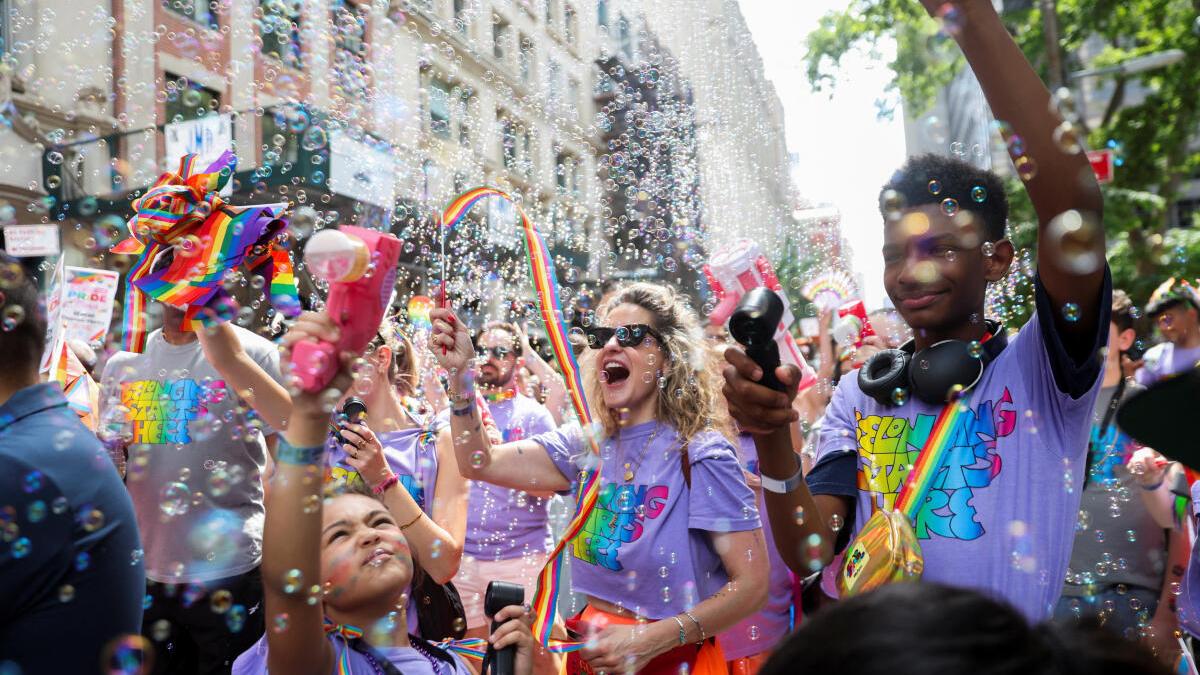
(This story is part of The Hindu on Books newsletter that comes to you with book reviews, reading recommendations, interviews with authors and more. Subscribe here.)Dear reader,In journalism school, we were often given outdoor assignments. They involved talking to meat sellers, animal rights activists, government authorities, domestic staff, writers, refugees... you get the gist. One afternoon during Pride Month, a classmate walked up to me and my friend. She wanted to do a story on students attending the Pride March. Assuming that I was fairly useless for this project, she asked my friend, who is gay, “Where do I find queer people?”Both of us stared at her with a mix of horror and astonishment and then laughed. “I’ll take you to the camp where they all live,” my friend replied with a wink. Her face showed that the sarcasm had completely escaped her.Though queer people and other marginalised communities are our friends, family, colleagues, neighbours, and classmates, many people still treat them as though they exist somewhere else, as specimens in a zoo, to be visited, observed, and gawked at whenever the occasion arises.Literature has a huge role to play in how we understand people different from us. Books lead us into other people’s worlds and gently help us to step into their shoes. I learnt about the horrific Magdalene Laundries of Ireland, the complex history of race in America, the age-old practice of binding women’s feet in China, and the atrocities of the civil war in Sri Lanka through books.Reading more and more about queer people does something basic: it normalises the community and helps us to cultivate empathy. It may or may not radically change the way you think, but it will certainly make you more aware — and hopefully, more sensitive.There are more queer stories being published now than ever before. Queer literature, according to The New York Times, has become one of the growth engines of the publishing industry. With Ali Smith winning the Dublin Literary Award for Gliff, Yang Shuang-zi winning the International Booker Prize for Taiwan Travelogue, and Rabih Alameddine winning the National Book Award for fiction for The True True Story of Raja the Gullible (and His Mother) recently, it is clear that queer literature is not relegated to the margins of the literary world.The scene isn’t very different in India. My most favourite in the genre is Cobalt Blue by Sachin Kundalkar (translated from the Marathi by Jerry Pinto), about Tanay and his sister Anuja who fall for the same paying guest. If you haven’t read it, I’d highly recommend this classic.In more recent times, we have had several releases, from Sunil Mohan’s Your Stick Will Not Break My Strength (Zubaan) to Farhad J. Dadyburjor’s Queerly Beloved (Penguin; reviewed here by Chintan Girish Modi) and Queer India (Queer Directions; edited by Dhrubo Jyoti and Dhamini Ratnam and reviewed here by Anish Gawande.) As we near the end of this year’s Pride Month, Soma Basu recommends a few books. She writes, “These books trace the changing contours of queer life in India — its intimacies, its institutions, and the unfinished fight for equality. They reflect the ongoing struggle for acceptance in an unforgiving society, and help us understand how much has changed, and how much has remained the same.” Reading widely means you don’t have to go “looking” for queer people. They are there in the palm of your hands, just as they are in everyday life.Books of the week
The Hindu On Books newsletter: Beyond the parade
The Hindu On Books newsletter: Beyond the parade
1,298 words~6 min read