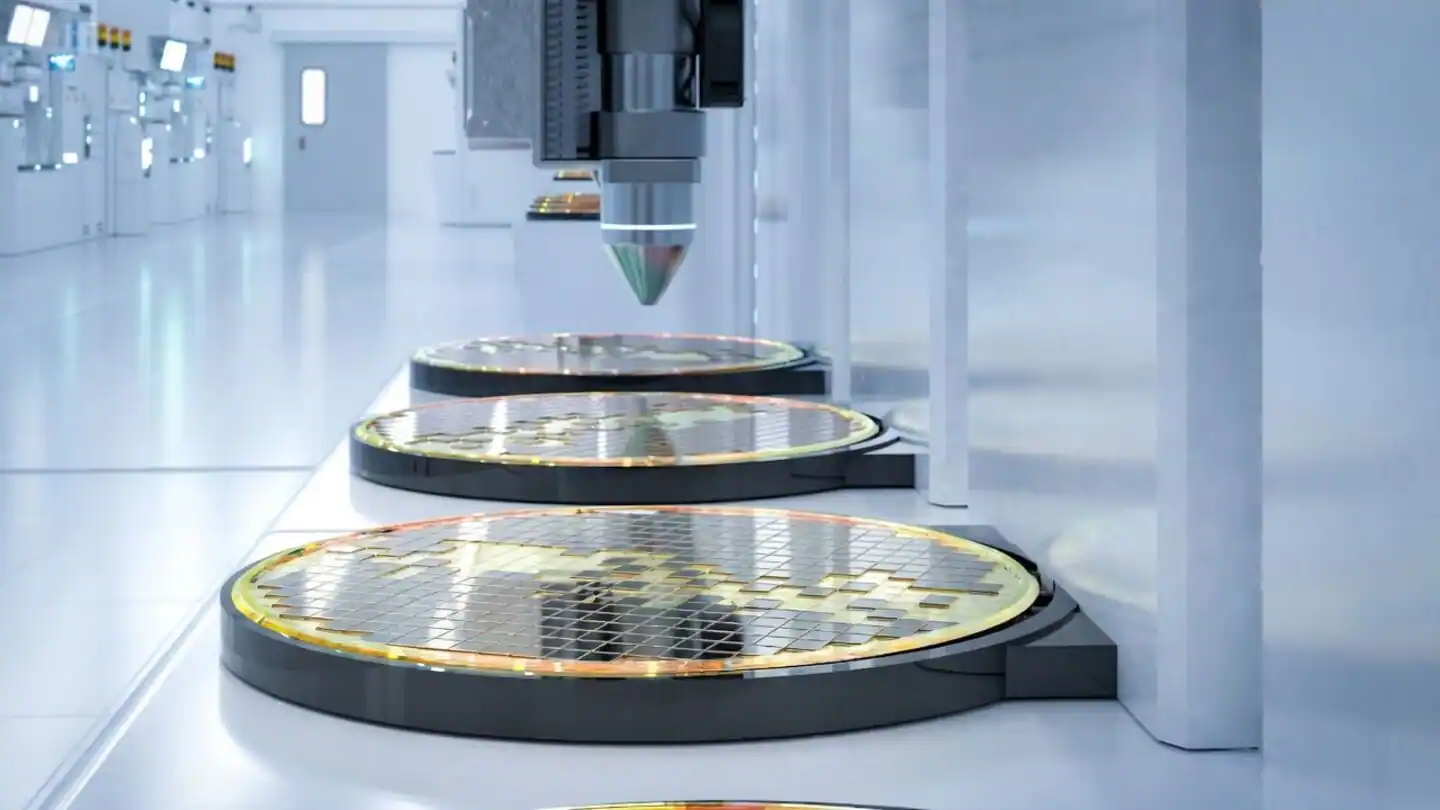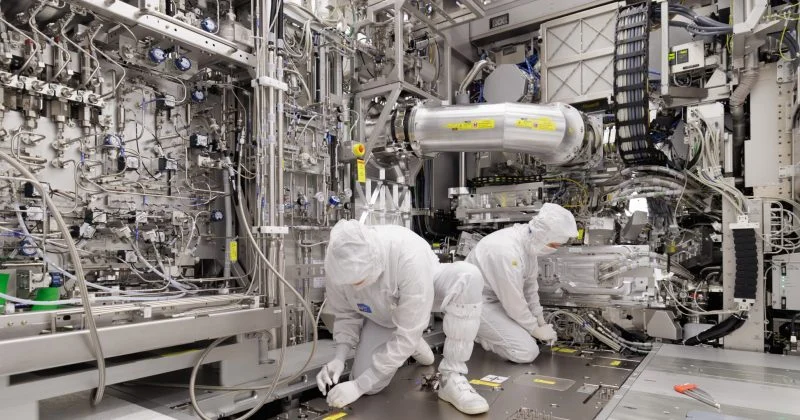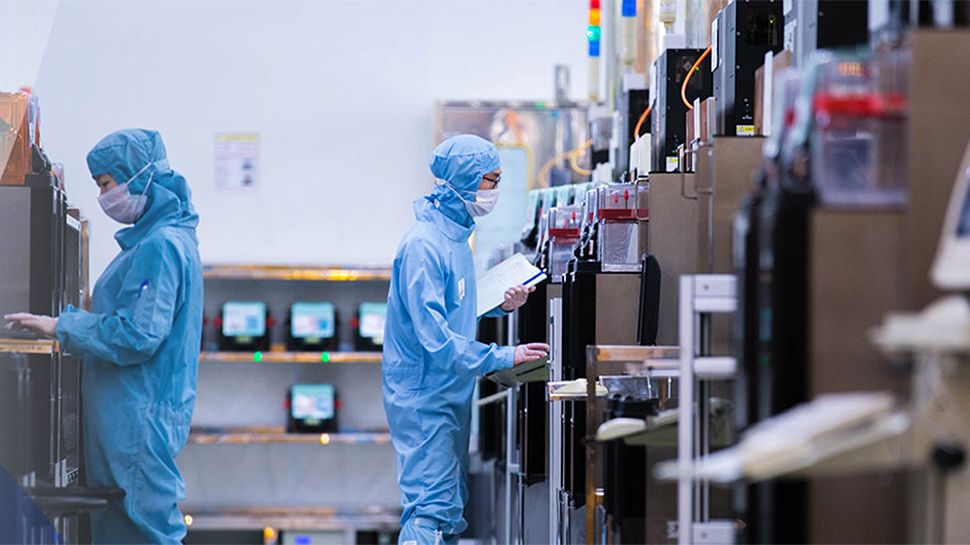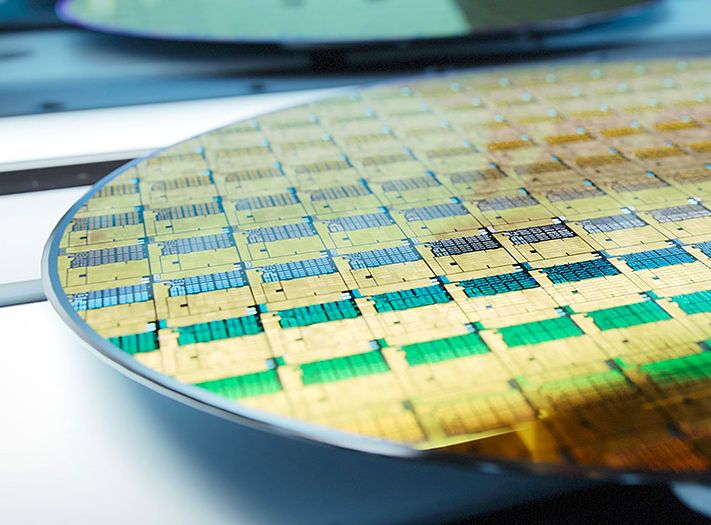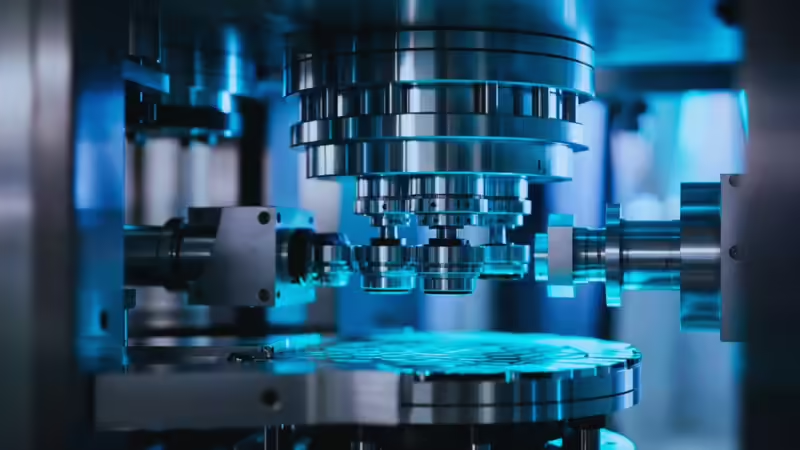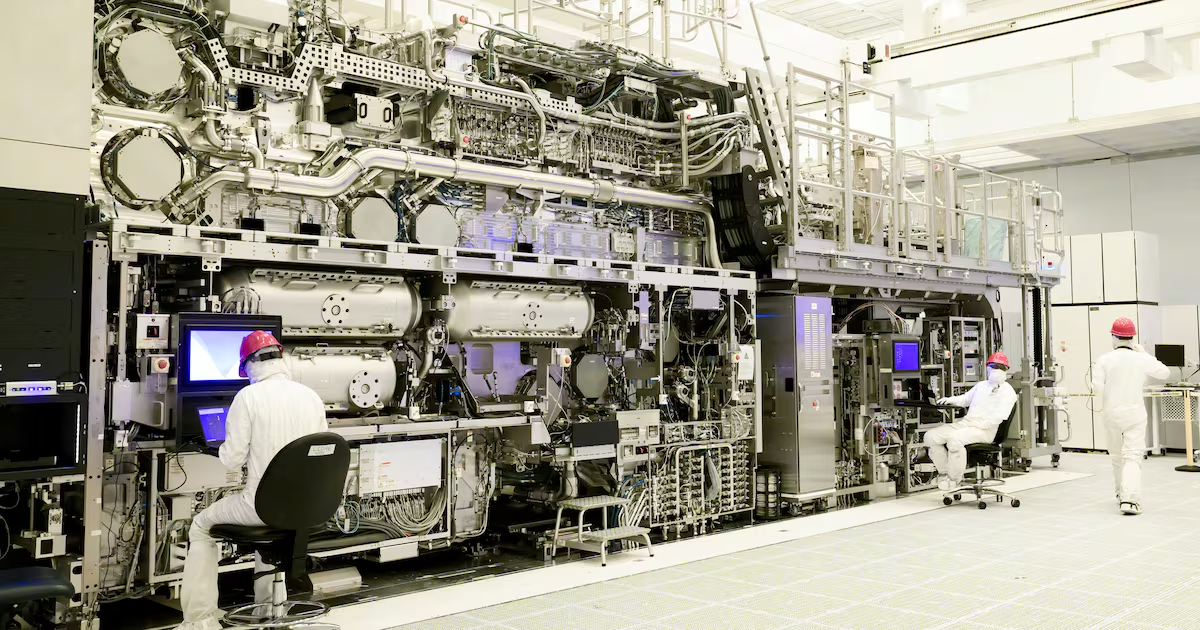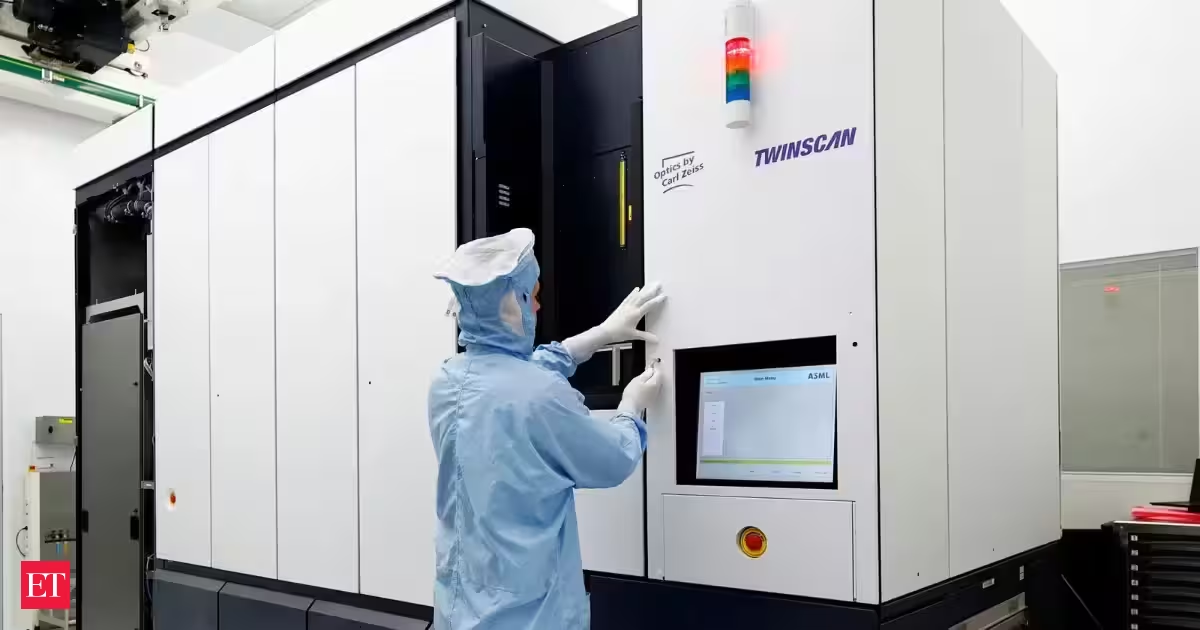
For years, the semiconductor industry has operated with one unquestioned assumption. When it came to the world's most sophisticated lithography machines used to manufacture chips, there is only one Dutch company, ASML. This assumption has suddenly been challenged. Reports that China has begun mass-producing its first domestically developed immersion deep ultraviolet (DUV) lithography machines have rattled investors, triggered a sharp selloff in semiconductor stocks across Asia and reignited debate over whether Beijing's campaign for technological self-sufficiency is beginning to produce tangible results. For long, the US has used export controls over ASML machines as a lever against China.The development is significant not because it immediately threatens ASML's global dominance but because it represents another milestone in China's long-term strategy of reducing dependence on Western technology. Industry experts, however, caution that manufacturing a handful of lithography machines is only the beginning. Turning them into reliable tools capable of supporting high-volume chip production remains a far greater challenge. But the development indicates China is breaking free of Western tech dependence in semiconductors.A breakthrough years in the makingChina has started mass-producing domestically developed immersion DUV lithography systems, marking one of the country's biggest advances in semiconductor manufacturing equipment, according to Reuters. The effort is being led by Shanghai Aishengna Electronic Technology Group, a relatively unknown state-owned company that has reportedly brought together engineering teams from several leading Chinese lithography startups. Reuters identified Aishengna as the company behind the initiative, after technology publication 'The Information' reported that a state-backed Shanghai company had entered production.Also read | AI boom is rewarding engineers more than codersPeople familiar with the project told Reuters that the machines are expected to undergo further testing before they become commercially viable. Production volumes are also expected to remain modest, with approximately five machines planned this year and around twenty next year. Even so, the development represents a symbolic victory for President Xi Jinping's drive to make China self-sufficient in strategically important technologies. Semiconductor equipment has long been one of the weakest links in China's chip ecosystem, particularly after successive rounds of U.S.-led export restrictions.Why lithography matters so muchLithography machines are often described as the heart of semiconductor manufacturing. They project intricate circuit patterns onto silicon wafers, enabling chipmakers to build increasingly complex processors.The world's most advanced chips are manufactured using extreme ultraviolet (EUV) lithography, an area where Dutch company ASML enjoys an undisputed monopoly. These machines power the production of cutting-edge processors designed by companies such as Apple and Nvidia and manufactured primarily by Taiwan Semiconductor Manufacturing Co. (TSMC).Immersion DUV systems occupy the tier below EUV. Although they cannot match EUV's capabilities, they remain indispensable for producing a vast range of chips used in automobiles, industrial equipment, smartphones and consumer electronics. Through sophisticated multi-patterning techniques, advanced DUV systems can also produce chips approaching leading-edge process nodes, though with significantly higher manufacturing complexity and cost.Also read | Indian consumers left staring at a high-cost AugustFor years ASML has dominated both DUV and EUV lithography markets. No competitor has successfully matched the Dutch company's technological capabilities or manufacturing scale.Markets react to the Chinese breakthroughThe reports from China immediately unsettled investors. Semiconductor stocks across Asia fell sharply, with South Korean companies leading regional declines amid fears that Chinese chipmakers could accelerate domestic memory production. Investors worried that a reliable indigenous lithography capability could eventually help Chinese manufacturers expand capacity despite tightening Western export controls. ASML itself also came under pressure. The company's shares fell sharply after investors questioned whether China could gradually erode one of the Dutch firm's important revenue streams.China remains one of ASML's largest markets despite export restrictions. Reuters reported that Chinese customers accounted for around 16 percent of ASML's net sales during the first half of the year. CNBC noted that China represented roughly 14 percent of the company's second-quarter net system sales, equivalent to about €924 million. The selloff reflected investor anxiety more than any immediate commercial threat.Experts urge cautionSemiconductor analysts were nearly unanimous in arguing that investors may have reacted too aggressively. "Producing a handful of immersion DUV tools is not the same as producing tools that can be used for high-volume manufacturing, where yield, overlay, throughput and reliability over thousands of wafer runs are what matter," JP Morgan analysts wrote in a research note. These technical benchmarks determine whether a lithography machine can support commercial semiconductor production around the clock. They are also areas where ASML has accumulated decades of operational experience.Stephane Houri, head of equity research at ODDO BHF, offered a similarly cautious assessment. "I would take this with a pinch of salt as what [China does] could be limited to the very low end," Houri told CNBC. The consensus among analysts is that demonstrating a functioning machine and delivering a commercially competitive product are fundamentally different achievements.Yield is everythingPerhaps the biggest unknown concerns manufacturing yield. A lithography machine is ultimately judged not by whether it prints circuit patterns but by whether it consistently produces usable chips in commercial volumes. High yields translate into lower production costs, greater profitability and more reliable supply. "It is currently unclear whether a Chinese manufacturer using the homegrown DUV machine will deliver a chip yield close to or above that of a machine from ASML," CNBC reported, highlighting one of the industry's central questions. "They need to get to at least yield parity, not just have a working tool," Nick Patience, AI lead at Futurum Group, told CNBC.Patience also pointed out that even imported DUV systems currently operated by Semiconductor Manufacturing International Corp. (SMIC) produce lower yields than those achieved by Taiwan's TSMC. "Any machine built by an unknown state-backed company are starting from a much worse spot. Reliability takes years of iteration in the field, which ASML has. China still has yet to achieve," he said. That accumulated field experience represents one of ASML's greatest competitive strengths and cannot easily be replicated through engineering alone.Manufacturing the machines is another challengeEven if China's lithography system performs well technically, scaling production presents another enormous hurdle. The Information reported that China expects to manufacture only about five systems this year before increasing output to roughly twenty next year. By comparison, CNBC noted that ASML plans to manufacture around 130 immersion DUV systems in 2026 and intends to expand production capacity by another 30 percent the following year.SemiAnalysis argued that production scaling is one of the industry's most underestimated challenges. "Tool performance, scaling production of the machine itself, fleet performance, surrounding ecosystem and poor economics against fully depreciated ASML machines all stack up against China DUV," analysts at SemiAnalysis told CNBC. They added that scaling production itself is probably the biggest obstacle facing any new entrant.Manufacturing lithography systems involves thousands of ultra-precise components supplied by highly specialized vendors. Building this ecosystem takes years, if not decades.Export controls have reshaped the landscapeThe Chinese breakthrough cannot be understood without considering the increasingly restrictive technology controls imposed by the United States and its allies. Washington has prohibited exports of ASML's most advanced EUV systems to China. Dutch authorities have also tightened export licensing for several advanced DUV systems. These restrictions were intended to slow China's progress toward advanced semiconductor manufacturing.Ironically, they may also have accelerated Beijing's determination to build domestic alternatives.Successful deployment of indigenous DUV systems would give Chinese chipmakers a backup option should Western governments impose even tighter restrictions on servicing or exporting foreign lithography equipment. SemiAnalysis suggested that the commercial impact on ASML may be limited precisely because export controls have already reduced its addressable Chinese market. "A tool ASML cannot legally or physically supply being built locally does not subtract from a sold-out order book," the firm's analysts told CNBC. They argued that any domestic Chinese systems would primarily replace equipment ASML was already prevented from selling.Building a global ecosystem is much harderCompeting with ASML involves much more than manufacturing hardware. Paul Triolo, partner at DGA Albright Stonebridge Group, believes China still faces an enormous support challenge. "Any challenge to ASML would require the Chinese company to produce reliable machines serially and support them in a variety of fab environments globally, which right now seems like quite a stretch," Triolo told CNBC. He added: "Providing a small number of even minimally capable DUV machines domestically is one thing. Supporting a global fleet that would provide real competition for ASML is quite another."ASML today supports thousands of systems operating across semiconductor fabrication plants worldwide. That requires an extensive network of field engineers, maintenance specialists, software upgrades and spare parts logistics.Building such a service infrastructure often takes longer than developing the original hardware.Does DUV success lead to EUV?The bigger strategic question is whether China's DUV progress could eventually pave the way toward indigenous EUV lithography. Reuters reported last year that China had successfully built a prototype EUV machine, though people familiar with the effort cautioned that commercial production remains years away.Most experts believe EUV presents an entirely different level of technological difficulty. According to CNBC, SemiAnalysis estimated that ASML spent roughly two decades developing commercially viable EUV technology with approximately $10 billion in research investment and financial support from companies including Intel, TSMC and Samsung. Commercial profitability arrived only around 2018 and 2019 despite years of earlier development. "Some breakthroughs in DUV immersion lithography are applicable to more advanced EUV technologies, but many are not. EUV light source and optics technology are much more advanced and complex for DUV," Triolo told CNBC.Stephane Houri expressed even greater skepticism. "I think EUV is out of reach. Never say never, especially with the Chinese, but it's a completely different technology," he told CNBC.A warning sign rather than a disruptionChina's new DUV lithography machine is unlikely to transform the semiconductor industry overnight. ASML retains overwhelming technological advantages in performance, reliability, manufacturing scale and global customer support. Analysts broadly agree that none of those advantages disappear simply because China has entered production.Yet dismissing the development would also be a mistake. Every major technological capability begins with a first commercially produced system. The emergence of a domestic Chinese alternative demonstrates that years of sustained government investment, talent consolidation and industrial policy are beginning to narrow at least some gaps created by Western export controls.For the global semiconductor industry, the immediate concern is not that ASML's monopoly has suddenly ended. It is that China has crossed another technological milestone that many observers once considered years away. Whether this becomes the foundation of a genuine challenger or remains a strategically useful domestic alternative will depend on what happens over the next decade rather than the next few quarters.
A machine made by China sends shockwaves in the chip industry
China has begun mass-producing its own lithography machines, challenging ASML's global dominance. This development marks a significant step towards Beijing's technological self-sufficiency goals. The move comes after years of US-led export controls on advanced chip technology. This breakthrough represents a milestone in China's semiconductor manufacturing capabilities.
TL;DRAI
Shanghai Aishengna started mass-producing immersion DUV lithography machines (5 in 2026, ~20 in 2027), breaking Western dependence in semiconductor equipment. Experts caution that yield and commercial reliability remain unproven; the move threatens ASML's 16% China-revenue and signals progress in China's semiconductor autonomy push.
1,744 words~8 min read