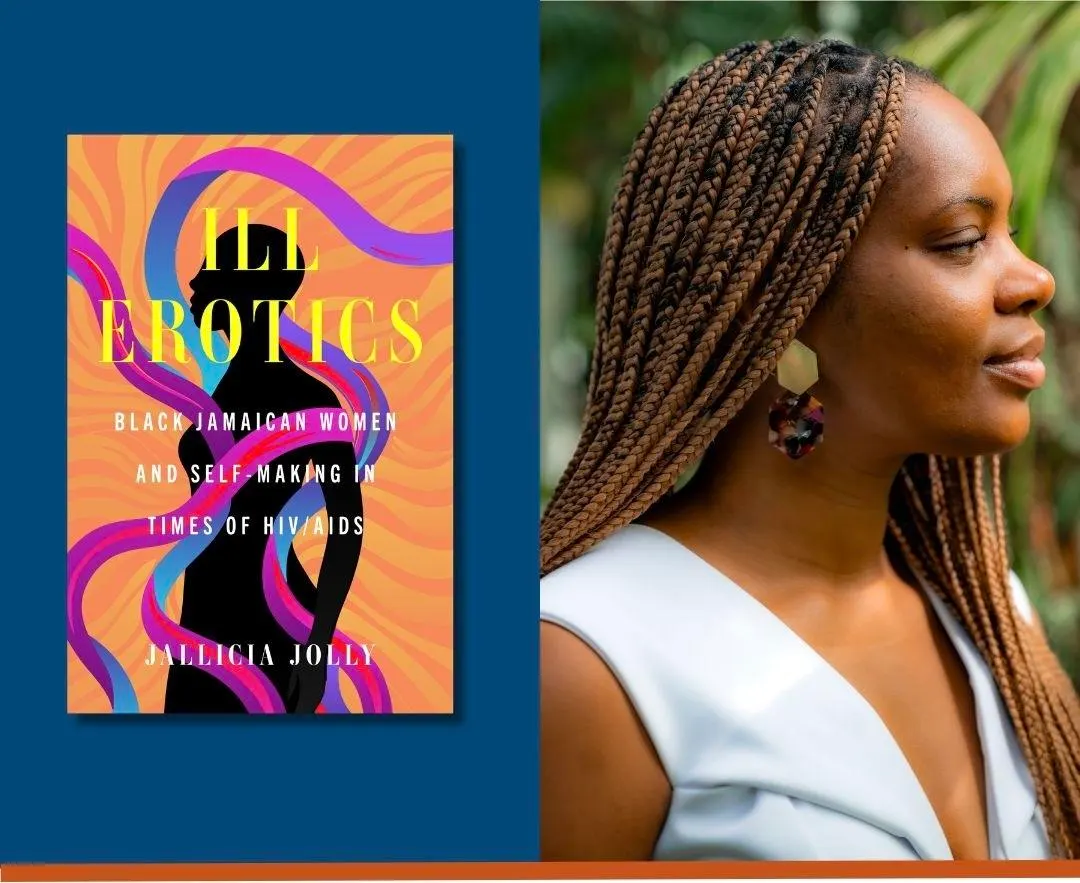
Dr. Jallicia Jolly is an Assistant Professor of Black Studies and American Studies at Amherst College and author of the forthcoming Ill Erotics: Black Jamaican Women and Self-Making in Times of HIV/AIDS. The book reframes the HIV/AIDS pandemic through the lives of Black women whose leadership, organizing, and community care transformed public health from the ground up.Portrait by Alex Terrill. Book cover design by Katy Beltran. Courtesy of University of California Press.Forty-five years ago, the Center for Disease Control published its report on the first AIDS case in the United States that would become known as the beginning of the AIDS epidemic. Today, as the global HIV/AIDS pandemic enters its fifth decade, scientific advances have transformed what was once widely understood as a death sentence into a manageable chronic condition for many people with access to treatment and quality care. Medical breakthroughs such as combination antiretroviral therapy (ART), Pre-exposure prophylaxis (PrEP), Post-exposure prophylaxis (PEP), rapid HIV testing, and mother-to-child transmission prevention have transformed HIV treatment over the past four decades, so much so that most people believe that the HIV epidemic is over. As we celebrate four decades of scientific breakthroughs in HIV we are simultaneously watching governments retreat from the public health commitments needed to ensure those breakthroughs reach everyone. The United States has withdrawn from the World Health Organization, HIV funding faces deep uncertainty, contributions to the Global Fund declined, and public health infrastructure continues to shrink. One message becomes increasingly clear: governments are retreating from the very systems that sustain global health. Yet these decisions are unfolding at a moment when HIV-related inequities remain deeply entrenched. My forthcoming book, Ill Erotics: Black Jamaican Women and Self-Making in Times of HIV/AIDS, argues that for many Black women, the HIV/AIDS pandemic never ended. It simply became unevenly distributed and less visible. Drawing on nearly a decade of research, Ill Erotics invites us to ask a different question: Who continues to build care when institutions fail?The 45th anniversary of the HIV/AIDS pandemic shouldn't simply prompt us to remember the epidemic. It forces us to rethink who we recognize as its leaders and what work remains to be done.
Forty-Five Years Of HIV/AIDS And We’re Still Ignoring Black Women’s Leadership, Says New Book, Ill Erotics
As HIV/AIDS enters its fifth decade, Black women's leadership offers urgent lessons about public health, community care, and democracy.
1,609 words~7 min read