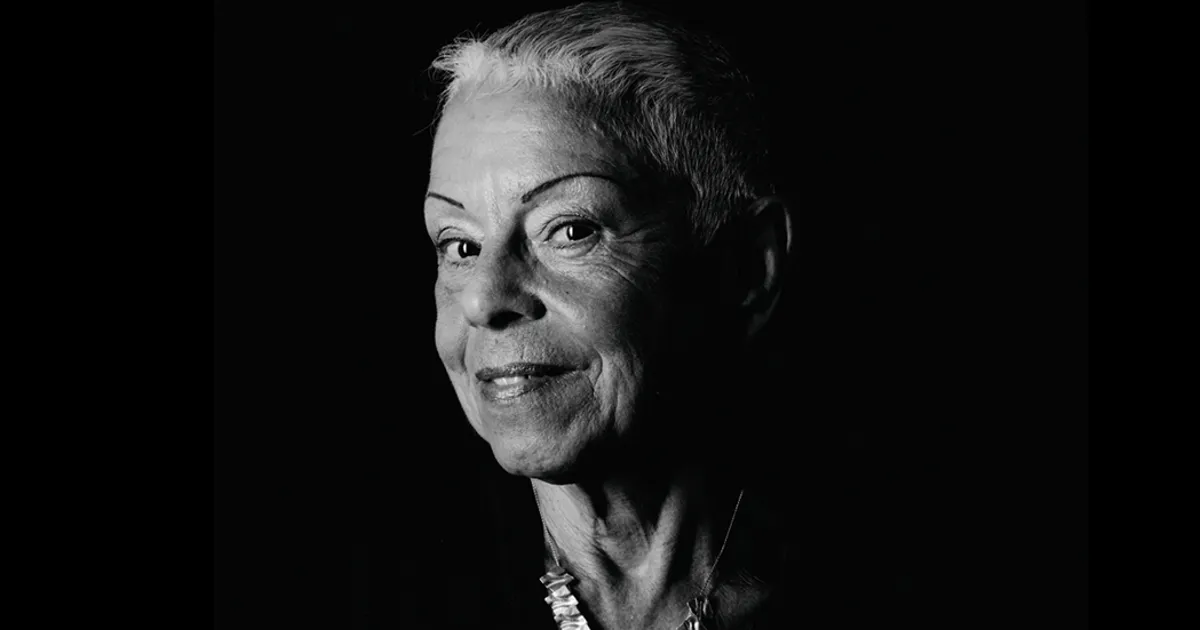
Nothing in Susan Newman's life prepared her for the possibility of contracting HIV. But once she did, she turned her diagnosis into a battle that saved countless livesIt was a night Susan Newman never forgot."A woman called from Ichilov [Hospital] and said, 'There's someone here who I don't think will get through the night.'"There was nothing unusual about the phone call. It was the 1990s, the height of the global AIDS epidemic. Newman was devoting herself to people who remained alone in the world. She went to hospitals, sat next to people dying from the disease – whom no one else would even approach – and held their hand."I got there and saw someone connected to an oxygen tank. I recognized him immediately. I told the nurse that I knew that man."The man on the brink of death was her former partner – the man who had infected her."I could have killed him then and there, but I had to be faithful to my mission," she recalled later . "So I stayed on, but I didn't hold his hand like I did with the others. That was too much. I sat in a corner and waited for morning to come."Newman had been informed that she was HIV positive a few years earlier, in a phone call. "I was shocked, in a panic. I didn't understand how it had anything to do with me," she related. "My image of AIDS was of a gay man dying in a wheelchair, isolated and alone. I remember going out to the balcony and feeling dirty. I asked God why I deserved to die so fast."Indeed, nothing in Newman's life trajectory had prepared her for this possibility. She was born in London in 1949 to a Jewish couple who had fled Nazi Germany with false papers, was drawn to Zionism as a teenager and did volunteer work on a kibbutz. After eventually settling in Israel, she and her husband created a religious home."We grew up in a classic religious-Zionist home," Lorin, her eldest son of three sons, relates. "Bnei Akiva [youth movement], knitted kippa, the whole thing. Yeshivas, too."After divorcing her husband and leaving the religious world, Newman moved to Tel Aviv and started dating a man she met there. Only later did she discover that he knew he had AIDS at the time."For years I was consumed by anger," she said. "Besides me, he infected another eight people. I searched for each one of them. We even met up once in a café; I was the only woman in the group. They all died a few years later. Subsequently I investigated his life. I understood where he came from and what he had to do to get out of there. Today I'm no longer angry."They call themselves "the dinosaurs" – a group of activists who were diagnosed as HIV positive during the period when the virus was considered a death sentence, struggled to get treatment and fought ostracism and stigmatization. Newman was the lone "dinosaur-ess." A grandmother of 10, she was an anomaly among the activists of her generation, virtually all of whom were gay men.That didn't lessen her commitment to the cause. On the contrary: Newman devoted more than three decades of her life to helping people with HIV, both in Israel and elsewhere. She demonstrated in the streets, fought in the Knesset, campaigned for the cause internationally. In short, her own fate was tethered to the disease."I can't think of my life without AIDS," she told me when we met about a decade ago. "People talk about how the disease is no longer terminal today. Forget it – the virus is part of me. It destroyed my life, destroyed my body, but thanks to it I also met people who brought me happiness. They were my family, my brothers and sisters."We first met in 2015, during research for a documentary about "the dinosaurs" that I was working on together with journalist and presenter Yinon Miles. In the next two years we filmed the main activists in the group – those who had engaged in a public struggle to demand state funding for proper medical treatment, and paid a steep personal price for it.Newman's farewell ceremony at Independence Park in Tel Aviv last month. She planned her death down to the smallest detail. Credit: Itai RonNewman's farewell ceremony at Independence Park in Tel Aviv last month. She planned her death down to the smallest detail. Credit: Itai RonNewman was different from the others, and not only because she was a woman. Unlike them, she never publicized the fact that she herself had HIV. In her media appearances during those years she was called an "activist." It was clear to us that the film would hinge on Newman – a slender woman with short-cropped hair, a sharp tongue and a British accent.Our project was eventually shelved, however, due to financing problems. In the years that followed I stayed in loose touch with Newman, who reported that her condition was deteriorating."My condition is critical," she informed me at one point. "I'm falling apart everywhere and suffer terrible pain. This is the cumulative effect of all the medication I received. For 40 years I worked from 8 in the morning until 8 in the evening. Today I'm still working, but with difficulty. And I have no pension or savings."She gave private lessons in English and continued to work even when her physical condition became acute, she said, asking, "Why didn't I think about the future? Because who would have thought I'd live? Who could have imagined that the thing I'd fear most today would be old age?"Last spring, Newman decided to put an end to her life. The effort started secretly – her sons didn't even know about it, until after her death. The war with Iran jeopardized the plan, but Newman, apparently as stubborn in death as she was in life, was determined to carry it out. In March she flew to Switzerland, accompanied by a close friend, and ended her life at Dignitas, a nonprofit that provides physician-assisted suicide.She requested that her ashes be scattered at Hilton Beach in Tel Aviv; for that event she had hired a yacht in advance and bought chocolate liqueur. For the party in her memory, held at the end of May in Independence Park, overlooking the Mediterranean, she had prepared a bottle of Campari. The playlist had also been carefully chosen, centering around a specific concert performed by Queen.What follows, then, is the story of a woman who for decades wrestled with the Angel of Death and vanquished him. Indeed, in the end she invited him in.When Newman discovered that she was HIV-positive, she decided to drop everything and go to New York. Only there did she dare look for people like herself."I was given the address of a support group in Manhattan," she related. "I got to the building, opened the door and saw 33 men there. They all looked at me as if to say: 'What are you doing here, a hysterical white woman who claims she has AIDS?' They ignored me. I stood outside and cried. Suddenly someone came over to me, and then another and then two more. Within a short time they became a family to me. Thirty-three brothers and sisters. Only one of them is still alive."Newman was brought to an apartment in Harlem, a neighborhood that had been hard-hit by the epidemic. "We would wrap the dead in a brown sack and wait for the ambulances, which arrived at 6 A.M., to take them," she said.She assumed that her days were also numbered, and after a year she returned to Israel: "I had huge debts, I didn't have a cent and didn't have a job, but my health was perfectly fine. The big difficulty was the secret I kept in my heart. I felt I had to meet Israelis."She joined a support group for people living with HIV. The fact that the group met in Jerusalem made it possible for those who preferred not to be seen in Tel Aviv to distance themselves from it."It was a winter morning in a private apartment," she recalled. "There were 16 of us. We promised each other that if we happened to meet on the street we would make no sign that we were acquainted. When we shut the door we were able to talk about all our fears. We cried, we laughed. It was another family. Of the 16, 14 have died. I remember all my dead in New York, Jerusalem and Tel Aviv."Around this time she met two men who would become her companions in the struggle: Patrick Levy and his partner, Ricardo Schneider. Along with some others, they helped head up the Israel AIDS Task Force. They would provide a home to anyone who might have been cast out. Newman knew that experience up-close."I was thrown out of my family because of AIDS," she related. "My father said, 'You are no longer my daughter.' He banned me from going to his funeral. My mother said I had brought shame on the family. When I had an operation, my sister refused to let me stay with her, for fear of being infected."Newman with her friend Angel Rotman. "We were each other's family," he says.Newman with her friend Angel Rotman. "We were each other's family," he says.The activists' first goal, she noted, was "providing daily help to those who had been left on their own. To see to it that they had food, medication, company. Most of the people we took care of had been thrown out of their homes, or their family had broken off relations with them. We asked the municipality to open bomb shelters for our use. Sometimes we let people sleep in our offices. It was a 24/7 thing, always someone next to the phone. Social workers called us so we would be by the side of someone who was dying."Death was also part of the lives of the activists, she said: "Every morning opened with the question of 'Who died today?' We would go on Shabbat to the hospice at Tel Hashomer [Sheba Medical Center, Ramat Gan] to be with people in their final moments. We also made the funeral arrangements. I remember cases when the family didn't even know we were there. We would stand far enough away, behind a tree, so no one would know that the person had died from AIDS. One time, the sister of one of those people called me before the funeral and said, 'Don't even think about coming. We don't want to see any of you.'"Ignorance about the disease was rampant during those years, even among medical personnel. "When I was being treated in Ichilov, I wasn't allowed to use the bathroom in the ward," she recalled. "They installed an en-suite toilet that had a special sticker pasted on it. The nurses took me there and gave me a bottle of bleach, to clean after myself, and then stood there and checked that I had actually cleaned."Those were horrific years, when a whole generation was wiped out – including a legion of creative individuals, among them actors and young artists – but they were also years of grace. Newman mentioned the makeshift hospice organized at the St. Louis French Hospital in Jerusalem. Dr. Israel Lichtenstein, a Holocaust survivor, was the only physician who agreed to take in dying patients there. The nuns nursed them and they left this world with the image of Mary, mother of Jesus, above their beds.Also in Jerusalem, social workers from Hadassah University Medical Center, realizing that these patients needed care that went beyond the purely medical realm, set up support groups for people with HIV. At Nahsholim, a kibbutz in the north, volunteers and physicians conducted workshops for patients who were in an advanced stage of the disease. The idea, unprecedented at the time, was that by creating a connection between body and mind, their quality of life could be improved and the progress of their disease could be slowed.A "buddies" project connected volunteers with people with AIDS, offering personal attention in the form of emotional support, practical assistance and also what seemed impossible at the time: genuine human contact. Newman herself was grateful to two "angels," as she called them, from Tel Aviv – Benny Schlesinger from Café Nordau, and Sami Dadon, from Café Basel – who provided hot meals for the lonely, the hospitalized and those languishing in hospices.Throughout, Newman focused special attention on women. Indeed, her colleague Patrick Levy terms her a "pioneer" in this realm. "She was in the forefront, in a very exposed way, when it came to childbirth or training gynecologists. And with all that she was careful about not letting her face be seen on the news," Levy tells Haaretz.She was also in the forefront of international forums of women suffering from AIDS, was the first HIV-positive woman to give a talk at Neve Tirza, Israel's prison for women, and even went further afield, helping young female sex workers in the favellas of Rio de Janeiro.Her personal life passed under the specter of waiting for the end. In 1996 she went to the Netherlands with Aviram Germanovich, who has also devoted his life to assisting people with HIV, for a workshop of preparation for death. "It was part of our process of saying goodbye," Germanovich would later say. "We took with us photographs and objects and burned them, to signal that it was over, to cry over it, to mourn and to embrace those who were still with us."But Newman was far from being depressed. She integrated naturally into the nightlife of the gay community in Tel Aviv and became a well-known figure in the city's developing club culture ("For people who don't know me from that period it's hard to imagine me young, but I had some amazing time," she said)."Cocktail parties" were held almost every Friday on the roof of her apartment, which overlooked Hilton Beach. "Cocktails of alcohol and of meds, for a change," Levy explains with a wan smile. That was also the venue for his "commitment ceremony" with Schneider, during a period when gay marriage was still a distant dream. "We did a proper ceremony, with an exchange of rings, and there was even a rabbi at the event," Newman recalled proudly.The rabbi, David Lazar, affiliated with the Conservative movement, was the only one who agreed to stand along with the HIV-positive community in those years. "It drove me crazy that the religion was giving us the boot," Newman said. "Rabbi Lazar did a lot to reconnect us with Judaism. He came to the hospice to sit with people who were dying, and he was the first, and in my opinion the only one, who was willing to recite Kaddish for us at funerals."A 1997 demonstration against Finance Minister Neeman, who refused to include the HIV drug cocktail in the government health basket. Credit: Israel AIDS Task ForceA 1997 demonstration against Finance Minister Neeman, who refused to include the HIV drug cocktail in the government health basket. Credit: Israel AIDS Task ForceThe turning point came at the end of 1996. An international study whose results were presented at an AIDS conference in Vancouver found that a certain combination of several drugs suppresses the virus with high effectiveness, keeps it "dormant" and alters the course of the illness dramatically: from a terminal disease to a chronic one."We had prepared for death," Newman related. "The question wasn't if, only when – and suddenly there was hope."Western countries quickly purchased the "cocktail" in order to provide it to patients. In Israel, too, it was put into initial use. But then the government decided not to include it in the so-called healthcare basket of medications covered by national insurance.It was 1997 and Benjamin Netanyahu's first right-wing government was in power. The starting conditions didn't bode well: A group of "pariahs" from the margins of society were asking for a budget of tens of millions of shekels. "We had to persuade the government and [especially] the Health Ministry to invest in a population that was of no interest to anyone," Newman explained. "After all, why invest in gays? They're worthless, they're on the margins and in any case they're a minority."The government dug in, and the medicine was denied to the patients. The feeling of urgency became palpable and the activism spearheaded by Newman and her friends morphed into a "battle for life." There was a small core of activists who included Rami Hasman, Avinof Frumer, Levy and Germanovich. Under the leadership of Hasman, an advertising and marketing professional, the group set up a project headquarters and came up with a strategy that was unique for its time. It split into several fronts: a media effort, intensive lobbying and a negative "guerrilla" campaign. One of the strategies was to align themselves with the demands of cancer patients to expand the list of medications covered by the national health basket. Framing the campaign as a shared struggle among the organizations proved to be a crucial turning point.The public manifestation of the protest movement encountered a substantial obstacle: Many of the activists were apprehensive about revealing that they were HIV-positive. The campaign's leaders came up with a creative solution: They showed up for a demonstration outside the Knesset in black hoods, holding a scythe. Some held up signs declaring that "AIDS has a faithful friend" – aimed at the finance minister, Yaakov Neeman, who refused to alter the budgetary framework in order to underwrite the drug cocktail.The demonstration attracted much attention, prompting a skit on the highly rated satirical TV show "Chartzufim," in which Neeman was portrayed as the Angel of Death. That too was a significant milestone in the struggle.Newman played a key role in the campaign. She developed contacts with MKs Naomi Chazan (Meretz) and Naomi Blumenthal (Likud), and occasionally came to the Knesset together with a teenager who had contracted HIV in a blood transfusion. She also led a delegation that met with Sara Netanyahu, the prime minister's wife, at the official residence in Jerusalem, in order to stress the singular needs of women who were HIV positive."I played the role of 'the woman,'" she said. "The idea was to make people aware of the issue of women and children who were affected – to persuade the politicians that it wasn't just a problem of 'just gays.'"Finally the government caved and approved the budget for the cocktail. The pariahs had triumphed.But none of the activists rested on their laurels. Indeed, all of them experienced the goings-on as a deep crisis. Newman, who in her early years in Israel had made a living as a tour guide and afterward taught English at the Loewenstein Rehabilitation Medical Center, in Tel Aviv, always worked as a freelancer – her premise being that, because of the disease, there was no point in taking out a pension plan. That was only one element of the feeling of living on borrowed time that she had once come to terms with, but now thought to abandon."I used up all my savings, I didn't take out life insurance, I didn't buy a home, I didn't sign a rental lease for more than a year. I even stopped buying new clothes," she said. "Because what's the point of investing in all those things if you're about to die? But suddenly I had to cope with the future."When the struggle abated, it was time to mourn. Among the survivors, including Newman, were some who felt guilty. "For years I asked myself why me, no, and them, yes," she said, describing a phenomenon known in the professional literature as AIDS Survivor Syndrome. The term refers to the mental and social consequences experienced by many who lived with HIV during the years of the epidemic, and lost friends and family to it."That's what Shosh had," Levy explains now, using Newman's nickname. "It was a trauma that she could hardly share with anyone and that an outsider wouldn't understand. It weighed down on her life more than any other loss.""The activism of Shosh and the other dinosaurs was and remains the activism of people who know that they are going to die," says her close friend Chen Shoval, who was infected with the virus in the late 1990s. "You are not fighting to survive, but so that people will accept you, respect you, see you. It was a struggle for recognition."In 2018, Shoval mounted a photographic exhibition at a gallery in south Tel Aviv of portraits of people with HIV who survived the first years of the epidemic.Newman agreed to have her picture taken and thus "go public" for the first time. "My photographs weren't prettifying or flattering," Shoval admits. "They were intentionally rough-hewn. For a woman like Shosh, who had aged, and for whom it was important to look good – it was a shock. She showed up, looked at the picture, didn't say a word and turned around. She only calmed down at the end of the evening, came over again and said nice things to me. She came back again later in the month, with her son."Newman (left) with Germanovich and Rochelle Griffin at an end-of-life workshop in the Netherlands.Newman (left) with Germanovich and Rochelle Griffin at an end-of-life workshop in the Netherlands.The son's arrival was an unusual event. Newman's friends, without exception, say that her boys' presence in her life was minimal, sometimes virtually nonexistent. Even after she underwent complicated operations that required lengthy recovery – and there were a few of those – their visits were few and brief, if they took place at all."That estrangement broke her heart," says one of her friends, "and that's not what I am saying – they're her words."The circumstances aren't fully clear but each of her three sons severed contact with Newman during different periods, for their own reasons. The lifestyle she chose and the decision to go public as HIV-positive were apparently what cast a pall over those relationships. Indeed, that was the case with her middle son, who clung to the religious way of life he was raised in, and today lives in a settlement. He requested that the revelations about her not become known to his children; she refused to "go back into the closet," and the ties with him and his family were severed. Newman did eventually manage, however, to establish close ties with his son, her grandson, and later with his sister, but that ended when the young woman got married and adopted a stricter religious way of life."That additional rupture destroyed her," a friend recalls."It wouldn't be fair to put all the responsibility exclusively on her sons," says Germanovich, Newman's companion at the end of her life. "Shosh was a complex character – we won't turn her into a saint just because she's not with us. She had combative sides and she was a fanatic person in large measure. Things always had to be done her way."Her rigid personality also meant that her relations with the dinosaurs had ups and downs. "We were like oil and water," Levy recalls. "We believed in the same things, we fought shoulder to shoulder, but we operated in different ways and that caused tension between us. Shosh didn't have patience for drawn-out processes. Her anger drove her and she barely had any filters."Germanovich has a magnet on his refrigerator that she gave him, that says: "Friends are our chosen family." Newman may have been hurt by the absence of her own family in her life, but was proud of the alternative family of friends she had established and she cultivated those relationships intensively.She referred to Hagit – one of her English students, who became a central figure in managing her end-of-life arrangements – as "the daughter I never had." Hagit, an accountant who lives in the center of the country and asked that her surname not be revealed, relates that their "relationship started as student and teacher, but over the years we became good friends. She was my mentor, my psychologist and my confidante."Newman's friendship with Angel Rothman started in 2010. The two of them, Rothman explains, bonded because of similarities in their backgrounds: They had both immigrated to Israel (Rothman is from Costa Rica), both rebelled against a religious lifestyle (Rothman left the Haredi – ultra-Orthodox – world) and both eventually found themselves without a nuclear family to lean on."We were each other's family," Rothman says. "She wasn't a mother, aunt or grandmother to me. The connection between us was bigger than that. The most precise way to describe it is 'soulmates.'"Newman led a vibrant social life, but did so in her own way, Rothman adds: as someone who grew up in a German-Jewish home suffused with British culture. "For example, it was hard for her to get used to people hugging her," he says. Moreover, Newman wasn't very spontaneous: She spoke with Rothman every Friday at 6 P.M. and made sure to finish their conversation a few minutes before 7 – when Gus, the last survivor of her New York circle, would speak to her.During one of their phone calls last fall, Newman informed Gus that she was dying. From that moment, it seems, she also started to plan how to terminate her life."She was totally reconciled to and very conscious of her choice," Shoval, Newman's photographer-friend, observes. "She did everything her way, big-time, but it cost her: physically, financially and family-wise. Her life was a huge drama, always at a fast pace, always at an extreme. She was exhausted, disappointed and didn't want to go on living. Her physical deterioration was very pronounced. Her hands became deformed, she couldn't drive any longer, she was on the verge of becoming disabled. The trend was clear: more and more suffering. There was no scenario of a reversal of that situation."Her doctors suggested that Newman undergo another operation, but she wouldn't hear of it. Indeed, she had promised herself that she would not have to cope with yet another Passover. "She was determined not to undergo again the experience of sitting alone on Passover eve and waiting for one of her children to call and wish her a happy holiday," one of her friends said.But just then something unexpected occurred: Her oldest son, Lorin, got in touch with her after 10 years of total disconnect. He would rather not talk now about the circumstances in which their ties were severed but he does say, however, that "it wasn't only because of her – I also wasn't the optimal son, to say the least."In May 2025 he decided to send her a text message, in part because his 8-year-old son kept asking about the grandmother he didn't know. Newman acceded without hesitation to renewing their relationship, which quickly became closer than ever."From the day I came into the world I had never had a relationship like that with my mother," Lorin admits. "Every morning, 'Good morning'; every night, 'Good night.' Countless phone conversations and above all an abundance of love and of a real desire to get to know each other. I am tormented by not having done it sooner."Newman, too, was anguished. Not about whether to call off the arrangements for ending her life – she was committed to them – but over the dilemma of whether to tell Lorin about them. Finally, after lengthy soul-searching, she decided not to share her plan with him, for fear that he, or his brothers who might find out about it through him, would try to stop her.At Newman's farewell ceremony. She chose to end her life wearing a shirt bearing the red ribbon, the symbol of the fight against AIDS – a shirt she had kept since her years in New York. Credit: Itai RonAt Newman's farewell ceremony. She chose to end her life wearing a shirt bearing the red ribbon, the symbol of the fight against AIDS – a shirt she had kept since her years in New York. Credit: Itai RonIn recent years, Newman had lived a Spartan existence, alone in a small basement apartment in Rishon Letzion. After deciding to end her life, she moved to a spacious apartment in Bat Yam with a large picture window facing the sea. The over-the-top rent there no longer bothered her. So it was, in a sense, that in the twilight of her life she returned to her old rooftop apartment opposite Hilton Beach, which she had always loved.Last December she was invited to speak at an event marking the 40th anniversary of the founding of the Israel AIDS Task Force. The woman who used to start by addressing people as "Darling," one of whose trademark retorts was "I don't give a damn," made it clear from the outset that she didn't intend to abide by any rules of decorum at the ceremony."I was given 45 seconds to speak, which is approximately a second for every year, so thanks very much but I'm going to keep talking," she said at the start of her remarks, which lasted almost 10 minutes. A decade after asserting that she could recite even in her sleep the names of 51 people who were no longer among the living, she admitted, "Yes I'm forgetting names, and every year it gets harder to remember them. But they are engraved in my heart and in the hearts of all of us until the day we join them."She then mentioned the names of her three closest friends, vowing that, "We will soon embrace again." Her friend Rothman, who knew about the plan to end her life, observed Newman from the audience. "She effectively took her leave from us," he says now.From that moment, the plan went into high gear. The preparations were like a logistical roller coaster, but that was nothing compared to the emotional turmoil she experienced because of the relations that were becoming closer with Lorin and his family."My son, who hadn't even known her before, held daily video chats with her," he relates. "Just a few days before she left us, I looked for her to tell her that I had been promoted at work and to suggest that she move in with me, so I could look after her. But we missed out. I am 99-percent sure that if I had managed to suggest that in time, she would have put off her decision. It's a tremendous missed opportunity that I regret every minute."In the final days the black humor that characterized Shosh became even darker. "When we were at the airport there was suddenly an air-raid siren," her friend Germanovich recalls. "Shosh said, 'I'm not going down into the shelter. If a bomb falls, you won't have to go to Zurich.'"In a video clip documenting their last day in Baden, Newman is seen wearing a white sweater, one of the few items she had inherited from her mother, her eyes lighting up at the sight of a little train carrying toddlers on the cobblestone street. Her attention was riveted by the display window of a store selling teddy bears."She was on a kind of high, taking the experience to its limit," Germanovich says. "We were on our feet the whole day. The last dinner was magnificent. She ordered almost the entire menu and ate like I had never seen her eat before."Three women belonging to the Dignitas staff received Newman. After she signed the final documents, she was asked if she wanted to wear something different during her final moments. She changed into a light-colored T-shirt with a red ribbon, the symbol of the battle against AIDS, which she had kept since her time in New York."At this point we no longer spoke, there were only smiles," Germanovich says. She sipped the drink that had been prepared for her and grimaced. "Until that moment I had thought that at the last moment she would say, 'Just kidding – I'm not going anywhere,'" he adds wryly. Then, at the instruction of the staff, she drank the last drop.Germanovich: "After the last swig she gave me her most charming smile, gave a big yawn, and a few seconds later she leaned back and fell asleep. I held her hand, and there it ended."Lorin called to wish his mother a happy holiday, but Germanovich answered and told him his mother had passed."I was surprised but not shocked," Lorin says. "If I had known, I wouldn't have tried to stop her. I would have helped her. She suffered tremendously, from every possible point of view. It was certainly a great relief. Where we missed out was in not having enough time together for her to be able to trust me and to feel my support. Because, despite the anguish, I would have parted from her with a hug."Her friends hugged her.Lorin: "That makes me both happy and sad. Happy, because thanks to them she was able to spend most of her life surrounded by people who cared about her. If you place on the scale the rich social life she had as against the suffering she experienced, you could say that she experienced a certain contentment. But it makes me sad that I wasn't part of that life. I wasn't part of the group that you could describe as a loving family. I said as much to my brothers: 'Those people were her family. We weren't.'"Newman's ashes were scattered in the Mediterranean on the eve of Passover this year. She had left her sons a few things, but requested that most of her money be placed in a new fund in her name that will support adolescents who are HIV positive.She concluded an article she wrote for the pamphlet marking the recent anniversary of the AIDS Task Force, with a quote from the musical version of Victor Hugo's "Les Misérables," which she also used in international conferences: "If I speak, I am condemned; if I stay silent, I am damned."
She wasn't supposed to survive. Her fight saved thousands
Nothing in Susan Newman's life prepared her for the possibility of contracting HIV. But once she did, she turned her diagnosis into a battle that saved countless lives
5,674 words~26 min read