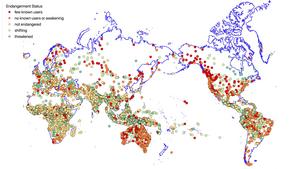
A groundbreaking study suggests humans may have experienced a forgotten era of extraordinary language diversity thousands of years ago, when communities across the planet could have spoken tens of thousands more languages than exist today. Researchers believe this lost “linguistic golden age” reached its peak before powerful states, migration and expanding civilizations transformed the way humans communicated.Around 12,000 years ago, during the Early Holocene, Earth is estimated to have been home to between 4,500 and 6,200 languages. Although people lived in relatively isolated groups, the total global population was only about 5 million, limiting the number of distinct communities and, in turn, the number of separate languages that could emerge.The picture changed dramatically with the rise of agriculture between 10,000 and 3,000 years ago. Farming supported larger populations and encouraged people to establish permanent settlements across valleys, plains, islands, and river basins. As these communities remained separated over generations, their speech gradually diverged. According to the new Science study, agriculture initially acted as a powerful engine of linguistic diversification, causing the number of languages to rise rapidly rather than decline.Researchers estimate that the world's greatest period of language diversity occurred between 1000 BCE and 1000 CE, when Earth may have supported anywhere from 20,000 to 75,000 spoken and signed languages. This represents the highest level of linguistic diversity in human history, with countless communities developing unique vocabularies, grammar, pronunciation, and cultural traditions that reflected their local environments and ways of life.The study also suggests that the decline in language diversity began much earlier than many historians had assumed. From roughly 2,000 years ago through 1500 CE, the expansion of large centralized states and empires—including the Roman, Han Chinese, and later Arab-Islamic empires—created a major linguistic bottleneck. Official languages became essential for administration, taxation, military organization, trade, and law, gradually replacing or absorbing many smaller regional languages across vast territories.By the beginning of the modern era after 1500 CE, European colonial expansion, global trade, missionary activity, centralized education systems, and improved transportation accelerated language loss even further. Today, researchers estimate that only about 7,500 languages remain worldwide, representing just a fraction of the linguistic diversity that may once have existed.One of the study's most important findings is that agriculture created thousands of new languages before later historical forces erased many of them. As farming communities spread into new landscapes, geographical separation encouraged dialects to evolve into entirely new languages over centuries. It was only later, when political power became concentrated in large states, that language diversity began to shrink rapidly.Another major conclusion is that empires initiated the first large-scale collapse of language diversity long before European colonialism. Standardized administrative languages made governance and commerce more efficient, but they also reduced the use of smaller local languages, many of which disappeared without ever being documented.Researchers also argue that the approximately 7,500 languages spoken today are a "survivor sample" rather than a complete reflection of humanity's linguistic past. Countless languages likely vanished before writing systems recorded them, taking with them unique grammatical structures, sound systems, oral histories, ecological knowledge, and cultural traditions.Before empires reshaped the world, humans may have spoken 75,000 languages—what happened to them?For much of human history, languages existed without written records. Small communities often developed their own ways of communicating, shaped by geography, traditions and daily life. Because many of these languages left no physical evidence behind, scientists cannot simply count them.To understand the hidden history of human speech, researchers used computer models, population estimates and ethnographic information to reconstruct patterns of linguistic change during the Holocene, the geological period that began about 12,000 years ago.Their findings suggest that before agriculture became widespread, humans likely spoke thousands of languages across different regions. The study estimates that early human populations may have had between 4,500 and 6,200 languages before farming changed the structure of societies.As humans developed agriculture, communities grew larger, populations expanded and new social groups emerged. These changes created more opportunities for languages to develop and diversify.Why did language diversity grow after agriculture spread?The rise of farming changed human life dramatically. Instead of living only in small mobile groups, many communities settled in permanent villages and later developed towns and cities.As populations increased, groups became more socially complex. Different communities developed their own traditions, identities and communication systems. Geographic separation also played a major role.Mountains, forests, islands and long distances often isolated communities from one another. Over generations, these differences allowed new languages to form.Researchers believe this period of human history created one of the greatest expansions of linguistic diversity. Their model suggests that language diversity reached a possible peak between 1000 BCE and 1000 CE, a time when many civilizations were expanding but thousands of smaller communities still maintained their own languages.What caused thousands of languages to disappear?The decline of linguistic diversity did not happen because people suddenly stopped creating languages. Instead, researchers believe major social changes gradually reduced the number of independent languages spoken around the world.One major factor was the expansion of large political powers. As empires grew, their official languages often became dominant in government, trade and education.The expansion of the Roman Empire, for example, helped spread Latin across much of Europe. Over time, Latin influenced the development of languages including Spanish, French, Italian, Portuguese and Romanian.Similar patterns occurred in other regions as powerful states expanded their influence. When one language became necessary for trade, administration or social advancement, smaller local languages often declined.The researchers suggest that the spread of languages was also connected with broader cultural changes. When communities stopped passing a language to younger generations, traditions connected to that language could disappear as well.How is language loss still happening around the world today?Language loss remains a global issue. Although thousands of languages are still spoken today, many face pressure from dominant languages used in schools, governments, media and technology.In the United States, linguistic diversity remains significant. The country is home to millions of people who speak languages other than English, including Spanish, Chinese, Vietnamese, Tagalog, Arabic and many Indigenous languages.For Native communities, language preservation has become an important part of protecting cultural identity. Many Indigenous languages were historically weakened by policies that discouraged their use, including forced assimilation programmes. Today, tribal communities, educators and researchers are working to restore language learning through immersion schools, recordings and digital resources.Can technology help save endangered languages?Modern technology is creating new opportunities to protect languages that may have limited written records. Researchers and communities are using digital archives, audio recordings and language databases to preserve words, stories and conversations. Artificial intelligence tools are also being explored as a way to support translation and documentation efforts.However, technology alone cannot save a language. A language survives when people continue using it in daily life — in homes, schools, ceremonies and communities.Experts say preserving endangered languages requires participation from the people who speak them. Their knowledge and involvement are essential because languages are not simply collections of words; they are living expressions of human experience.Losing a language mean losing part of human historyEvery language represents a unique record of human creativity. Different languages contain different ways of describing nature, relationships, emotions and experiences.A community’s language may include knowledge about local ecosystems, traditional practices and cultural stories developed over generations. The study of ancient language diversity shows that human communication has always been changing. Languages appear, evolve and sometimes disappear as societies transform.While researchers may never know exactly how many languages existed thousands of years ago, the evidence suggests that humanity once had a far richer linguistic landscape than today.
3000 years ago, a hidden chapter of human history was written in thousands of languages, then fell silent
For a long time, the assumption was that ancient history was a endless sea of thousands of small isolated tribes—meaning language diversity must have started at its highest point and steadily decayed. The new models show a very different story: a massive bell curve where language diversity peaked just 1,000 to 3,000 years ago before crashing into a severe bottleneck.
1,249 words~6 min read