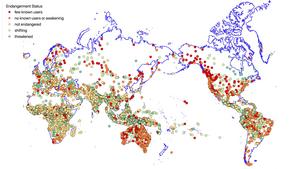
A linguistic “golden age” flourished between 1,000 to 3,000 years ago when tens of thousands of languages were spoken throughout the world, according to a new study coauthored by Yale linguist Claire Bowern that traces trajectories in global language diversity over the past 12,000 years. The golden age was followed by a period of rapid decline in linguistic diversity that coincided with the rise of large states and multinational empires, such as the Roman Empire, the researchers found. The finding challenges a commonly held view that widespread language extinction began later, about 500 years ago, with the onset of European colonial expansion.The languages of expanding states and empires were disproportionately likely to survive while those of absorbed, displaced, or declining populations disappeared, the researchers concluded. This means that the roughly 7,600 languages spoken or signed today represent a small and historically biased sample of the languages that once existed, which has important implications for the study of global patterns in language and culture, they said.
Claire Bowern
Photo by Mara Lavitt
“In a way, language is ephemeral — a spoken sentence disappears into sound waves — and, yet, our work demonstrates that we can use patterns in language to reconstruct large demographic events over the course of millennia,” said Bowern, a professor of linguistics in Yale’s Faculty of Arts and Sciences, and coauthor of the study. “We show that language isn’t isolated from political currents and that this dynamic has been a facet of human history for much longer than previously thought.“This finding is important for the many endangered languages of today because political currents don’t have to move in one direction. It’s not inevitable that endangered languages become extinct.”The study, which was published July 23 in the journal Science, is the result of a long international collaboration between experts in language, demography, and evolutionary biology.