You're building a chatbot for a company's internal documentation — hundreds of pages of engineering specs, HR policies, product guides. You plug in ChatGPT, write a clean system prompt,launch a demo. Someone asks "What's the reimbursement limit for travel expenses?" and the model confidently answers with a number. The number is wrong. It's not from your docs — it's from the model's general training data, some pattern absorbed from the internet years ago that roughly sounds like a reasonable reimbursement policy.
This is the fundamental problem with raw LLMs in production: they don't know your data. They know what was in their training set — a snapshot of text from months or years ago, with no awareness of your internal docs, your product specs, your latest pricing, your customer records, or anything else that lives inside your organization. And when they don't know something, they don't say "I don't know" — they say something plausible-sounding that might be completely fabricated.
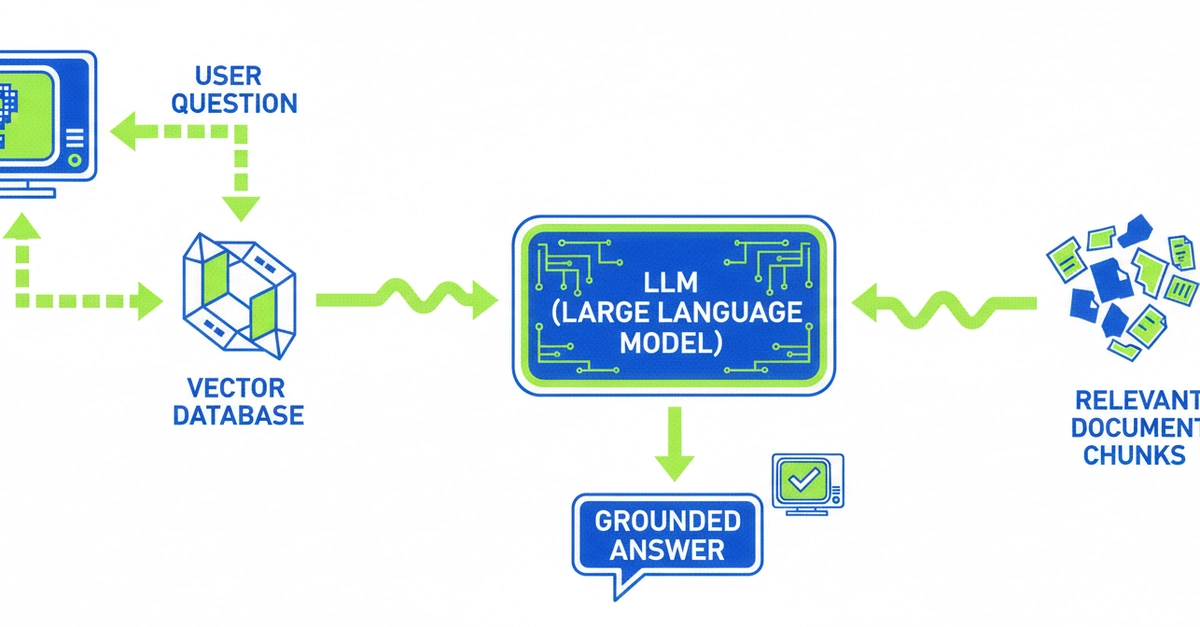
The fix has a name: Retrieval-Augmented Generation, almost universally abbreviated as RAG. The idea is elegant: before asking the model to answer a question, find the relevant pieces of your actual data and hand them to the model as context. Now, instead of guessing, the model is summarizing and reasoning over the real information you provided.