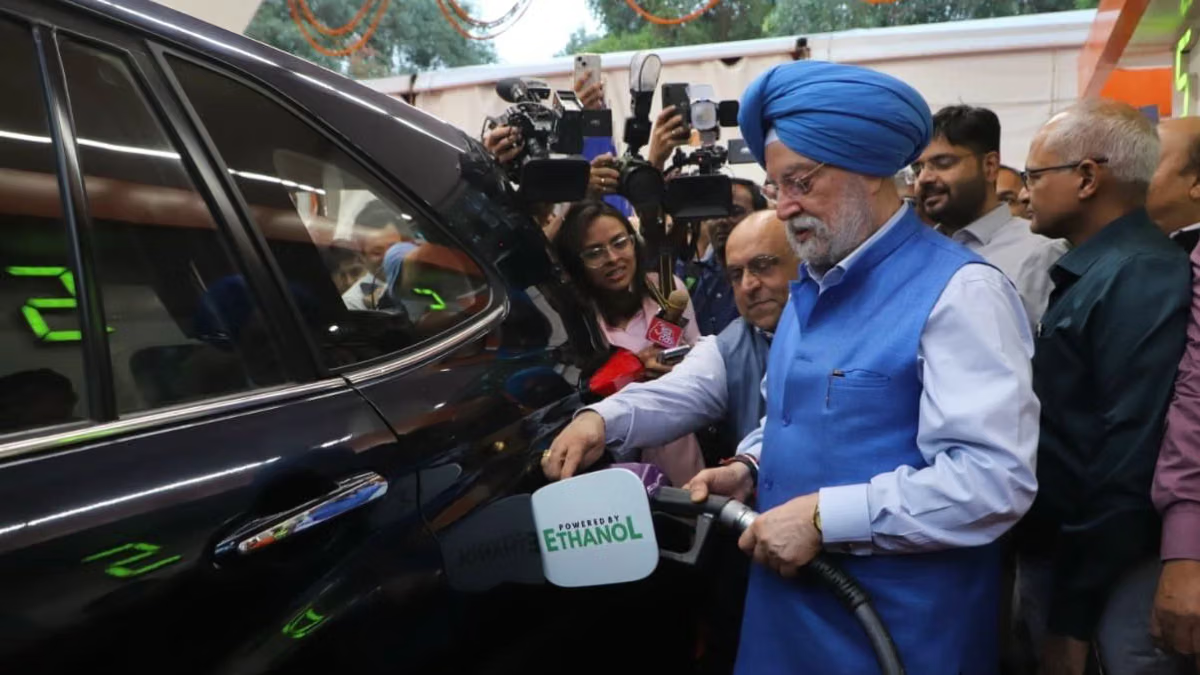
India’s ethanol blending programme has quietly become one of the country’s better clean energy stories. It has changed how transport fuel is sourced and chipped away at the country’s dependence on imported crude. The latest supply numbers point to a shift worth paying attention to: grain-based ethanol is now doing much of the heavy lifting, and that is making the whole programme sturdier.By June 2026, cumulative supplies under the Ethanol Blended Petrol (EBP) Programme had crossed 717 crore litres. Nearly 480 crore litres of that came from grain feedstocks; sugarcane-based sources accounted for roughly 238 crore litres. Not long ago, those proportions would have been hard to imagine. Today, multiple feedstocks work in tandem to keep supplies flowing through the year.Why does this matter? Because a programme built on a single crop is a programme at the mercy of that crop. A poor monsoon, a shift in the sugar cycle, a spike in prices, any of these can knock blending targets off course. Grain-based ethanol, led by maize and supplemented by surplus and damaged food grains, gives the system a cushion it never had before.Growing farmers’ confidenceMaize deserves particular mention. It has become the largest grain contributor, and that reflects real gains in farm productivity as well as growing confidence among farmers that demand is here to stay. Meanwhile, drawing on surplus Food Corporation of India (FCI) stocks and damaged grains shows how resources that might otherwise go to waste can be turned into fuel, without touching food security. Grain that cannot feed people can still power vehicles and put money back into the agricultural economy.The gains reach well beyond the fuel pump. When ethanol demand spans several crops, farmers have reason to diversify what they grow and new markets to sell into. Grain distilleries have brought jobs to rural districts, and around each plant a local supply chain has taken shape — storage, transport, processing, logistics. That kind of embedded rural industry is hard to build any other way.There is also the energy security argument, which remains as strong as ever. Every litre of ethanol produced domestically and blended into petrol is a litre of imported fuel the country does not buy, and foreign exchange it does not spend. Blending cuts greenhouse gas emissions too, which keeps the programme aligned with India’s climate commitments.Grain complementing sugarOne point needs stating plainly: grain ethanol is not here to replace sugar ethanol. The two complement each other. Sugarcane juice, maize, surplus grains, damaged grains, together they form a multi-feedstock model where a shortfall in one stream can be absorbed by the others. That redundancy is a feature, not an accident. India achieved its 20 per cent blending target in December 2025, well ahead of schedule, and that did not happen by luck. It took years of coordination between the government, oil marketing companies, farmers, and the distillery industry, along with serious investment in distillation capacity, now around 2,000 crore litres, backed by consistent policy support.The question now is what comes next. Sustaining this momentum will need continued policy stability, logistics infrastructure, further gains in agricultural productivity, and a willingness to adopt advanced biofuel technologies as they mature. Feedstock diversification should stay at the centre of the strategy, growth must not come at the cost of overburdening any one crop.What began as an alternative fuel experiment, has grown into a strategic pillar of national energy security. The rise of grain-based ethanol shows an ecosystem that has learned to adapt to weather, to markets, to shifting agricultural realities. It lifts farmer incomes, supports rural industry, and moves India closer to its clean energy goals.That, more than any single supply statistic, is the real milestone: proof that innovation, sound policy, and the strength of Indian agriculture can together build a more self-reliant and energy-secure country.The author is President, All India Distillers’ Association (AIDA)Published on July 25, 2026
Grain-based ethanol gains momentum: What it means for India’s blending programme
Grain-based ethanol boosts India's blending program, enhancing farmer incomes, rural industries, and advancing clean energy goals.
642 words~3 min read