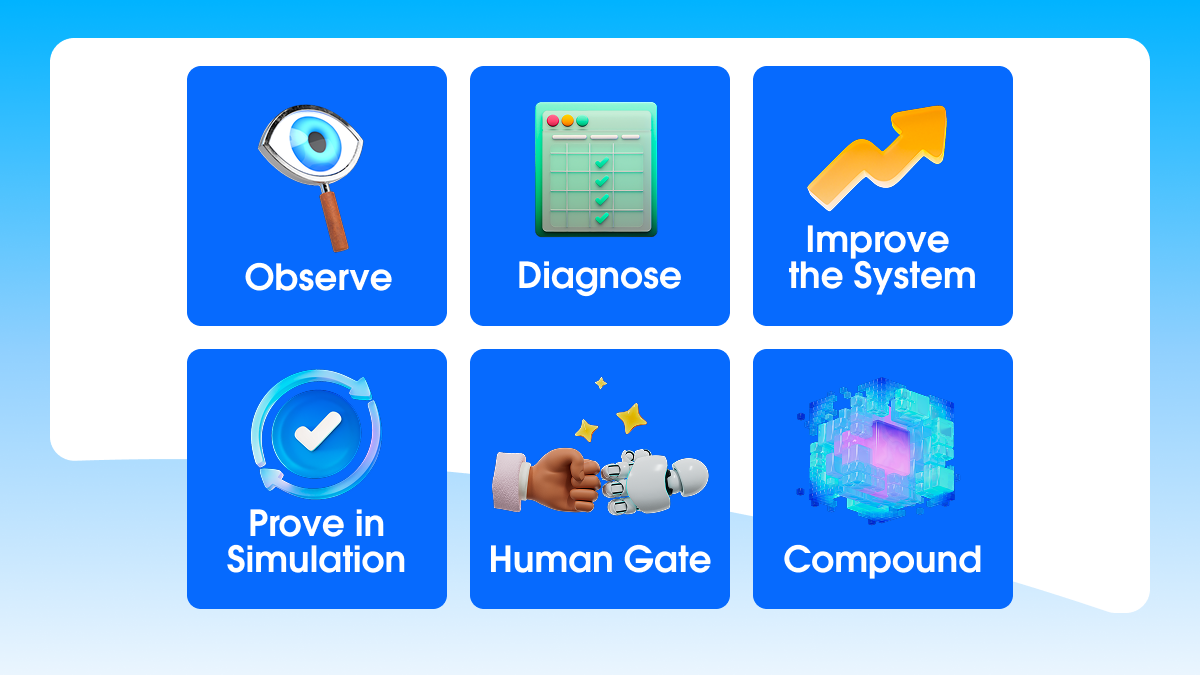
Two teams ship an agent on the same Monday. Same model, same use case, same starting accuracy. One team activates a governed self-improvement loop around the model and its harness. The other ships the agent and moves on.
Three months later, one agent is dramatically better and noticeably cheaper to run. The other has been subjected to laborious manual patches that don’t evolve quickly enough to keep up with changing usage patterns, foundation model capabilities, and market expectations.
The foundation model both teams started with has been updated (or will be soon). But both teams got that upgrade for free; nothing about the model explains the gap between those two agents. The only thing that changed was how quickly the first agent learned from its contact with users, and how it improved at addressing the needs of those users.
Today, enterprise agents are often deployed like static applications. Improving them usually means employing human subject matter experts who spot a recurring problem, hypothesize possible fixes, and ship a patch while rolling it back if it didn’t work.
The goal of recursive self-improvement (RSI), however, is to use the AI agent to automate that cycle at scale: detect what’s failing, diagnose root causes, test multiple improvements using simulations, and learn from the combinations that increase performance on both technical and business KPIs.