Academia
American hegemony has given way to a new formulation based on rivalry and competition among several major powers, where there is no longer a fixed, codified set of rules.
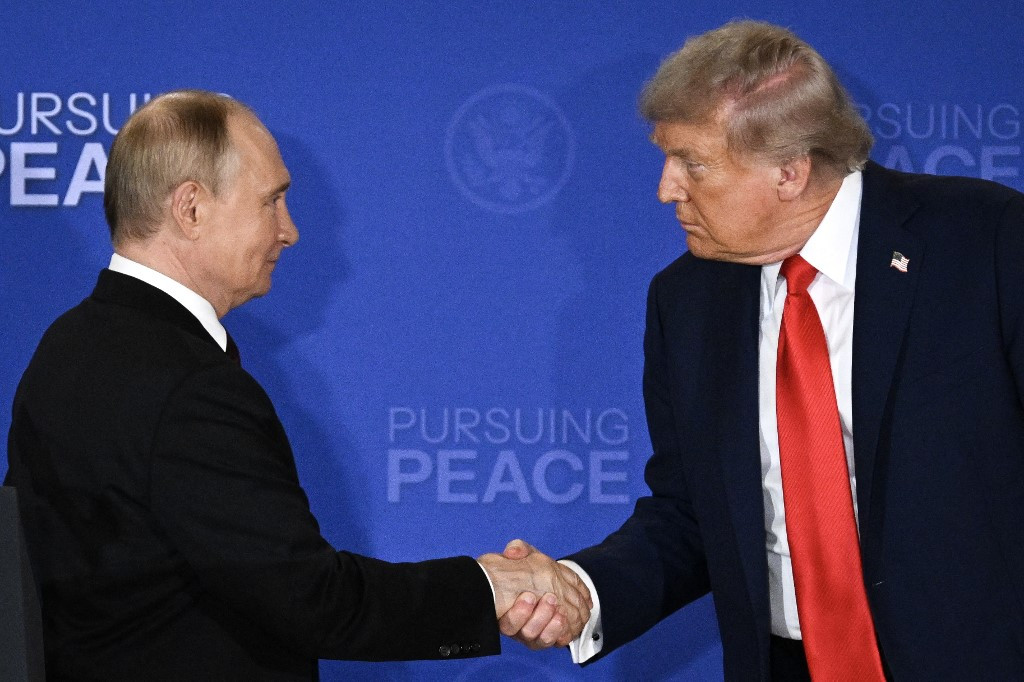
United States President Donald Trump (right) and Russian President Vladimir Putin shake hands at the end of a joint press conference after participating in a US-Russia summit on Ukraine at Joint Base Elmendorf-Richardson in Anchorage, Alaska, on August 15, 2025. (AFP/Drew Angerer)
The era in which global order rested on a United States monopoly over military and economic power and values has finally come to an end, taking Europe’s long period of stability with it. The world has become significantly more turbulent and uncertain, and the near future will bring even more instability.In the past, the contours of the world order were clearly reflected in the G7/G8 format, which brought together the leading industrialized countries. But now there are competing formats such as the China-led Shanghai Cooperation Organization, the Russia-led Eurasian Economic Union, and the BRICS+ (Brazil, Russia, India, China, South Africa, and a half-dozen other members, plus 10 partner countries), all consisting predominantly of emerging economies.