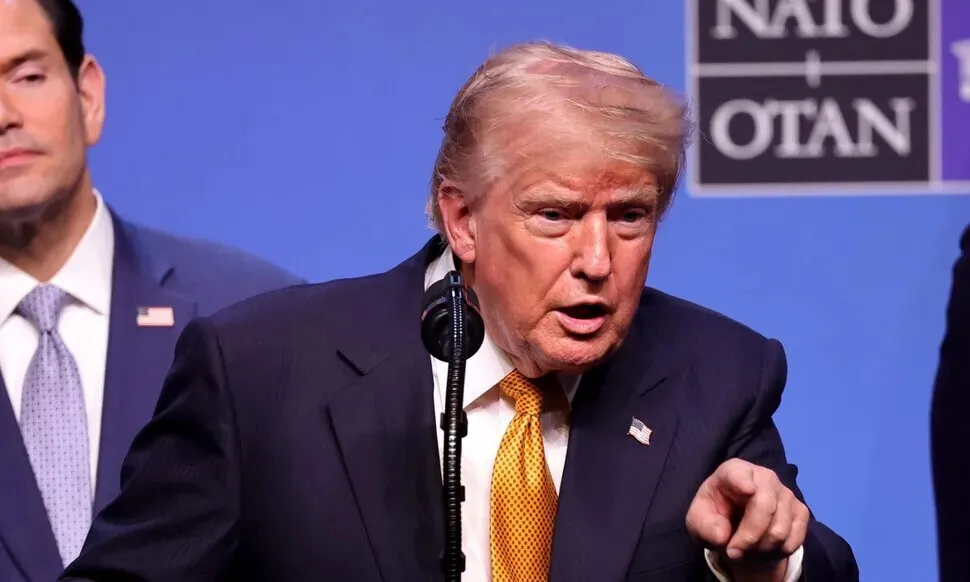
US President Donald Trump speaks at a press conference during the NATO summit in Ankara, Turkey, on July 8, 2026. (EPA/Yonhap)
It has become fashionable of late for pundits to predict the end of American hegemony.The essential feature of hegemony is having the power, whether tangible or intangible, to bend other countries to your will.But the US has failed to force Iran to accept its terms for ending the war. It has also failed to convince its allies to join operations in the Strait of Hormuz. Indeed, several NATO member states have rejected US requests to use their bases and fly through their airspace.At the beginning of his second term, US President Donald Trump glibly pledged to bring Russia’s war against Ukraine to a swift end. But the fighting has dragged on.These are all signs that the US’ global hegemony is weakening. But we may be mistaken to conflate that with the end of American hegemony.The US’ current predicament is less due to a shortage of hard power than to blind faith in that power, as well as unrealistic assumptions and greed that lead to its misuse.We’ve seen such behavior before. After jumping on dubious claims about an attack in the Gulf of Tonkin as an excuse to join the Vietnam War, the US believed it could force North Vietnam to yield through its overwhelming military force and the threat of nuclear weapons.There were also fears that letting South Vietnam fall to communism would set the stage for communists taking over one Southeast Asian country after another under the so-called domino theory. But even after the defeated Americans left Vietnam, the dominoes never fell.Fast forward three decades. In 2003, the US, aided by the UK, launched its invasion of Iraq. The US justified its attack with the claim that Iraqi President Saddam Hussein was developing weapons of mass destruction — a claim that soon proved false.Nevertheless, the US sought to use its occupation to install a friendly government. Despite the US’ quick declaration of victory in the Iraq War, defiant rebels mounted a fierce insurgency that dragged the US into a military quagmire.That was actually a second quagmire for the US, given the prolongation of the war in Afghanistan, which the US had invaded prior to Iraq.The Vietnam War and the Iraq War had something in common: the US had initiated them both unilaterally, trampling on international norms and disregarding international opinion. Neither of those wars was authorized by the UN Security Council.As a result, a substantial number of American allies turned their backs on the US. The US was saddled with the massive cost of prosecuting those wars and the potential collapse of its network of alliances, prompting many to predict American decline.An instructive comparison can be made with the Gulf War in the early 1990s. When Iraq invaded Kuwait, the US guided the debate in the UN Security Council and mobilized its allies to push Iraq out of Kuwait. Furthermore, the goal of the Gulf War was not occupying Iraq and deposing Hussein, but liberating Kuwait, driving back the Iraqi forces, and weakening the Hussein regime through powerful economic sanctions.Given the war’s clear rationale and limited goals, the US was able to convince numerous allied countries to stand with it. It was after the Gulf War that many proclaimed that the world was entering an American era.As this suggests, the US was able to achieve victory in the Gulf War not solely through its strength, but also because it set limited goals and paid heed to international norms and opinion.In contrast, the US’ failure in the Iraq War was the self-inflicted result of making the opposite choices.When the Great Recession struck just a few years later, some commentators spoke of the end of American hegemony, but that didn’t happen. Numerous countries in the global community still needed the US, and after Obama became president, the US demonstrated its resilience.But the outbreak of two major wars — Russia’s war against Ukraine and the current crisis in the Middle East — is once again leading some to declare the end of the American era. At the heart of both these wars is American avarice and misjudgment.The US continued to expand NATO, breaking pledges made to Russia at the end of the Cold War. NATO even made unmistakable overtures to Ukraine.While that was not an inevitable casus belli for Russia’s invasion of Ukraine, it certainly stoked Russia’s concerns over its strategic environment.When the Russian invasion was imminent, the US explicitly ruled out direct intervention, in effect acting as a bystander. That reflected the US’ strategic calculations about weakening Russia and more effectively containing China.But in the end, Russia’s robust ties with countries in the Global South helped it offset the tough economic sanctions that the US and its Western allies sought to impose.Furthermore, the US’ attempts to contain China through NATO and its partners in the Indo-Pacific — South Korea, Japan, Australia and New Zealand — have also aroused China’s sense of strategic vulnerability.The air campaign against Iran that the US and Israel launched in February 2026 carried a terrible cost. The fact is that the Trump administration could have asserted American strength without the attack. The US had put intense pressure on Iran by moving a carrier strike fleet and other military assets to the area during their negotiations.Whether because of that pressure or for other reasons, Iran offered remarkable concessions on its nuclear program. If the US had reached a deal based on that offer, Trump could have eased concerns about Iran’s nuclear ambitions while also congratulating himself on the efficacy of “peace through strength.”But the US chose to strike during the negotiations.As the war’s objectives, Trump chose not only the elimination of Iran’s nuclear facilities but the degradation of its military capabilities and the decapitation of its leadership, leading to regime change. Throwing restraint to the wind, the US soon confronted sharp resistance from Iran and is now seeking to end the war without actually achieving any of its stated goals.Does the US’ strategic failure signal the advent of the multipolar era and the decline of American hegemony? Probably so, and maybe not.There are definite signs pointing to the emergence of a multipolar order, including China’s great power turn and its growing influence, the rise of the Global South, Russia’s invasion and occupation of eastern Ukraine, and the EU’s push for strategic autonomy.But the shift toward a multipolar world order doesn’t necessarily signify the end of American hegemony — and we should take pains not to conflate the two.First, the Trump administration believes that maintaining a US-led unipolar system is neither possible nor rational. As evidenced by its declaration that the era of the US singlehandedly “propping up the entire world order like Atlas” is over, the administration considers the system to be the worst value for its money.Washington instead has become a predatory hegemon rallying around the motto of “America First” and seeking to maximize its economic and commercial interests by pressuring vulnerable nations. It is doing this by using its status as the world’s largest military and economic power, the greenback as the cornerstone of global finance, and America as the world leader in advanced technologies such as artificial intelligence. In crude oil, the US ranks first in output and among the top three in exports, meaning that it remains formidable enough to make discussion of the end of its hegemony premature.But it’s also necessary to carefully examine the future of the alliances that have long undergirded US hegemony. As the rifts in such alliances continue to grow under Trump, so does the tendency to read such division as a sign of the end of American dominance. Yet we should be careful not to conflate phenomena with the underlying structure that gives rise to them.Concerns over a crisis in the US alliance system have repeatedly surfaced whenever the US waged wars of aggression, and ran rampant when the first Trump administration shook the foundations of its alliances. Yet these situations were usually resolved quickly. From the transition from the Bush to the Obama administrations and then from Trump to Biden, the US-led alliance system has consistently recovered and emerged stronger. Despite the US disparaging its allies and even resorting to predatory behavior since the launch of the second Trump administration, a crucial point bears examination: No American ally wants its alliance with the US weakened or severed. On the contrary, such friends more commonly seem to scramble to appease Trump. But why?The main factor is their lack of independent problem-solving capabilities. Aside from the US, the European Union’s key adversary is Russia, Japan’s is China and South Korea’s is North Korea.Yet the EU lacks the ability to bring a favorable end to the Russo-Ukraine war or the will to improve relations with Moscow. Japan has shown little desire to mend fences with China yet cannot sustain this hostile relationship on its own.Seoul remains at a loss vis-a-vis inter-Korean relations due to Pyongyang’s declaration of the two Koreas being two states hostile to one another and its pursuit of irreversible status as a nuclear state. Thus, the common problem facing American allies is a lack of capacity to solve their problems independently, and whether they like it or not, they need the US. This is all the more true given the convergence of major geopolitical shifts such as China’s rise as a superpower, Russia’s belligerence, the North’s nuclear armament and the increasingly close relationship among these three states.As global geopolitics grows more uncertain, US allies without exception are resorting to massive military buildups, but resolving the problem this way has limits. This is because the intensifying security dilemma, driven by the growing military capabilities of rival powers, increases states’ dependence on the US for security and, consequently, their vulnerability to US hegemonic demands. Despite striving for self-reliance, dependence on Washington is impossible to escape. This is precisely why the sun won’t set on the era of US hegemony any time soon. Though its influence is weakening on a global scale, the US acts more aggressively toward regions and nations where it believes it can throw its weight around, particularly its allies. And if the next administration in Washington is more accommodating toward its allies, it will benefit from lowered expectations created by the Trump administration.So how should Seoul respond to this time of major geopolitical upheaval? Regaining wartime operational control (OPCON) is often cited as a likely course of action. While OPCON must rightfully be reclaimed, there are points to consider. Once control is restored, the US Forces Korea will likely seek to strengthen its identity as a unit of the US Pacific Command rather than the ROK-US Combined Forces Command, and take a more active role in containing China. This corresponds to the fundamental principles pursued by successive administrations in Washington. Another concern is that the hostile relationship between both Koreas could become entrenched following the transfer of OPCON. The primary objective of the Combined Forces Command is to maintain deterrence against North Korea while ensuring a military victory if deterrence fails. Joint operations have been led by Washington, but a Seoul-led model could accelerate the transition of the focal point of military confrontation from a framework centered on the US and North Korea to one focused on the two Koreas.This underscores the critical importance of devising a new national strategy primarily aimed at stably maintaining the status quo in East Asia. Globally, the status quo of this region can be described as the coexistence of two countries on the Korean Peninsula and recognition of the prevailing international consensus of “one China” despite Taiwan’s high degree of autonomy.Yet this situation is extremely disconcerting. South Korea maintains its basic principle of reunification without recognizing its northern neighbor as a state, while the North is fixated on its stance of two hostile states, claiming that Seoul seeks a change in the status quo, namely reunification through absorption. China’s position is to pursue reunification by force if a peaceful method proves impossible, and Taiwan is suspected of seeking independence in rejecting the “one China” principle. Unless this precarious state of affairs is resolved, South Korea won’t be free from the risks of entanglement in hostile inter-Korean ties and unwanted wars even if it regains OPCON.In this context, the realignment of US hegemony and the changes in North Korea offer opportunities. In the past, America encouraged Taiwan’s independence to contain China’s rise, but now it emphasizes coexistence on account of Beijing’s growing power, saying it wants neither a Chinese military invasion of Taiwan nor the latter’s independence.Plus, advocacy for regime change and a preemptive strike on North Korea, once prevalent in US political circles, have vanished. While it’s too soon to draw conclusions, the implication is that American strategy in East Asia is leaning toward maintaining the status quo. Another point is that Pyongyang’s two-state theory implies a renunciation of its theories of reunification via revolution or war, both of which seek a change in the status quo.To proactively adapt to these changes, South Korea must recognize North Korea, or the Democratic People's Republic of Korea, as it prefers, as a sovereign state and promote peaceful coexistence to maintain stability and peace on the Korean Peninsula, two actions that fall within Seoul’s sphere of influence. And while upholding respect for the “one China” principle, the foundation of its ties with China, South Korea must make it clear that it wants neither secession nor independence of Taiwan nor a Chinese attempt at reunification by force.By Cheong Wook-sik, director of the Hankyoreh Peace Institute and director of the Peace NetworkPlease direct questions or comments to [english@hani.co.kr]