Findings
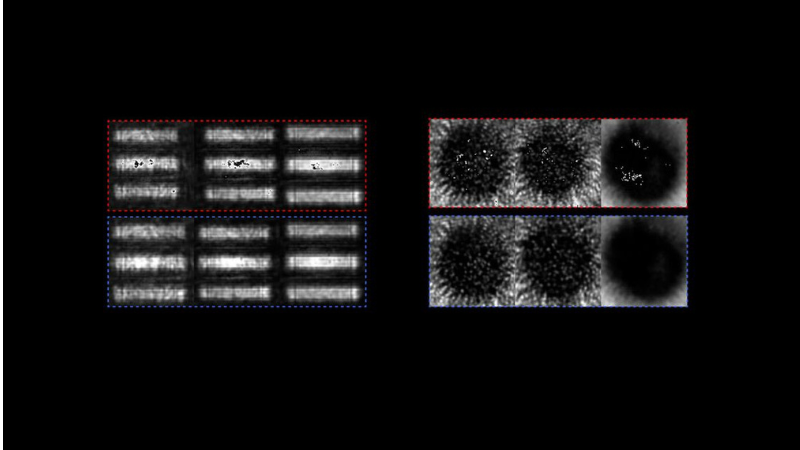
A research team led by UCLA and the University of Rochester has demonstrated a promising evolution of an imaging system designed to capture details within “complex media,” which scatter light, from depicting structures inside body tissue to seeing obstacles through heavy fog. The system uses physics-based machine learning to improve upon an existing imaging technique.
In tests with standard calibration images obscured by complex media, the new system more than doubled the signal-to-noise ratio compared to a previous generation of the technology. The system also created images in close to real time — thousandths of a second.
Background
Today, conventional applications for seeing inside complex media depend on expensive cameras that detect just beyond the limit of visible light, into the near-infrared.