Article
Nature
(2026) Cite this article
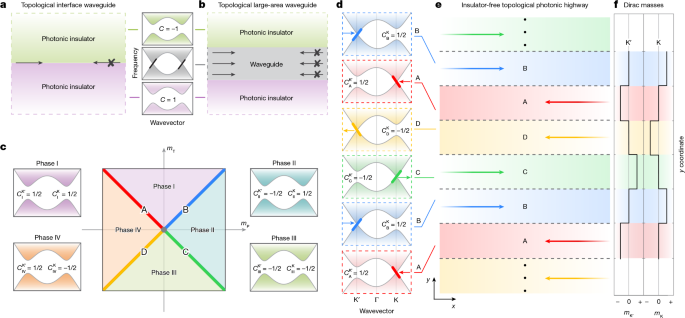
AbstractTopological protection in photonic structures enables robust unidirectional propagation immune to structural disorder1,2,3,4,5,6,7,8,9,10,11,12,13,14,15,16,17,18,19,20. However, conventional implementations obtain this protection from topological-insulator domains whose interfaces host narrow guiding channels, leaving much of the insulating bulk inactive for transport. This imposes a fundamental trade-off between topological robustness and spatial footprint21,22,23,24,25. Here we introduce an insulator-free topological waveguide architecture that eliminates this trade-off, enabling multi-lane unidirectional light guiding with both 100% spatial utilization efficiency and topological protection. By strategically combining time-reversal and inversion-symmetry breaking in gyromagnetic honeycomb photonic crystals (PCs), we achieve four inequivalent photonic valley half-semimetals (PVHSMs)26,27 at distinct critical transition boundaries between trivial and Chern insulator phases. We arrange these four structures in a parallel, cyclic configuration, such that each domain simultaneously functions as a valley-selective waveguide and a topological barrier for the other valley in adjacent domains, circumventing the need for further topological insulating layers. Our experimental and theoretical results demonstrate that this multi-lane configuration transforms conventional edge states into densely packed, large-area one-way modes. These modes exhibit alternating unidirectionality across the four domains while maintaining robustness even under arbitrary sharp bends and pronounced shape variations. This work exemplifies a design strategy for ultracompact topological photonic circuits, with potential for high-density integrated optics.