Researchers have successfully demonstrated a new superconducting quantum circuit architecture that achieves a critical gauge symmetry. This specific symmetry is a fundamental requirement for the development of future topological quantum computers. The experiment confirms that engineered hardware can replicate complex theoretical properties necessary for building highly stable and error-resistant quantum systems.
Breakthrough in Non-Planar Circuit Architecture
The recent study introduces a departure from traditional quantum hardware designs. Most modern superconducting systems, such as those developed by major technology firms, rely on planar circuits. These designs feature superconducting elements and Josephson junctions arranged on a flat surface, where each node connects primarily to its immediate neighbors. This spatial limitation can restrict the types of quantum interactions and symmetries that the hardware can support.
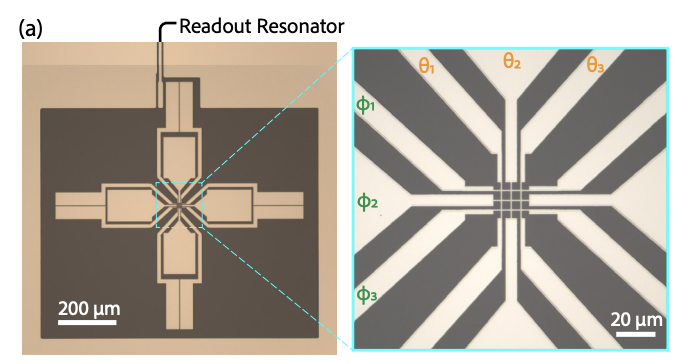
The research team, led by scientists from the University of Chicago, developed what they call a non-planar qubit. This device uses a crossbar array featuring three horizontal superconducting wires that intersect three vertical wires. This arrangement creates nine Josephson junctions in a grid pattern. By moving away from a strictly flat connectivity model, the researchers can facilitate interactions that are impossible to replicate in standard planar layouts.