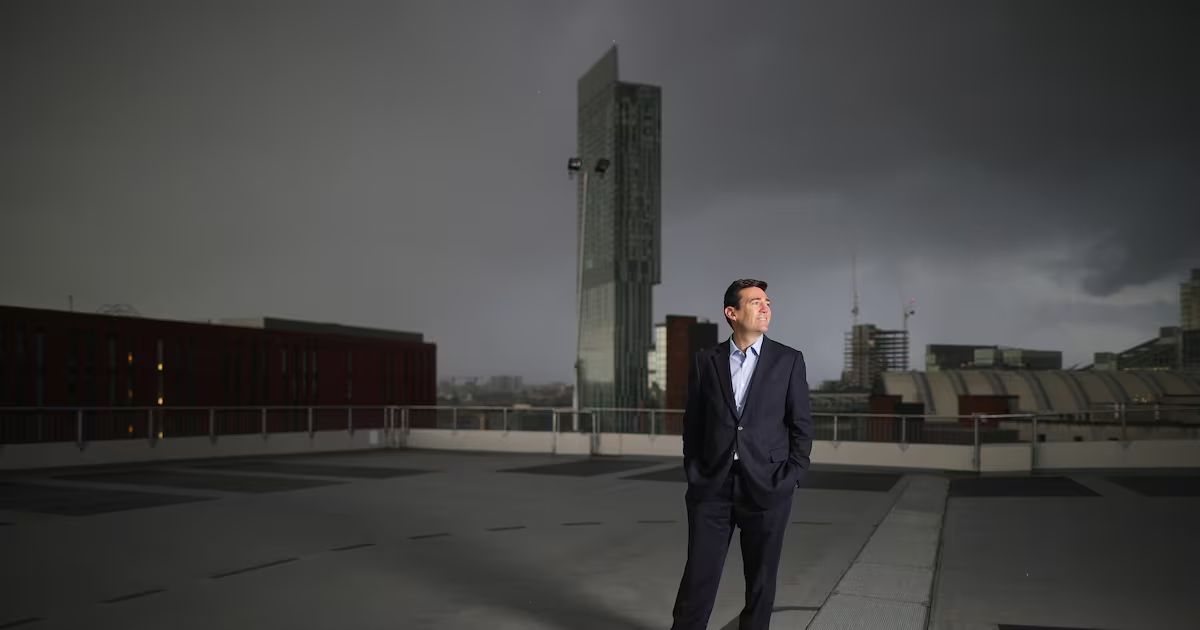
To better understand incoming UK prime minister Andy Burnham and his “Manchesterism” vision, take a 15-minute stroll southwest across the northern city from his old mayor’s office towards Deansgate. It is most fun when done as a pub tour.As Greater Manchester mayor until last month, Burnham’s office was in the old redbrick Tootal Buildings on Oxford Street, a bustling thoroughfare in this booming city: the city’s local economy has grown twice as fast as the rest of Britain’s for more than a decade.Burnham wasn’t mayor for the first couple of years of that period. Therefore, contrary to the suggestion of some of his more enthusiastic political allies, he was not responsible for the seeding of Manchester’s boom. Still, his policies helped to keep it going.Now for the pub tour. Turning left from the Tootal Buildings, you risk stumbling down the steps into one of Burnham’s favourite bars, the Temple. It was once a Victorian public toilet. Now it is Manchester’s most famous dive bar, a subterranean pit of grunge.The Temple in Manchester, a pub based in a former lavatory, is also known as The Temple of Convenience. Photograph: Mark Paul This week, as Mancunians sweated on the sun-drenched pavements above, the tiny Temple provided a dark, cool refuge from the heatwave. Indie music and the stench of beer wafted up from below, while tourists stopped for selfies at the top of the steps. Burnham always promoted the weaponisation of Manchester’s gritty cultural scene to attract more visitors. The city’s culture doesn’t come much grittier than the Temple.Continuing down Great Bridgewater Street, directly across from the landmark Peveril of the Peak pub you will find another hostelry that Burnham says he loves. The chic Rain Bar is popular with the kind of young professionals attracted to the city by big businesses such as Booking.com. Burnham’s mayoral office aggressively courted multinational investment.The final pub on this street before you bear left to Deansgate is the Britons Protection, a historic boozer beloved of Mancs. Burnham subtly lent his support a few years ago to a campaign to shield the pub from commercial interference by one of the big brewers.The Britons Protection. Photograph: Andy Barton/SOPA Images/LightRocket via Getty Images Burnham told The Irish Times in a 2024 interview that the 1819 Peterloo massacre of campaigners for parliamentary reform inspired him and was clear evidence that “Manchester has always been the radical voice challenging the establishment”.The Peterloo massacre took place right outside the Britons Protection pub. Burnham takes control of Downing Street on Monday planning parliamentary reform of his own.The end of the walk nears as you pass Deansgate-Castlefield Metrolink stop, a hub of Manchester’s yellow Bee bus-and-tram transportation system. Burnham took the city’s buses back under public control and integrated them into the Bee network. The rebooted transport system is regularly cited as one of his finest achievements as mayor.Finally, you will cross over Deansgate at the southern edge of the city, where the pubs get a little more hipsterish as Burnham’s Manchesterism philosophy literally reaches for the sky. More than a dozen glass towers have sprung up in this area in recent years, transforming Manchester’s horizon in a conspicuous display of its vertical ambition.The Deansgate area of Manchester, where more than a dozen glass towers have sprung up in recent years. Photograph: Oli Scarff/AFP via Getty Images Andy Burnham took the city’s buses back under public control and integrated them into the Bee network. Photograph: Christopher Furlong/Getty Images Further skyscrapers are being built, with cranes peppering the skyline in a scene reminiscent of Dublin’s Celtic Tiger heyday. One tower advertises a “dog spa” for residents. The towers were financed by a £1 billion (€1.18 billion) fund controlled by the Greater Manchester Combined Authority that Burnham chaired – taxpayer cash was loaned to private developers to build the developments.“It is a very Manchester tale, that,” says John Blundell, a Labour councillor in Rochdale in the Greater Manchester region and the co-founder of Rise Associates, a well-connected public policy consultancy.“Most cities that build glass towers near their centres put offices in them. But Manchester’s are all flats. Burnham has helped to repopulate the city’s inner core.”As few as 500 lived in Manchester’s inner core 35 years ago. Now it is about 100,000, a chunk of whom live around the Deansgate towers that reanimate the city.Greater Manchester’s overall population is about three million, but its inner core was historically more of an industrial site with few residential quarters. That is why, Blundell says, there are still few churches in Manchester city centre compared with other big cities.Blundell continued: “Some older locals look at Deansgate and say this is a city that sold its soul. But for me, such nostalgia is misplaced. Manchester was always a city of contradictions. At Deansgate, the state fixed a market failure – the developers couldn’t borrow elsewhere at affordable rates. London banks didn’t want to know.”Yet Burnham cannot take all the credit. The Greater Manchester mayor is one of the less powerful roles of its kind in English devolution. Burnham held just one vote out of 11 on the administration. The other 10 are held by leaders of the borough councils who often, insiders say, ganged up on him to hold “bully Burnham” committees to check his power.Others say he still deserves huge credit for Manchester’s boom. Blundell, for example, says Burnham developed a “cultural glue” for the region based on Greater Manchester as a vibrant city brand: its music, its attitude, its vibe, its culture and personality.“And what he has been exceptional at is this: no matter what corner of the city you live in, whether it’s the inner core or the outer boroughs, you now identify with that Greater Manchester brand. It expanded people’s horizons, especially in the outer towns.“All the kids want to get on the yellow trams and buses (Burnham gave teenagers free travel passes). They want to come into the city. They feel its vibe. They see the towers and other developments. It makes them want more. I think that is all down to Burnham.”The incoming prime minister plans to expand across Britain this “Manchesterism”, with its more muscular state economic intervention, “business-friendly socialism” and greater taxpayer control over utilities such as water and power that are essential for everyday life.If that is the sort of political philosophy that Britons will get from Monday, what sort of a political leader will they get along with it?A slew of sources in London and Manchester who have worked directly and indirectly with Burnham paint a picture of a complicated character. They say he can be genuinely warm, personable, empathetic and sensitive. He can also be sulky and stubborn.“If you say no to him, his bottom lip literally comes out,” said one former official who has collaborated with him on a handful of projects. Another, who said they actually like Burnham, complained he can still be a “proper shithouse” if he comes into conflict.Another said Burnham “doesn’t suffer fools” and if he doesn’t rate you highly, he will just ignore you. Others say he is ideologically promiscuous, which yet more sources seem to regard as essential pragmatism.Burnham has said precious little of substance since he won the Makerfield byelection last month, which paved the way for his return to Westminster to oust Keir Starmer. He gave a couple of speeches promising to “rewire Britain” and rebalance political power with a “Number 10 of the North” – a branch of the prime minister’s office in Manchester.He has spent much of the last month hunkered down with his closest confidantes, including former transport secretary Lou Haigh, now routinely described by Labour insiders as “the most powerful woman in Britain”.Former transport secretary Lou Haigh. Photograph: Ian Forsyth/Getty Images She has been helping him design a programme for government along with James Purnell, a former cabinet minister who is set to become his chief of staff in Downing Street. Others who are close to Burnham’s inner circle include Knowsley MP Anneliese Midgley and Doncaster Central MP Sally Jameson.Burnham’s closest allies, most of whom are English northerners like him, are said to be much more instinctively party political and wilier than the team that surrounded Starmer.They are also formidable characters. One story doing the rounds among Burnham’s allies concerns Jameson, a fresh-faced, softly-spoken young woman who, somewhat incongruously based on her appearance, previously worked as a guard at a tough male prison.The story goes that last week, Jameson was walking across Lambeth Bridge in London when a thief snatched her mobile phone. Infuriated, she chased after the culprit while screaming all manner of industrial language at him. They say he gave back her phone.Labour MP Sally Jameson (second from left) with with Labour MPs and campaigners, pictured in 2025. Photograph: Leon Neal/Getty Images These are the sort of people who now protect Burnham in Westminster’s shark-infested political waters.Meanwhile, back in Manchester, prominent UK economist Paul Ormerod has worked closely with Burnham as the chair of one of his “mayoral development zones”, the Atom Valley tech cluster that is planned to link sites north and east of Manchester.Ormerod argues that Burnham will bring to Downing Street a quality of political leadership that is often critically underestimated by economic thinkers: raw optimism. Ormerod says he has seen this tendency up close in the incoming UK prime minister.“This is where [outgoing chancellor Rachel] Reeves and Starmer made a catastrophic mistake. They came into office all gloomy talking about fiscal black holes caused by the Tories. They thought they were still fighting the election they had already won,” he says.“That helped to make business and consumer confidence fall, and it never really recovered. Burnham is naturally much more optimistic and I think this will carry over into his premiership. The concept of sentiment and narrative are really fundamental to how market economies operate.”Burnham, Ormerod says, understands how to use the “bureaucratic machine” of government to work for him: “He knows how to steer things through. He has the ability and skills to use the civil service to get it done.”The lack of such an ability was seen as one of Starmer’s biggest deficiencies.The outgoing prime minister once famously said there was “no such thing as Starmerism”. His ouster, Burnham, hopes that Manchesterism will help him succeed where his predecessor failed.Who are the key players likely to tog out for Team Andy? Burnham has refused to comment on cabinet appointments until after he takes power and his tightly-knit top team have stuck to an omerta that has driven the Westminster lobby crazy.Yet it is now widely believed that former Labour leader Ed Miliband, who helped Burnham to topple Starmer, has failed in his mission to be rewarded with the job of chancellor of the exchequer. Current home secretary, self-professed fiscal conservative Shabana Mahmood, is hotly tipped to take the treasury role instead.Miliband would need to be given another top-tier position. He is now seen as a potential foreign secretary, a job once believed to be coveted as a return by his older brother, David Miliband. It was also previously linked with former Burnham rival Wes Streeting, who could now be shunted to another senior role – defence secretary is seen as one possibility.Lou Haigh seems poised to take over the powerful cabinet office as chancellor of the duchy of Lancaster, effectively with a remit as chief secretary to the prime minister. This will make her one of the most powerful members of the UK government.A name being linked by insiders to the role of secretary of state for Northern Ireland is Pat McFadden, who once ran the cabinet office for Starmer. Glasgow-born McFadden is the son of Irish-speaking parents from Falcarragh in Donegal.Chief whip Jonathan Reynolds is seen as a contender for his old role as business secretary, while deputy Labour leader and Manchester native Lucy Powell is seen by many as lead candidate for deputy prime minister.
A pub tour of ‘Manchesterism’ as Andy Burnham gets ready for Downing Street
From ‘warm and optimistic’ to occasionally a ‘stubborn shithouse', Britain’s next prime minister elicits strong opinions
1,979 words~9 min read