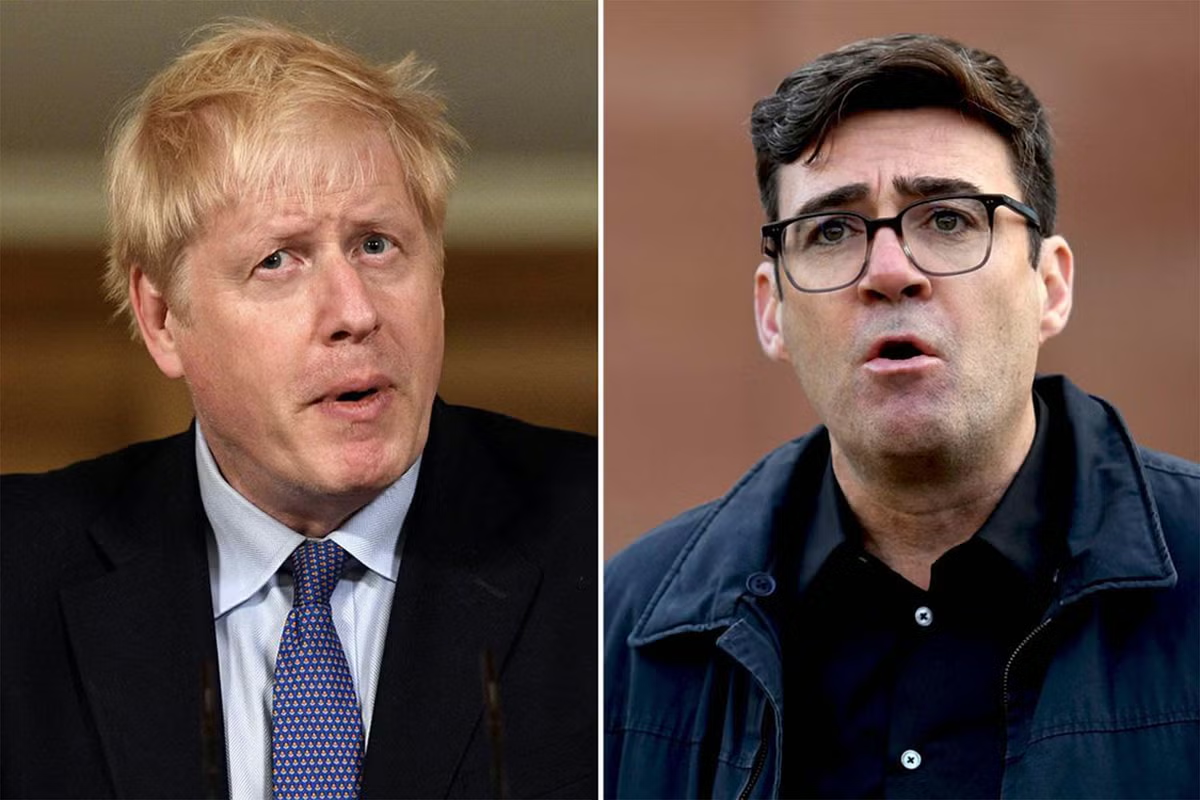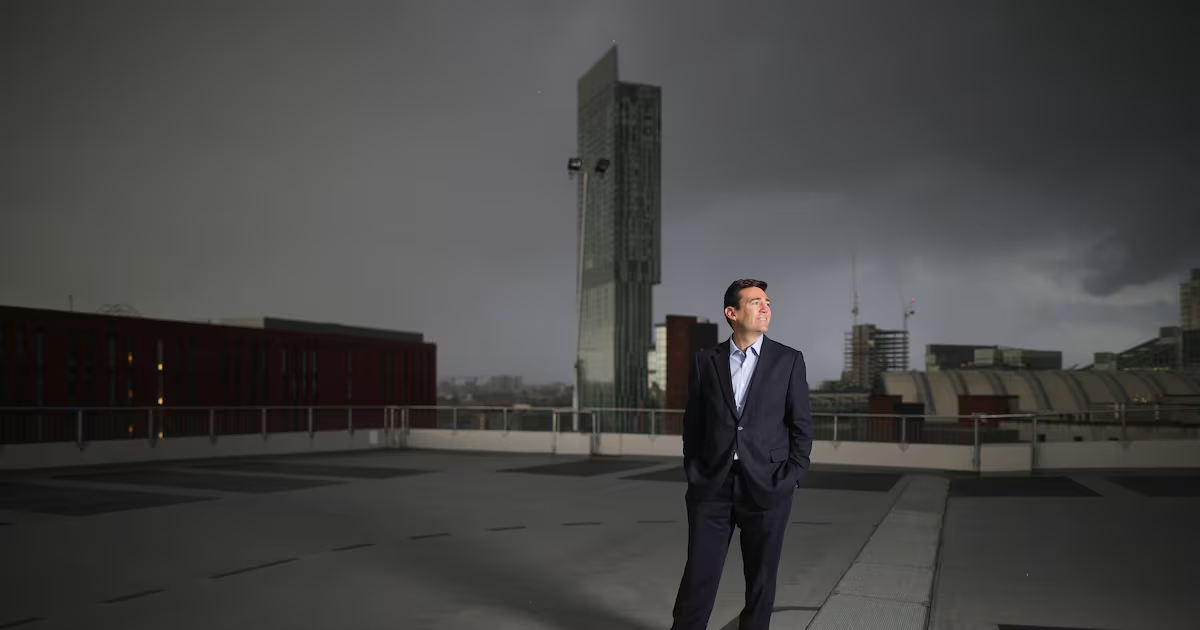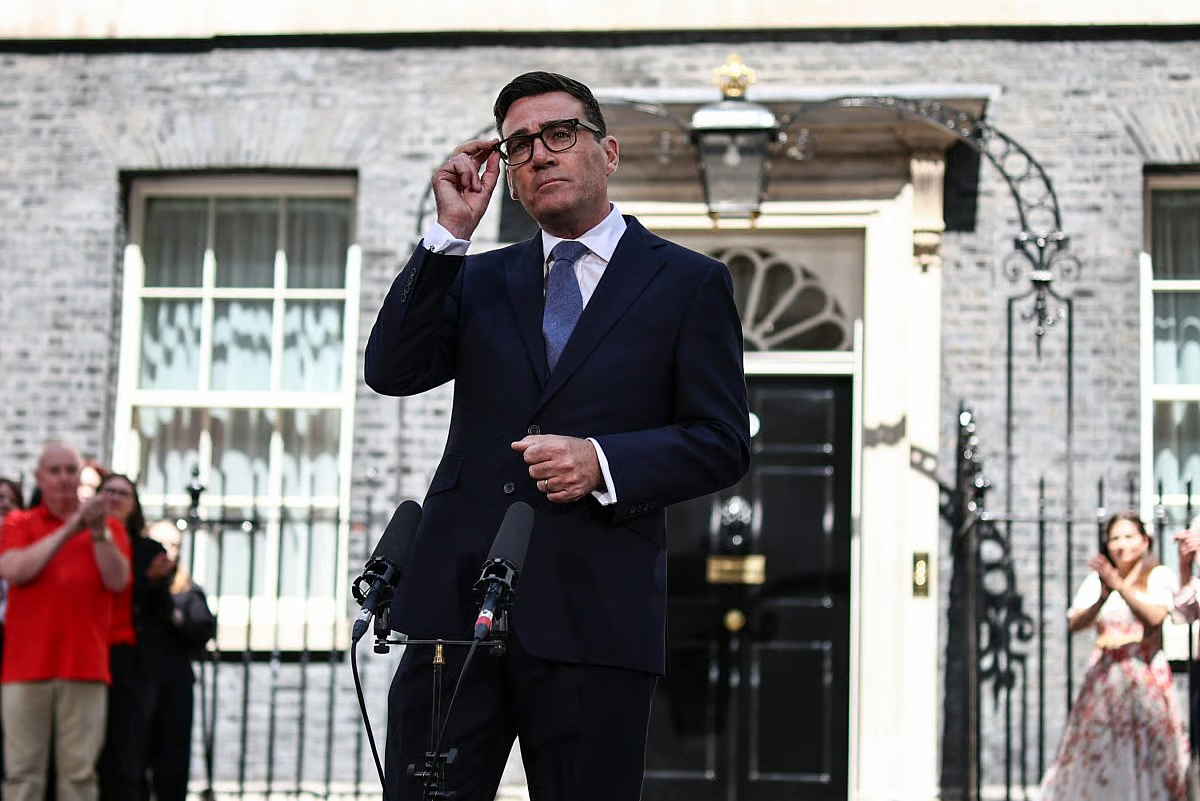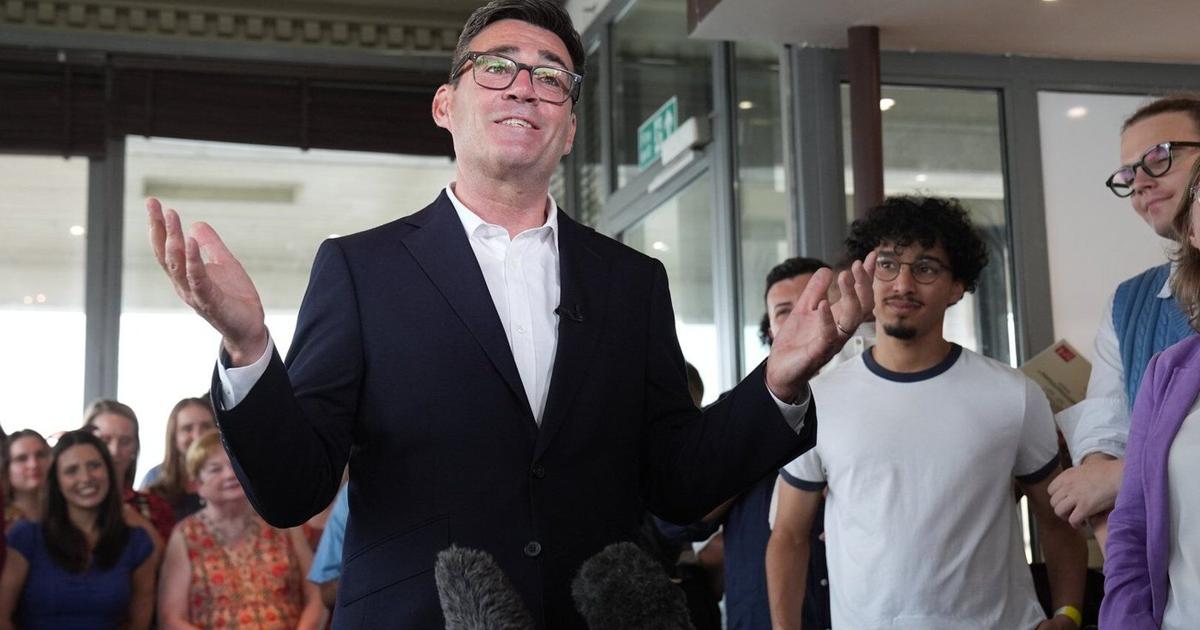
Andy Burnham was a broken man. In a pub a short walk from parliament, which he had taken to calling “the madhouse”, he plotted his escape over beers with three trusted colleagues.It was late March in 2016. Burnham, the MP for Leigh in Greater Manchester, had been in Westminster for 15 years but here, in a politico-free pub on Horseferry Road, his mood was dark.“He was pissed off,” said Steve Rotheram, his close friend and then the MP for Liverpool Walton. In the space of seven months, Burnham had lost his second Labour leadership bid and felt aggrieved at what he saw as the “aloof” campaign to remain in the EU.He had served in the governments of Tony Blair and Gordon Brown but was now in the crossfire of an internecine war raging under the Labour leader, Jeremy Corbyn, and his confidence was draining faster than the midweek pints.It was this night at the pub that would lead Burnham to Downing Street a decade later. He agreed, after some convincing, to leave Westminster and run for the newly created role of Greater Manchester mayor, with his “bezzie mate” Rotheram heading for Liverpool.(From left) Steve Rotherham, Jeremy Corbyn and Andy Burnham arriving at the Hillsborough inquest in Warrington, in 2016. Photograph: Peter Powell/PAOn Monday, the day after the World Cup final, the football-mad former altar boy who once described himself as “one of the lads” will become Britain’s seventh prime minister in 10 years.His inner circle can scarcely believe he has made it to No 10, a feeling Burnham himself probably shares. “I thought when we left [Westminster] it was done,” Rotheram said of his friend’s leadership ambitions. Did Burnham think that too? “Yeah, I think he probably did.”In the early summer of 2016, Burnham had announced his intention to leave parliament and chaos was unfolding all around him. He was in Jeremy Corbyn’s shadow cabinet and colleagues were resigning en masse over the leadership. “We were all in a private world of pain,” recalled Gloria De Piero, a fellow shadow minister.At one point, virtually the only shadow ministers left were Corbyn’s closest allies, Diane Abbott, John McDonnell and Jon Trickett – and, curiously, Burnham, not a natural political soulmate of the firebrand leftwinger.Cannily, the Leigh MP cast himself as a mediator between Labour’s warring factions and publicly refused to join the revolt. Colleagues recall him turning up to an “unbelievably fractious and very hostile” meeting of Labour’s ruling body, the national executive committee, and imploring all sides to find common ground. “He is a party loyalist but he never agreed with Jeremy’s politics,” said De Piero.(From left) Jeremy Corbyn, John McDonnell and Andy Burnham at a press conference in Salford in 2019. Photograph: Sean Smith/The GuardianYet some viewed Burnham’s refusal to resign – leaving him oddly stranded – as an example of his political opportunism: if he was to be Greater Manchester mayor, he needed the support of the thousands of Corbynistas who had joined the party under the new leader.“He didn’t want to alienate his allies and he didn’t want to be seen to be opposing Jeremy. It doesn’t take a political genius to see why that was the case,” said one close Corbyn ally during his leadership.On 26 June that year, Burnham publicly distanced himself from the growing rebellion, tweeting: “I have never taken part in a coup against any leader of the Labour party and I am not going to start now.”He was involved in a plot of sorts, however. Just four days after that tweet, according to newly unearthed documents seen by the Guardian, those close to him helped draft what became known as the “Corbyn declaration” – a commitment to the Labour leader that his policies would continue if he stepped aside.It never took off – and it is not clear if Corbyn ever got wind of Burnham’s role in the plan – yet those around the leader already viewed him with an air of caution. Burnham had, after all, recently lost a leadership contest against Corbyn and then, according to those in the room, privately insisted on bringing his campaign manager, the Labour MP Michael Dugher, into the shadow cabinet. Dugher was no fan of Corbyn and was soon sacked for “poisonous” briefing against the Labour leader.Andy Burnham and Jeremy Corbyn on stage at Labour party conference in 2016. Burnham had by then declared his intention to step down. Photograph: Christopher Thomond/The Guardian“He was definitely not the most difficult of the non-Corbynite members of shadow cabinet,” said a senior Corbyn ally. “Trust is possibly putting it too strong, but he was definitely more amenable.”To some, Burnham’s studied neutrality was an example of his tendency to follow “what he thinks is expedient and by political calculation rather than following his own lights”. He would no doubt believe the infighting betrayed the worst instincts of Labour, a party he felt had left him and millions more. It did, though, show a flash of his political ruthlessness, a trait he would display again years later. But for now he was heading north.Nearly a year later, on the morning of 6 May 2017, came Burnham’s second act. He became the first directly elected mayor of Greater Manchester, heralding the “dawn of a new era” in a victory speech at Manchester Central convention centre. Politics had been “too London-centric for too long”, he told supporters.In Manchester’s Grade II-listed Tootal Buildings the following Monday morning, Burnham was given a hero’s welcome by about 200 staff at the Greater Manchester Combined Authority.The reception from the region’s 10 council leaders was less rapturous, however. None of them had backed him for the role, with most supporting the veteran Labour MP and interim mayor Tony Lloyd. Richard Leese, the leader of Manchester city council, was a political heavyweight in Greater Manchester and his endorsement mattered. He backed two candidates: Lloyd and the Labour minister Ivan Lewis.“Quite a lot of people had a cynical view that he had run for leader twice and lost and that he needs to go do something else,” said one of the council leaders. Burnham put their noses out of joint during the mayoral campaign by saying it was a “cabinet-level job that needed cabinet-level experience”, seen as an insult to the town hall lifers. To some, it smacked of arrogance. The Stone Roses anthem This Is the One was played during his manifesto launch.“People would say: he doesn’t understand the job he applied for, he doesn’t understand what local government was,” a former council leader said. “It was a cynical view that people had developed at a distance and I don’t think it was fair.”As a show of magnanimity, Burnham asked Leese to be his deputy mayor, keeping the most powerful of his council leaders firmly on side. “I don’t think he would have asked me to be deputy mayor if he had been holding a grudge,” said Leese. “I take that as a real indicator that Andy wasn’t interested in old battles, he wanted to get things done.”Andy Burnham and Richard Leese speak to the media outside Manchester town hall after the Manchester Arena attack in 2017. Photograph: Dave Higgens/PAHaving spent his formative political years under New Labour, Burnham took some time to shed these tendencies as mayor. His meetings would often run late, council leaders said, because he would open them with a “monologue” about a particular issue. “He didn’t differentiate between public and private meetings early on and so the kind of showbiz style that he brought to public meetings he’d still do that in the private ones,” said one former colleague.Burnham was infamous for his poor timekeeping. His weekly leaders’ meetings would often run over by an hour or more. More than once, at least one of the leaders would abruptly walk out at 12 on the dot. “He’s late for everything,” said one former colleague. “The diary was a guide rather than a to-the-minute military plan.”Shortly after 10.30pm on 22 May 2017, Burnham was at home watching Newsnight, the BBC’s flagship late-evening news show, in a sweaty football kit having just played his regular five-a-side match when his phone rang. It was Rotheram. He left it and let a second call ring out. When he called a third time, Burnham picked up. “Andy, Andy, my girls are in Manchester and we’ve been told a bomb’s gone off at the arena,” Rotheram screamed into the phone. The Liverpool mayor had been in a meeting with a senior US diplomat when his wife, Sandra, called him in a state of panic.The loud bangs were probably pyrotechnics, Burnham told his friend. Then another call came through: it was Ian Hopkins, the chief constable of Greater Manchester police. Hopkins told him it was a bomb and that there were multiple casualties at Manchester Arena. Burnham told Rotheram to get his girls out of Manchester as fast as he could.Andy Burnham joins mourners after the 2017 Manchester Arena bombingThe events of that night – when a suicide bomber killed 22 people, mainly children, and injured hundreds more at an Ariana Grande concert – are seared into Manchester’s consciousness.The trauma takes visible form to this day in the cuddly toys, portraits and love heart balloons in a corner of Manchester Victoria station, which links to the venue, and the countless worker bee tattoos that became a permanent symbol of the city’s unity. Burnham was among those who queued for a tattoo.The Glade of Light memorial commemorates the victims of the 2017 terrorist attack at Manchester Arena. Photograph: Christopher Thomond/The GuardianLess than 24 hours after the attack, a crowd of hundreds gathered sombrely in Albert Square in the city centre, bathed in spring sunshine. For many, the vigil will be remembered for Tony Walsh’s soaring rendition of his poem This Is the Place which lifted a fragile city from its knees: “We won’t take defeat and we don’t want your pity / Because this a place where we stand strong together / With a smile on our face, Mancunians forever.”David Walker, the bishop of Manchester, stood beside Burnham on the podium, knowing this would be a defining moment for both the mayor – two weeks into the job – and the city itself. “It was a turning point,” said Walker, praising Burnham’s “innate” ability to connect with a large audience with emotional intelligence, a skill that cannot be taught by spin doctors.Andy Burnham lays flowers in tribute to those who lost their lives in the terror attack in 2017. Photograph: Leon Neal/Getty Images“That’s absolutely crucial and I think he gets that,” Walker said. “He knows how to be in that moment, be totally present with people, knowing that he can make a contribution that will make a difference. Until then, largely, these sorts of terrorist attacks had … proved divisive, communities struggled afterwards. I think we did it differently in Manchester.”After the worst possible start, Burnham found his feet as mayor. His flagship promise was to end rough sleeping in Manchester by 2020 and he almost halved it. By last year, however, Britain’s housing crisis sent homelessness to record levels and the number of people on the city’s streets had crept back up.By far his proudest achievement is Bee Network, bringing buses back into public control for the first time since the 1980s, capping fares and joining up the region’s messy public transport system. He took some convincing to get on board with the plan, according to colleagues, but once he did he went full throttle. Now it is a central part of his plan for government.“We will ensure all parts of the UK are able to take greater public control of essential services, like water, housing, energy and transport, learning from the model that has transformed our bus networks here in Greater Manchester,” he said in a speech at the People’s History Museum last month, wearing the yellow Bee Network logo as a badge of honour on the lapel of his jacket.The yellow liveried Bee Network of buses and trams began running in 2023. Photograph: Christopher Thomond/The GuardianIt was during the Covid-19 pandemic, though, that Burnham took on a new public persona. “Covid was a turning point,” said council leader who worked alongside the mayor in this period. “It’s where he managed to define himself.” As Britons struggled through intermittent and confusing lockdowns, Burnham was rarely off the television, railing against Boris Johnson’s government. He had not been invited to Whitehall Cobra meetings, central government’s primary crisis response system, so the media was his megaphone.Andy Burnham sticks up for local communities during Covid-19 pandemic lockdownA defiant speech outside the city’s Bridgewater Hall, near the site of the Peterloo massacre, saw him crowned “the king of the north”. For the first time, he was seen to be speaking for much of the country as he railed against the government’s top-down restrictions.Andy Burnham speaks outside Bridgewater Hall, Manchester after negotiations with the government over new lockdown restrictions broke down. Photograph: Christopher Thomond/The GuardianThree men who had been drinking nearby stumbled across the alfresco press conference on their way out of the pub, telling one of Burnham’s colleagues they had never voted Labour and probably never would but that they supported the mayor’s lockdown fight.When Nicholas Watt, the BBC Newsnight journalist, asked Burnham a pointed question suggesting the mayor was grandstanding, the three men angrily booed. They were fully on the Burnham bandwagon. “That was the point I realised: Andy’s got appeal beyond the Labour party brand,” the colleague said.It took Burnham to another level of political stardom. His face was splashed across Manchester on murals by the artist Stanley Chow, a King of the North IPA was created in his honour and the navy worker’s coat he wore for the Bridgewater Hall speech – which he calls his “second division” jacket, normally worn to watch Everton football club at the weekends – went on display at the People’s History Museum.Andy Burnham is reunited with his ‘king of the north’ jacket after it was acquired by conservators at the People’s History Museum in Manchester. Photograph: Christopher Thomond/The GuardianHe revelled in the adulation, DJing at club nights, visiting countless charities and giving his phone number to strangers who wanted his help. He read most of his press coverage, occasionally texting or calling journalists when he felt they had written something unfair – a habit that continues to this day.He felt most at ease when out meeting people, one former adviser said: “He liked the fact he was in the north. He liked the fact that, unlike in Westminster where you’re the current secretary of state for a government department, the Greater Manchester machine was very much set up to support him.”Early in his first term as mayor, Burnham said his second act as a politician was bringing out “the real me”. Westminster, he added, “makes a fraud out of you”. Now, as he embarks on his third act in a job he has coveted for decades, will the real Andy Burnham step forward?
The Manchester years: how Burnham’s rebirth as ‘king of the north’ set him on road to No 10
In the second part of a two-part profile, Josh Halliday charts PM-in-waiting’s journey northward, where as mayor he revelled in his Covid-era popularity – and changed his approach to politics
2,500 words~11 min read