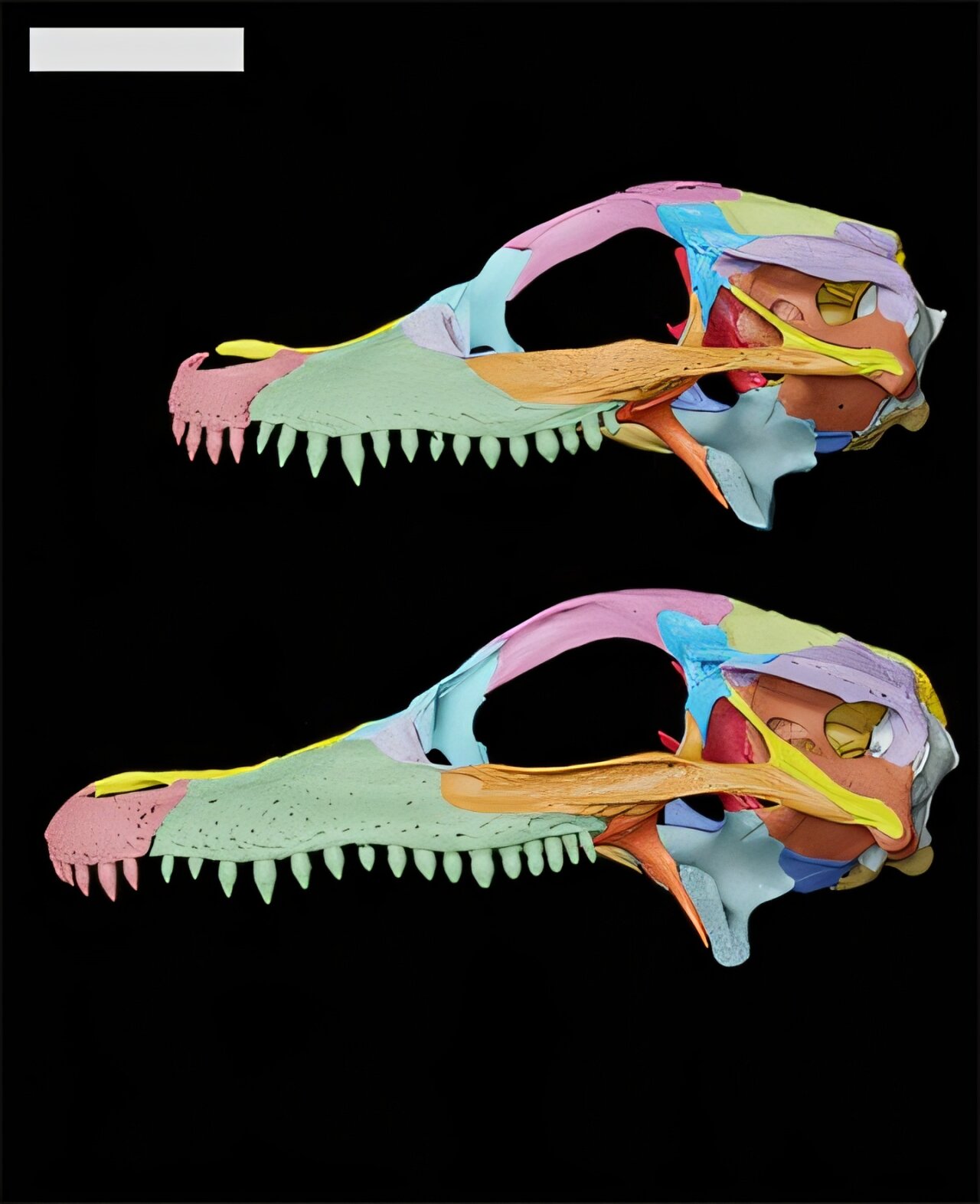
These CT scan images show a comparison of a hatchling Chinese alligator (above) and an American alligator (below). The images illustrate the subtle species-specific differences between the two animals that are present throughout their lifespans. Credit: James Napoli
Fossil finds are exciting moments that sometimes introduce the world to an ancient mammal or dinosaur that existed millions of years ago. But a longstanding problem in paleontology is that fossils are often incomplete, and subtle differences between certain species, along with major changes that can occur as an animal grows, complicate species identification. A paper published this month in Paleobiology lays the groundwork for a new approach to correctly identifying ancient animal fossils, with significant implications for vertebrate paleontology.
Authored by paleontologist James Napoli, a research instructor in the Department of Anatomical Sciences in the Renaissance School of Medicine (RSOM) at Stony Brook University, the study describes an experiment to determine whether the guidelines and statistical tests paleontologists often use to identify species could distinguish American alligators from Chinese alligators—living species that differ in size but are otherwise very similar.