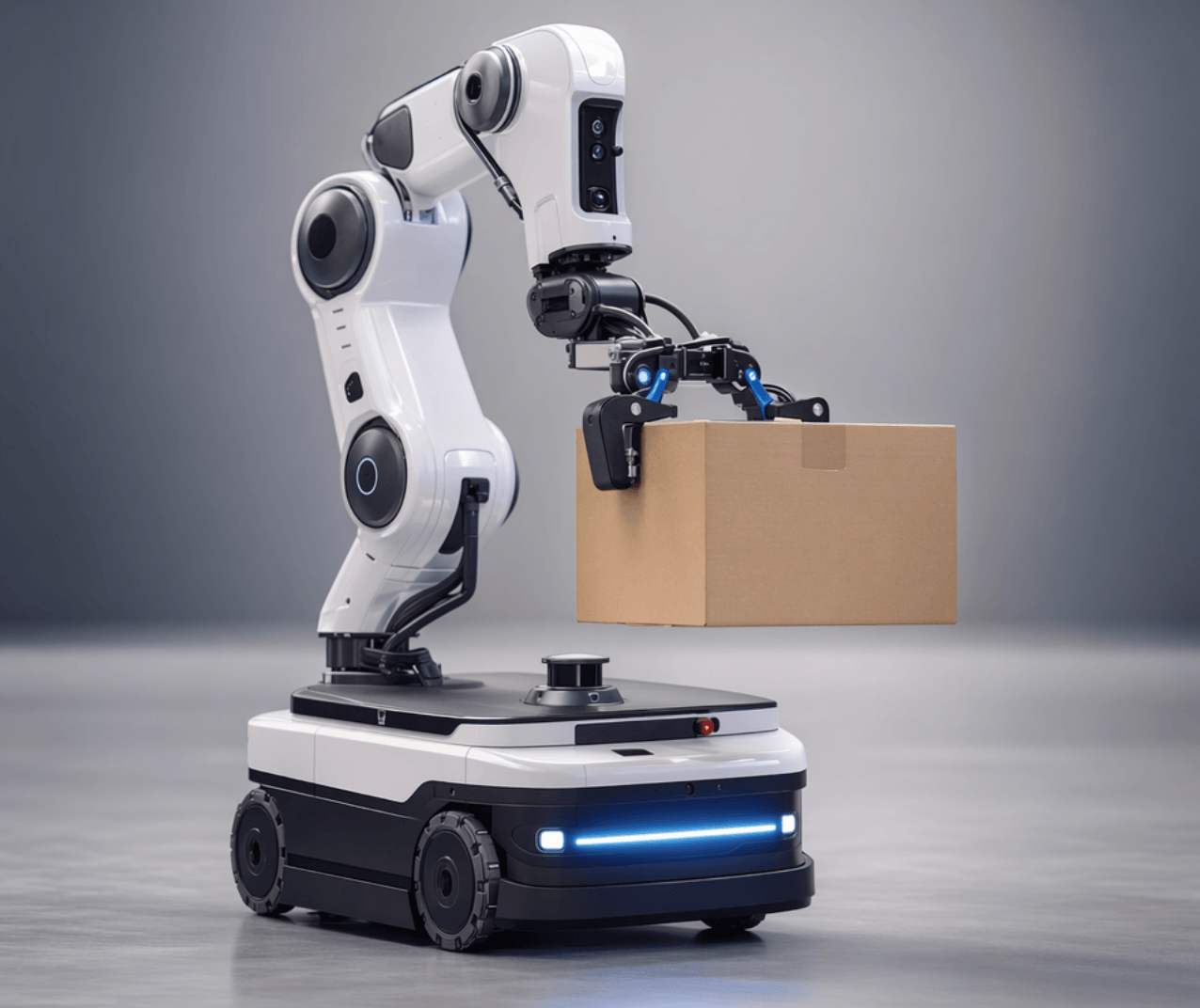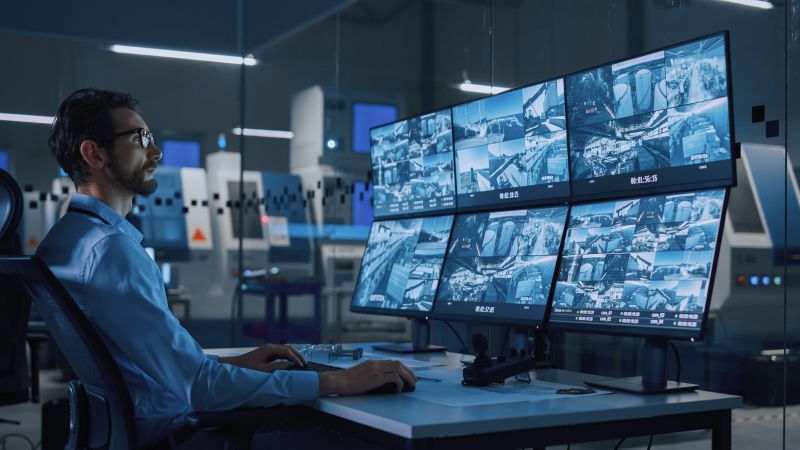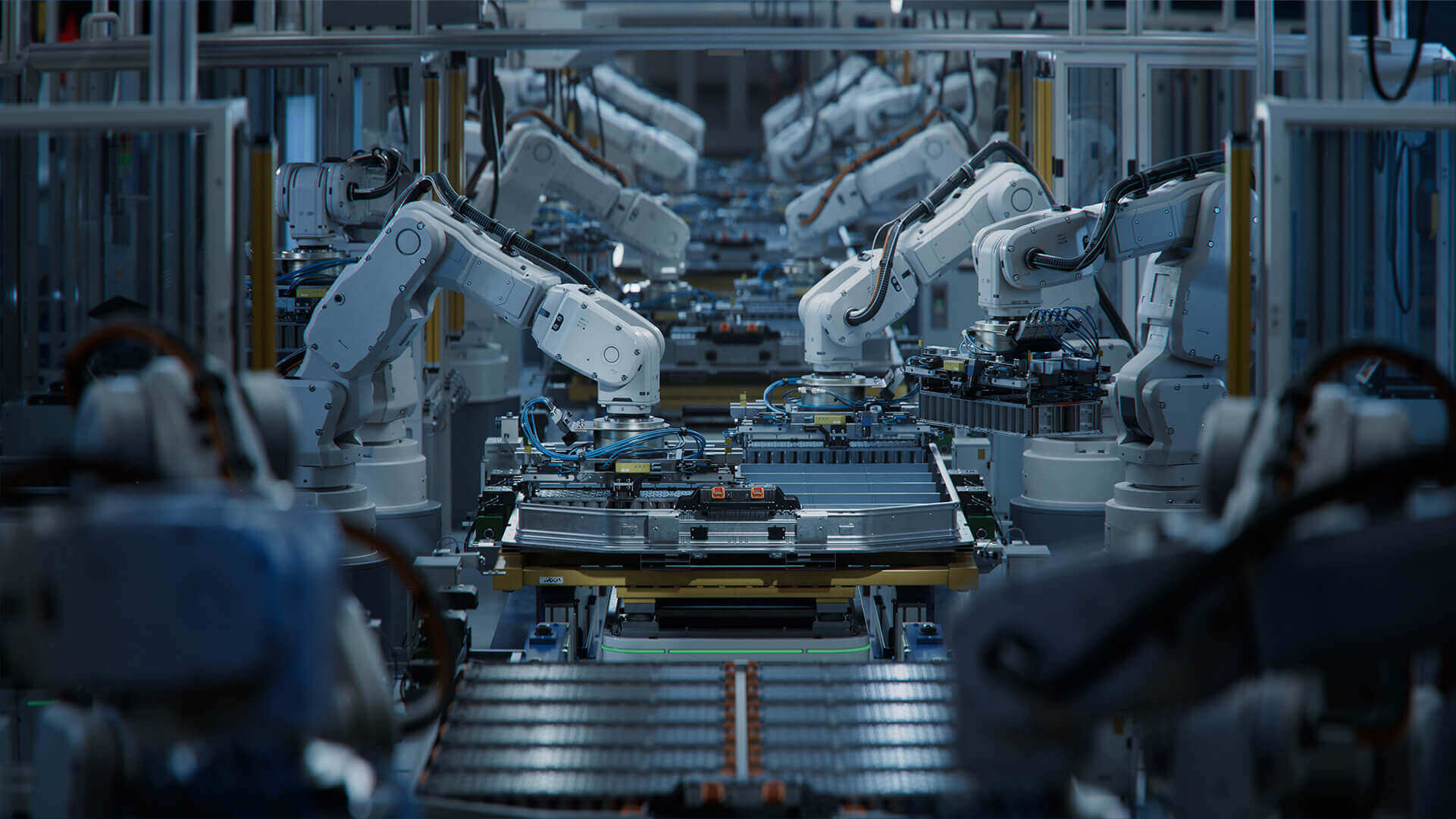
Every company that depends on physical operations is dealing with the same set of problems today. The infrastructure that was built years ago demands changes faster than operations teams can adapt. Repetitive tasks done by humans at high speed produce errors. The system wasn't designed to be monitored at scale. On top of all that, competitive pressure keeps growing, regulatory requirements are increasingly strict, and many organizations are locked into rigid automation systems that can't evolve with their needs.These are structural problems, and incremental improvements within the current model aren't going to fix them.In this 2-part article, we explore how a new generation of technology is reshaping the way physical operations automation works. In this first part, we look at the real challenges companies face today, the innovative solutions already addressing them, and the concept that ties it all together: Physical AI. In the second part, we'll go deeper into what makes physical AI different from current approaches and how Red Hat helps organizations build the infrastructure to run it more safely and at scale.Physical operations: Challenges and innovationTo understand what physical AI really means in practice, it helps to look at 3 areas where physical operations are already being transformed. In each case, the pattern is the same: a real, expensive problem that existing approaches can't fully solve, and a new generation of intelligent systems that addresses it in a fundamentally different way.Operations automationTraditional automation works well in stable, predictable conditions, but it breaks down when variety increases, layouts change, or peak seasons arrive. Demand spikes, product variety, and operational complexity create situations where simply running existing processes faster isn't enough. Rigid, pre-programmed systems can't adapt quickly, and every change requires specialist intervention, time, and cost.Today, a new generation of robotic and AI-orchestrated systems is changing this. Autonomous mobile robots (AMR) navigate dynamically through facilities with no fixed tracks and no architectural redesign required. AI-powered sorting systems organize packages by size, destination, and urgency, and continue learning from their environment over time. Robotic arms with vision-guided grasping are able to handle high-mix, low-volume production, adapting to new parts on their own. Collaborative robots work directly alongside human operators on assembly lines, extending what teams can do while keeping human judgment where it still matters most.The return on investment (ROI) is increasingly clear. For example, the deployment costs for autonomous mobile robots in mid-size fulfillment centres have fallen by over 35% since 2021, and payback periods have compressed to as little as 18 to 24 months.Security and surveillanceLarge, distributed facilities with high-value assets are impossible to monitor consistently with human teams alone. Coverage gaps appear between shifts, blind spots exist at every perimeter, and static camera systems record what happens, but they don't respond to it. By the time a threat is identified, it has often already crossed the line.A new class of autonomous system is shifting security from reactive to preventive. Patrol robots equipped with Light Detection and Ranging (LiDAR), thermal imaging, and HD cameras cover ground continuously with no fatigue, no shift gaps, and no blind spots. Unlike static cameras, they can investigate: repositioning, following a subject, or checking an area on demand. Perimeter drones, dispatched automatically by sensor alerts, can reach a breach point in seconds, responding while a situation is still unfolding rather than after the fact.Maintenance and inspectionAging infrastructure and unplanned downtime are silent cost sources. Failures tend to happen in places that are hard to reach or dangerous to access. Traditional inspection methods require expensive shutdowns that take systems offline and put teams at risk. And by the time a problem becomes visible, it is often already serious.Intelligent inspection systems are turning this around. Predictive maintenance powered by AI detects equipment failure patterns weeks before anything breaks, transforming maintenance from emergency response into a planned, data-driven discipline. At the same time, these systems are complemented with inspection drones that survey rooftops, solar arrays, and large warehouse interiors in minutes, even sometimes performing replacement tasks. Next-generation tactile sensors and force-controlled actuators give inspection systems the ability to assess physical properties such as pressure, surface irregularity, and material stress that previously required a human hand to evaluate.The convergence that makes this possibleThese solutions aren't science fiction, and they aren't 5 years away. They're happening now, and the reason is because 3 things converged at roughly the same time.First, edge hardware became powerful enough and affordable enough to run AI inference locally. Modern processors and dedicated neural processing units now pack enough compute into small, low-power form factors to run real-time vision and decision models directly on a robot or drone, without sending data to a cloud server. Second, at the same time, AI models matured beyond narrow, controlled conditions and became more capable of handling the messiness of the real world, recognizing objects under variable lighting, planning movements around unexpected obstacles, and adapting to situations they were never explicitly trained on. Finally, robotics middleware reached a level of production-grade stability that organizations can now build on with confidence.None of these 3 things alone would have been enough, but together they created the conditions for physical AI to move from research labs into real operations.What is physical AI?Physical AI refers to AI systems that operate in and interact with the physical world, rather than existing only in software or digital environments. It's the combination of AI, edge computing, and robotics working together so machines can sense what's happening around them, reason about it, and take action, all in real time.To understand why this is different from what came before, it helps to think about how traditional robots actually work.Traditional robots are programmed. They follow fixed sequences of instructions in controlled environments, and they stop or fail when something unexpected happens. They're precise, but they're rigid. Change the process, and you have to reprogram the robot. Change the facility layout, and you have to redesign the whole setup. If the system needs to handle a new type of product, you bring in a specialist and spend weeks reconfiguring. Every improvement requires human intervention, every change has a cost, and the system never gets smarter on its own.Physical AI changes this completely.Drawing the boundaries of physical AIBefore going further, it's worth being precise about what physical AI actually covers, because the term is broader than it might first appear, and also more specific than some may assume.When we introduced robotics as a main component of physical AI, we were using the word in a much wider sense than most people expect. Robotics in this context means any physical system that can act on the world based on a decision, and that includes a lot more than factory arms or humanoid machines. A semi-autonomous vehicle navigating city traffic is a robotic system. So is a smart grid that detects a fault in a power line and reroutes load automatically, a wind farm that adjusts turbine angles based on real-time atmospheric data, or a building management system that responds to occupancy, temperature, and air quality simultaneously. What these systems share isn't a mechanical body, it's the ability to perceive the physical world through sensors, reason about what they observe, and take action that produces a real physical consequence.At the same time, physical AI isn't everything that involves AI and physical assets. The key question is always whether the system closes the loop autonomously. Take predictive maintenance as an example: an AI model that detects a developing fault and sends an alert to a maintenance team is genuinely useful, but it isn't physical AI on its own. Physical AI requires that the prediction triggers a physical action without a human relaying the instruction. The decision and the action are part of the same automated loop.Digital twins are another good example worth clarifying. A digital twin is a virtual model of a physical system—a software mirror of a factory, a turbine, or a city block, used for simulation, monitoring, and planning. It's a powerful tool and while it's often part of a physical AI architecture, it doesn't become physical AI until it closes the loop: sensing real-world data, reasoning about it, and triggering an action back in the physical environment. A digital twin that only monitors and reports is a simulation tool. A digital twin that detects an anomaly and instructs a physical system to respond is part of a physical AI system. NVIDIA describes digital twins as the data generation and world modelling layer that physical AI systems train and plan within, not as the end point of physical AI itself.And what about traditional automation? A conveyor belt running at a fixed speed, a robotic arm following a pre-programmed path, a sensor that triggers an alarm above a threshold: these are all automation, but they aren't physical AI. They're deterministic, rigid, and unable to adapt when conditions change. Physical AI systems learn, generalize, and improve over time. The difference represents a fundamental shift from automation to autonomy. Automation does what it is told. Autonomy figures out what needs to be done. Physical AI is the bridge between cognitive computing and physical execution, and that bridge is what makes the examples in the previous section possible.A word on embodied AIYou may encounter another term in this space: Embodied AI. This is closely related to physical AI, and while many people use them interchangeably, they aren't the same thing, and the distinction is worth understanding. Some will tell you that physical AI does not require action in the physical world while embodied AI does. That isn't accurate, physical AI always implies operating in or interacting with the physical world, real or simulated.Embodied AI is a subset of physical AI, specifically referring to systems that learn and adapt through direct physical interaction with their environment, shaping their intelligence through experience rather than static programming, usually specialized in interacting with humans. In other words, all embodied AI is physical AI, but not all physical AI is embodied AI. The difference becomes clear with an example. An AI system that reads conveyor sensors, detects an anomaly, reasons that a motor is running hot, and sends the command that slows down the belt is physical AI. It perceives the physical world through sensors. It reasons about what is happening and acts by changing the state of the floor, but it has no body, no physical form, and no experience of what it feels like to interact with the environment. It processes data and sends commands. A disembodied AI could know that fire is hot because it's in the sensor training data, while an embodied agent knows it because touching something hot changed its state. That difference in how knowledge is acquired changes how the system generalizes, adapts, and handles situations it has never seen before.An embodied AI learns through experience and interaction, much like humans do, rather than simply processing pre-existing data about the world. A robot that learns to navigate uneven terrain does so because its body experienced the terrain, not because it read about it. The physical characteristics of the body—its weight, its joints, and its sensors—are part of the intelligence itself. The term physical AI—intelligence that understands and operates in the physical world—is the broader, more commercially adopted umbrella. Embodied AI is the more academically rooted concept that describes a specific and particularly powerful subset of it. For the purposes of this article, the relevant scope is physical AI in its full breadth: any system that closes the perceive-reason-act loop in the real world, whether or not it has a body in the traditional sense. The 3-stage loopEvery physical AI system, regardless of where it is deployed, works through the same 3-stage loop. Understanding this loop is key to understanding why these systems behave so differently from traditional automation.It starts with perceiving the world. Sensors such as LiDAR, RGB-D cameras, thermal imagers, and tactile sensors gather continuous data from the physical environment. Unlike traditional systems that send that data to a remote server for processing, however, physical AI systems handle it locally, at the point of action, in real time. This isn't a minor technical detail, it's what makes the whole thing possible. Edge hardware running on x86 or ARM architectures, combined with specialized accelerators like GPUs, NPUs, and FPGAs, runs AI inference fast enough for a physical system to actually use it before the moment has passed.From there, the system moves to reasoning. Raw sensor data is used to make decisions. AI models interpret what the sensors are seeing, predict what is likely to happen next, and plan the best response. This is where the real shift from traditional robotics becomes visible. Technologies like world simulation tools (MuJoCo, Genesis), predictive generative models (NVIDIA Cosmos, DreamerV3), and vision-language-action systems (OpenVLA, Gemini Robotics, NVIDIA GR00T) don't simply classify what they observe, they can simulate possible futures and plan a course of action before committing to it, something no rule-based system can do.Then the system acts. Actuators, robotic arms, wheels, and drive systems carry out the decision with precision. And here is what makes the loop powerful: every action produces new sensor data, which feeds straight back into the perception stage. The system is never finished learning. Robotics control subsystems like ROS 2, MoveIt, Nav2, and Open-RMF orchestrate all of this across the full robotic platform, keeping perception, planning, and motion in continuous coordination.This loop, perceive, reason, act, is what separates physical AI from the automation that came before it. It isn't a faster version of the same thing, it's a fundamentally different architecture that gets better the longer it runs.Instead of following pre-programmed instructions, these systems learn and react. Instead of breaking when conditions change, they adapt. Instead of needing to be reprogrammed for every new situation, they generalize from experience and over time, the system improves. It gets faster, more accurate, and more capable of handling situations it was never explicitly taught to deal with. This isn't an incremental upgrade to existing automation, it's a different way of thinking about what machines can do.What comes nextAccording to market research, robots that integrate AI can deliver up to 40% higher operational efficiency compared to traditional automation systems. That’s why the global physical AI market was valued at $5.23 billion in 2025 and is expected to reach $49.73 billion by 2033, growing at a rate of 32.53% per year. The direction is clear, but understanding what physical AI is and why it works is one thing, but making it work reliably in a production environment is another.The technical challenges are real. Running AI inference locally on edge hardware requires an operating system (OS) that can deliver deterministic, low-latency performance without the unpredictability of a standard Linux kernel. Managing hundreds or thousands of distributed edge devices, each running sensors, models, and actuators, requires consistent fleet management, atomic software updates, and security patching at scale. And the robotics middleware that ties perception, planning, and motion together needs to run on a stable, enterprise-supported foundation that doesn't disappear when a research project loses funding or a vendor changes direction.But perhaps the most underestimated challenge is the AI model itself. A model trained in a simulation or on a controlled dataset doesn't stay accurate forever. Real-world conditions drift, new objects appear, lighting changes, processes evolve, and a model that performs well at deployment will degrade over time without continuous monitoring, retraining, and revalidation. Getting a model to the edge is one problem. Keeping it accurate, safe, and up to date across a fleet of physical devices operating in unpredictable environments is a different and much harder one. This requires MLOps pipelines that extend all the way to the edge, not just to the datacenter.And it rarely stops at one model. A single robot in a real deployment will typically run multiple models simultaneously, with different models for object detection, navigation, manipulator control, and anomaly detection. These models also often come from different vendors, are trained on different data, and have different update cycles and hardware requirements. Managing that heterogeneous mix, making sure the models work together, stay current, and don't conflict with each other, adds a layer of complexity that's easy to overlook in a proof of concept (POC) but impossible to ignore at scale.This is also where most physical AI initiatives fail: a POCworks in a controlled environment, results look promising, leadership approves a wider rollout, but then the project stalls. The model behaves differently on real hardware than it did in simulation, the edge devices are harder to manage at scale than anyone anticipated, and security and compliance requirements that were deferred during the pilot become blockers in production. Analysts consistently report that more than half of AI projects never make it past the pilot stage, and in physical AI the consequences of a failed deployment are more visible and costly than in a software-only project.These aren't unsolvable problems, but they require a foundation that was designed for them. Organizations that try to build physical AI on top of unmanaged open source tooling or proprietary systems that can't evolve often discover that the integration between edge, AI, and robotics is where projects stall. These are exactly the kinds of problems that Red Hat has been working on at the intersection of enterprise Linux, edge computing, AI, and open robotics. The second part of this article goes into detail about how Red Hat addresses each of these layers. But the short version is this: Red Hat provides the open, stable, long-term-supported foundation that makes it possible to build physical AI systems that aren't just impressive in a demo, but are more reliable in production, manageable at scale, and reduce the vendor dependencies that have trapped organizations in the past.
Physical AI: Physical operations are broken, a new kind of intelligence is needed
Learn how physical AI reshapes physical operations automation, addressing real-world challenges with innovative approaches.
2,939 words~13 min read