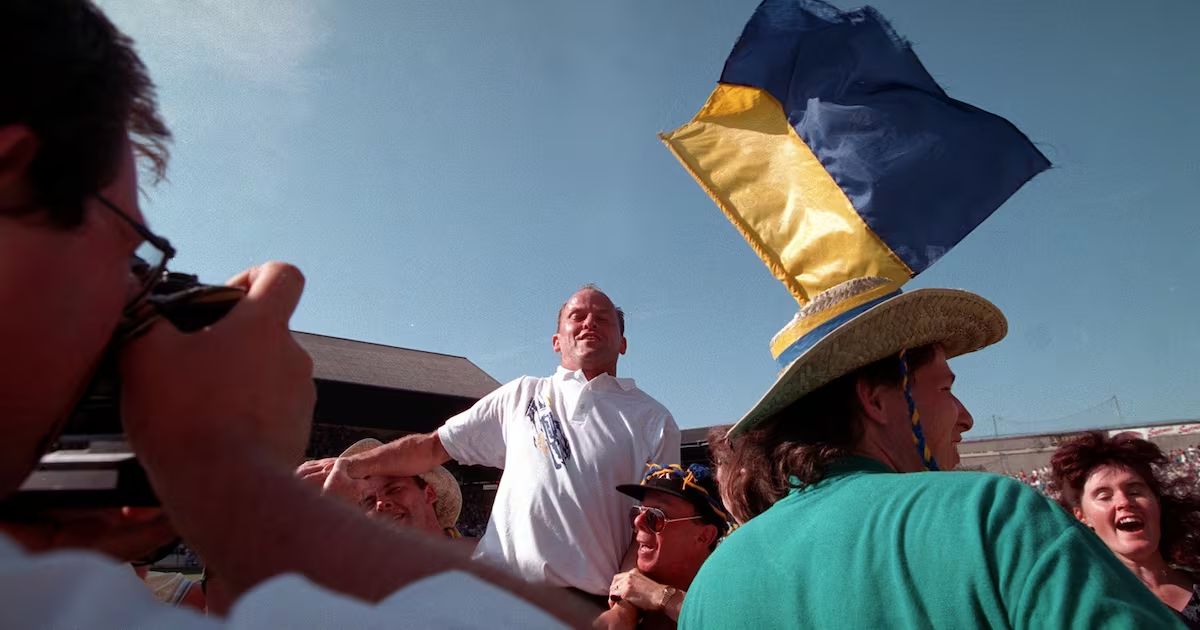
I remember my first All-Ireland hurling final in the press box. It was historic in that Antrim hadn’t been to one for so long. There were reports of one engaged/foolhardy British soldier offering light-hearted advice to supporters on their return from the semi-final win over Offaly. He told them to make sure to do better than in 1943.That left a lot of leeway given that year’s 5-16 to 0-4 defeat by Cork. To be fair, the Ulster champions made inroads into that without ever threatening to prolong the Tipperary famine – an 18-year gap back to their previous title.Throughout Gaelic games, there’s always a hankering for unexpected achievement and that is particularly true of hurling, a game with a rigid caste system and few ways of breaking into it.When I began my current job with The Irish Times, I had the good fortune to enjoy immediately two breakthrough stories. The first year was 1995, a glorious summer when the sun took up residence in early July and didn’t leave the daytime skies for two months.At the same time, the pioneering Guinness sponsorship was beginning and the country was covered in billboard advertising with portentous slogans, creating a real sense of anticipation.Clare emerged for a first Munster title in 63 years with Ger Loughnane as an engaging ringmaster. The county was rapt and so engrossed in being provincial champions that the possibilities of the All-Ireland didn’t appear to occur to them.Loughnane recalled being first on the scene of a non-fatal car crash near his home the week of the All-Ireland semi-final against Galway. An old man was in shock, dazed by the impact. As the Clare manager ran through the obvious checks – could he feel his legs etc – a bystander is looking at him, checking, “Ger, isn’t it?”Yes, he’s told. So, the bystander leans forward into the car and insists to the shaken occupant: “It’s Ger Loughnane. Isn’t that enough to make you feel better?”Even the nurse from the ambulance checks with him that “everything’s right for Sunday”.So, when in the famous broadcast scene after half-time, Loughnane assures the sideline reporter, Marty Morrissey, “we’re going to do it, we’re going to do it”, everyone watching at home would have simply nodded their heads in relief.A brief look at the match from 31 years ago confirms how much the game has changed.The final score of 1-13 to 2-8 was the lowest-scoring final since 1987 when Galway beat Kilkenny 1-12 to 0-9, also on a very wet day. But that represents the difference in hurling styles between the contemporary and back then.Manager Liam Griffin is held aloft by supporters following Wexford's improbable 1996 All-Ireland hurling triumph. Photograph: Billy Stickland/Inpho The 1995 total of 30 points (including goals) compares with 57 from last year’s final. Clare’s winning tally of 16 (1-13) is 20 lower than Tipperary’s in 2025, 36 (3-27). Over the decade, the 1990s had an average winning total in All-Ireland finals of 20.3, compared to 34.8 in the current decade.The losing average from the 2020s (25.8) would be enough to beat comfortably the winning average from the 1990s.It was a time that didn’t prize possession above everything else and prioritised moving the ball with an implicit trust or hope that a teammate would win the battle for possession elsewhere.The 1990s was scattered with notable All-Ireland wins, including two for the Offaly team that Clare beat in 1995. Wexford, winners in 1996, were also led by a charismatic front man – local hotelier Liam Griffin, who planned and cajoled an All-Ireland from nowhere.Nobody alive could really have remembered Clare’s previous All-Ireland in 1914 but for Wexford people, 1996 was Paradise Regained, a revisiting of great times.What Clare did achieve was the beginning of a genuine legacy that saw them average a title a decade up until now, most recently two years ago under the management of Brian Lohan, dauntless full back from the 1990s, who played the 95 final with a torn hamstring.The empire struck back this century. After the breakout wins of the 1990s, the big three of Cork, Kilkenny and Tipperary won 14 All-Irelands on the trot from 1999 to 2012 – an unparalleled run of success; eight had been the previous high-water mark.It was mostly to do with Kilkenny, whose formidable team only needed the qualifier route for one of their 11 titles. By the first decade of this century, just Cork, 1941-44, had won four successive Liam MacCarthys. Within the last 24 years, two counties, Kilkenny and Limerick, had emulated that mark.Kilkenny’s tilt at the near-mythical five-in-a-row in 2010 ended with defeat by old rivals Tipperary. The final, played on a wet and overcast afternoon, showcased the liberated prescriptions preached by Liam Sheedy’s coach, Eamon O’Shea, but also their opponents’ ill fortune in losing two of their most influential hurlers, Henry Shefflin and Brian Hogan.Limerick’s attempt at a similar history came unstuck in a pressure-cooker All-Ireland semi-final when Cork got in the flow and swept past their provincial rivals. If I search for a moment that encapsulates the wildness at the heart of big hurling matches, it comes in the 47th minute of that match.The Cork crowd are lustily cheering a double save by Patrick Kelly and his defence from Gearóid Hegarty, and on the rebound Aaron Gillane. As Mark Coleman clears the ball, the noise reaches a crescendo. Declan Dalton takes it on his own 65 and sweeps over a point.The crowd are still acclaiming the deliverance at the back and when Dalton scores, the decibels have nowhere to go except to sustain one extended roar.Limerick are back this weekend to face up-and-coming opposition in Galway and in pursuit of a sixth All-Ireland in eight years. Time is probably running out for John Kiely’s team. They must wonder at how quickly it passes.sean.moran@irishtimes.com
Seán Moran: Looking at hurling through the prism of 32 All-Irelands from the crow’s nest
From early years watching uplifting breakthroughs to marvelling at the power of the juggernauts
967 words~4 min read