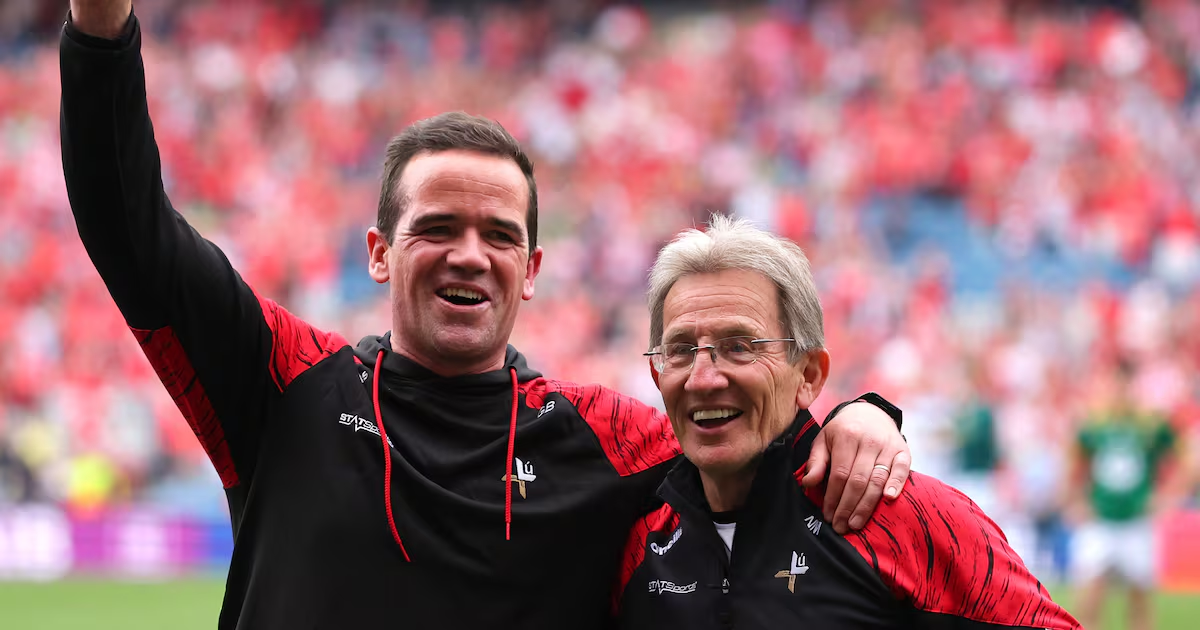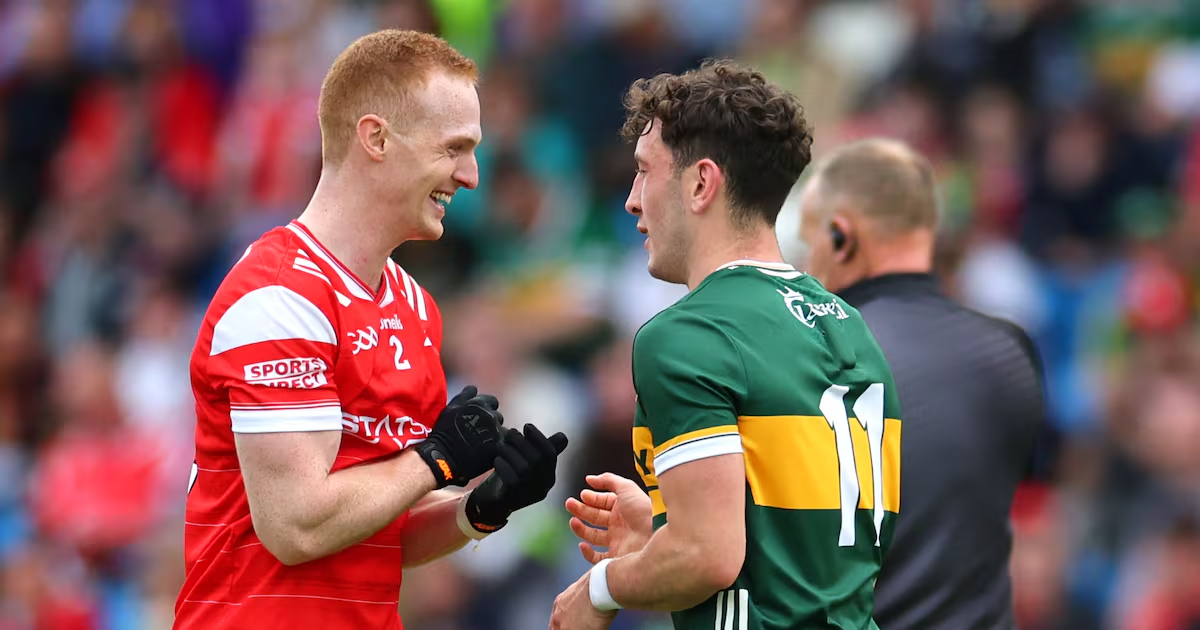
Twenty-five years on, the reformed football championship structure continues to deliver unexpected All-Ireland semi-finals. If you were being cranky, you could grumble that three of this year’s last four are, in fact, the most frequent visitors to the semi-finals this century.Equally, you might complain that yet another iteration of Dublin and Kerry, who have played once every two championships during the same period and are now contesting their fifth semi-final of that period, may well be viewed as less than riveting in the other 30 counties.But then, you roll out Louth – back in the last four for the first time in the 69 years since they last took home the Sam Maguire.Their striking win over Monaghan on Sunday closed the gap back to 1957. It wasn’t flash-in-the-pan stuff either. The county won Leinster last year, even if they didn’t raise much of a gallop thereafter, and also reached the All-Ireland quarter-finals the previous season.Their campaign so far in the All-Ireland series has included wins over two of the three most recent champions, Dublin and Armagh – the result of measured progression.Louth’s Craig Lennon celebrates scoring a goal against Dublin in May this year. Photograph: Ryan Byrne/Inpho Were they to beat Mayo and avenge the 1951 All-Ireland final defeat, a fascinating prospect exists that Louth might well find themselves playing Kerry in the decider.That would be a truly historic rematch, not so much of the group matches two and three years ago but of a consequential history more than a century old.The Croke Memorial final in 1913 matched the counties after a fractious rivalry during the previous four years. Kerry won the 1909 All-Ireland, defeating Louth, who nonetheless lodged several objections.The following year, with the same two counties back in the final, the champions refused to travel in protest at what they saw as the dismissive attitude of the Great Southern and Western Railway and its refusal to agree a special carriage for the team and reduced fares for the team’s entourage.[ No Ulster team has made the All-Ireland semi-finals for the first time since 2016Opens in new window ]Locally, the Kerryman newspaper fulminated that considering the vast sums the company had made from the county team over the previous five years, its actions were “mean and despicable”.If Kerry were expecting solidarity, they were sadly mistaken. The GAA awarded the 1910 All-Ireland to Louth even though their opponents turned down the walkover and offered to travel south to play the final.Kerry declined, saying their argument was with the GSWR and not Louth.However, a challenge was issued to the new champions and the inflammatory response, apparently from the Louth county board, said they would send their junior team, which would be sufficient for the job. This was published nationally and triggered apoplexy.The Kerryman fumed that “not since the inception of the GAA was such an insult heard of”.Neither county emerged from their provinces a year later and, in 1912, with Louth already in the final and Kerry expected to breeze through their semi-final with Antrim, there took place what was described by Sport magazine as “perhaps the most sensational GAA result of all time”. Kerry were beaten.[ Stephen Rochford: If it’s a red card in the 66th minute, it’s a red card in the sixth minuteOpens in new window ]So, football’s pre-eminent rivalry hadn’t actually been consummated on the championship field for four years when they met on May 4th, 1913, for the Croke Memorial final.The tournament was intended to raise funds for a statue commemorating Archbishop Croke, the GAA’s first patron, and the final on Jones’s Road caused huge excitement.According to Richard McElligott, lecturer in Irish and modern history at Dundalk Institute of Technology, in his widely praised Forging a Kingdom, about the early years of the GAA in Kerry: “Once news broke that Kerry and Louth were to face each other, the Irish sporting media and public went into a near frenzy. Quite simply, this was a match four years in the making.”The crowd was estimated at 26,000, bringing in gate receipts of £750, and easily achieving the modest target of £700. Serendipitously, it also ended in a draw, Kerry 0-4 Louth 1-1, and the febrile atmosphere intensified for the replay.Expatriate Kerry associations in the US sent home money for the team’s training fund. The GAA granted both counties £50 towards their expenses. Interest was stratospheric, according to McElligott.A thronged Jones’ Road on All-Ireland final day. Photograph: Ryan Byrne/Inpho “A crowd estimated to be anywhere from 36,000 to 50,000 strong somehow squeezed into Jones’s Road. Such was the demand for entrance that a full two hours before throw-in, people had to be turned away from the turnstiles, as there was no more room in the ground.“If in 1905 (the twice replayed 1903 All-Ireland home final between Kerry and Kildare) the GAA had come of age, in 1913 it became unsurpassed as the island’s pre-eminent sporting body.”[ Louth v Kerry: The rivalry that created modern football and built Croke ParkOpens in new window ]The Croke Memorial Cup final replay raised a further £1,183, bringing the total fund to £2,366. It meant the GAA’s ambitions moved beyond commissioning a statue to the idea of acquiring the sports ground where the matches had been played, which they would name Croke Memorial Park.Central Council gave the purchase the go-ahead on October 4th, 1913, and after negotiations, news that the deal had been concluded was broken in The Gaelic Athlete at the end of the month and later welcomed in the same pages the following week.Speaking to The Irish Times three years ago when the counties met in an All-Ireland group match, McElligott summarised: “Most people will say, ‘Kerry-Louth – what rivalry’ but I would suggest the next time supporters walk into Croke Park, they pause and think about it because they wouldn’t have the stadium there but for that rivalry.“It was brief, but it was intense, and in historical terms one of the most significant rivalries because of what came out of it.”sean.moran@irishtimes.com
Seán Moran: Kerry and Louth in the All-Ireland final would be a truly historic rematch
Rivalry between the two counties captivated the public more than a century ago and led to the GAA acquiring Croke Park
1,000 words~5 min read