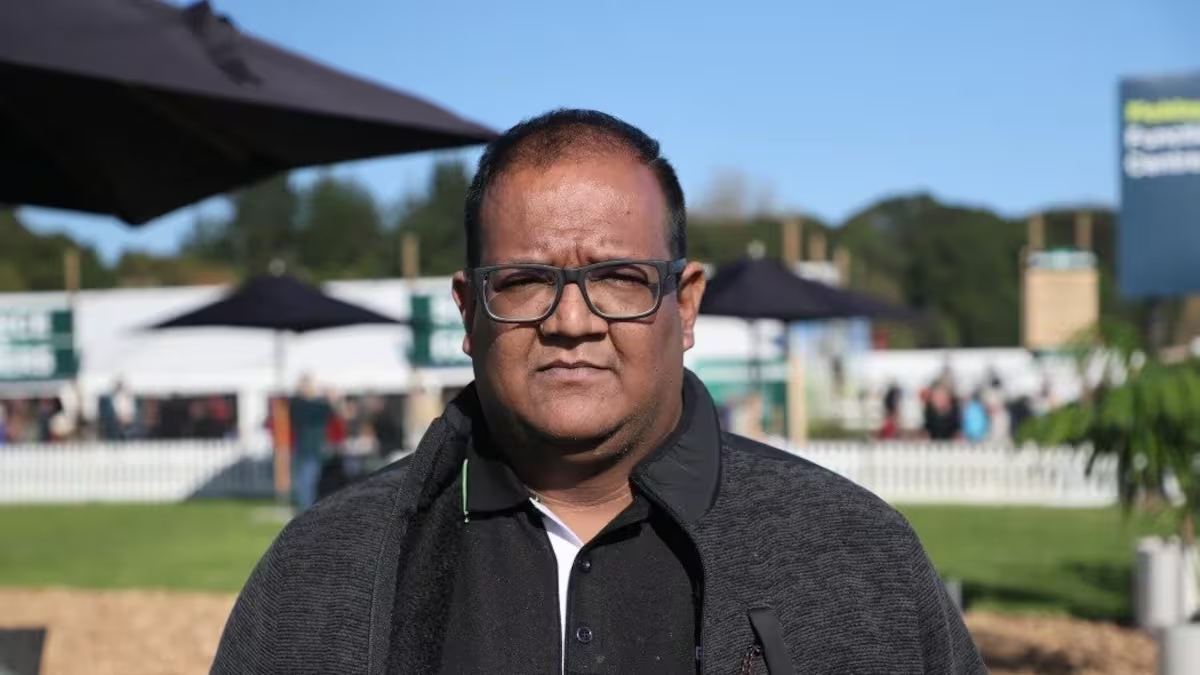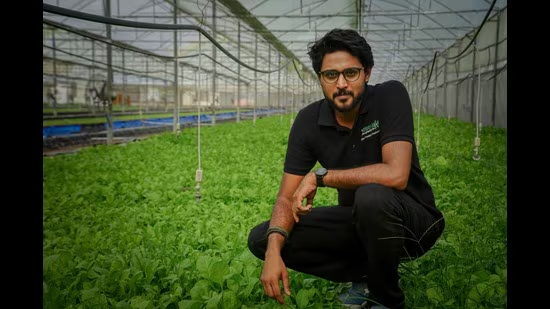
Pune is emerging as a hub where technology and agriculture converge. Surrounded by the fertile farming belts of western Maharashtra, the city is fostering agri-tech innovation to address challenges such as climate change, water scarcity and shrinking cultivable land. While Growize Farms is headquartered in Bengaluru, the company has received significant support from investors in Pune, reflecting the city’s growing interest in sustainable food systems and agri-tech solutions.“The biggest myth we grew up with is that farming is timeless,” says Arvind Narayanan (in pic), co-founder of Growize Farms. (HT)India has always been a nation shaped by its farmers. For generations, agriculture has been guided by experience, tradition and a deep understanding of the land. Today, however, that legacy stands at a crossroads. Climate change, erratic weather patterns, declining soil health and increasing pressure on water resources are compelling the sector to rethink how food is produced.For Growize Farms, this rethink began with a simple yet urgent question: What happens when the soil itself can no longer keep up?“The biggest myth we grew up with is that farming is timeless,” says Arvind Narayanan, co-founder of Growize Farms. “But the reality is, farming today is under more pressure than ever before. And pretending otherwise is dangerous.”A wake-up callLike many in the agriculture ecosystem, Narayanan believed farming would continue much as it always had, resilient, dependable and rooted in tradition. However, what he observed on the ground painted a different picture.Across India, farmers are grappling with unprecedented uncertainty. Monsoons arrive late or in intense bursts, heatwaves damage crops before harvest, and rainfall patterns no longer follow familiar cycles. In Maharashtra, where agriculture remains heavily dependent on increasingly erratic rainfall, these shifts are becoming more evident with each passing season.“For a country feeding over a billion people with just 4% of the world’s freshwater, we are walking a very tight rope,” Narayanan explains. “Climate volatility is no longer a future risk—it’s already here.”Scientific studies reinforce this urgency. Even a 1.5°C rise in global temperatures could reduce suitable farmland for more than half of the world’s major crops. In India, where millions depend on rain-fed agriculture, the implications are especially significant.Yet, according to Narayanan, the deeper crisis lies beneath the surface.“People talk about yield and productivity, but very few talk about soil,” he says. “The truth is, our soil is exhausted. We’ve been extracting from it for decades without giving back.”India’s soil organic carbon levels have declined sharply over the past seven decades, while nearly 30 per cent of the country’s land is now classified as degraded. For Growize Farms, these findings became more than statistics—they served as a catalyst for exploring alternative cultivation methods that could complement conventional farming.Rethinking the foundationsGrowize Farms was founded on the belief that the future of agriculture cannot depend on soil alone. At the same time, the company maintains that innovation should strengthen, not replace, traditional farming systems.“We’re not here to disrupt farmers,” Narayanan says. “We’re here to support them. Technology should strengthen agriculture, not erase its roots.”This philosophy led the company towards controlled-environment agriculture, with a focus on hydroponics and aeroponics.At first glance, the concept of growing crops without soil may appear unconventional. Yet these systems represent an evolution in farming that uses technology to optimise the growing environment while reducing dependence on finite natural resources.“In aeroponics, you’re giving the plant exactly what it needs—no more, no less,” Narayanan explains. “It’s precision farming at its purest.”In these systems, plants are grown either in nutrient-rich water or with their roots suspended in air and nourished through a nutrient mist. The result is faster crop cycles, higher productivity and dramatically lower water consumption.“We’re talking about up to 95% less water compared to traditional farming,” Narayanan notes. “In a water-stressed country like India, that’s not innovation—that’s necessity.”Farming without boundariesOne of the most significant advantages of soilless farming is its ability to reduce agriculture’s dependence on geography.Traditionally, farming has been constrained by land availability, soil quality and climatic conditions. Controlled-environment agriculture makes it possible to cultivate crops inside warehouses, urban buildings and even rooftops, allowing fresh produce to be grown much closer to where it is consumed.“For the first time, farming is not limited by where you are,” Narayanan says. “You can grow food where people actually live.”For rapidly growing cities such as Pune, where urbanisation continues to place pressure on land and supply chains, this approach offers significant potential. Producing food closer to consumers can reduce transportation costs, minimise post-harvest losses and ensure fresher produce reaches markets.“In India, we lose a huge percentage of produce before it even reaches the market,” Narayanan adds. “If we can grow closer to consumption, we solve multiple problems at once.”Soilless farming is unlikely to replace India’s vast network of conventional farms, nor is that its purpose. Staples such as rice, wheat and pulses will continue to rely on open-field agriculture. Instead, technologies such as hydroponics and aeroponics can serve as complementary solutions for high-value crops, leafy greens and produce that benefit from controlled growing conditions.As cities like Pune continue to emerge as centres of innovation, the convergence of agriculture and technology presents an opportunity to build a more resilient food system. The future of farming may not lie in choosing between soil and soilless cultivation, but in recognising that India’s food security will depend on embracing both tradition and innovation in equal measure.
How Growize Farms is reimagining future of agriculture
The Bengaluru-based company’s co-founder Arvind Narayanan says Growize brings structure, and modern systems to commercial agriculture
888 words~4 min read