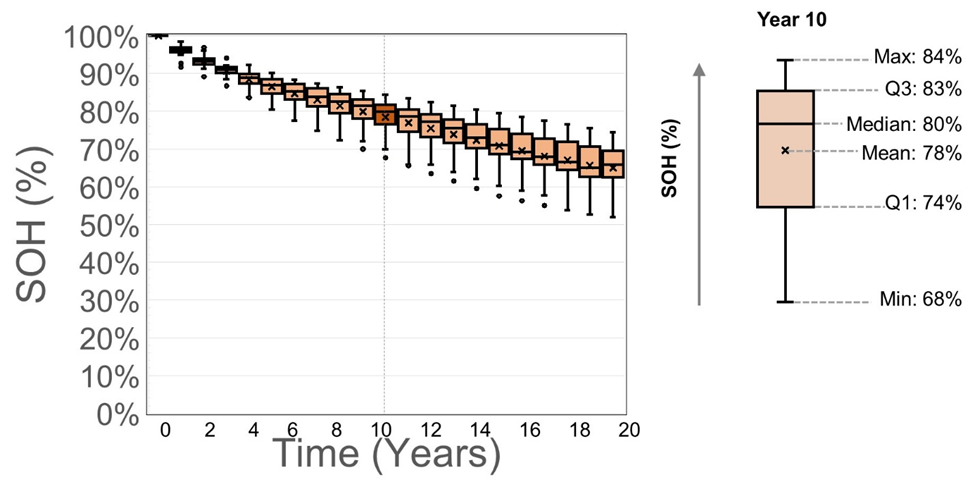
SOH is closely linked to both state of charge (SoC) and battery degradation. The battery management system (BMS) predicts battery degradation, and a lower SoH is directly correlated with it, as degradation commonly manifests as reduced capacity and/or safety issues.
As detailed in a previous article in this series, the SoC is the current charge in a battery when it is in use, charging, or idle. It is also expressed as a percentage compared to the theoretical charge it can possess, so if the SoH is low, then the SoC of a battery will also be affected.
The SoH is also related to the internal resistance, which is a direct result of cell ageing, and can be compared with the original internal resistance to see how much the battery has aged. As a battery ages and the SOH is reduced, the internal resistance increases, meaning that less current is delivered at a defined voltage.
Therefore, SoH is not only critical for seeing what the maximum capacity of a BESS installation is, it is also a key indicator into how much ageing has occurred, as excessive wear can affect electrode structures and the ability for cells to work safely.
If the SoH is too low and ageing is too high, BESS operators know it’s time to replace some cells before thermal runaway or other battery hazards occur (which would mean many more cells and containers would need to be replaced if a fire broke out). Therefore, having an accurate understanding of the SoH can help BESS operators save money on Opex, avoid costly and damaging thermal events and maintain the operational efficiency and availability of their asset.