view more
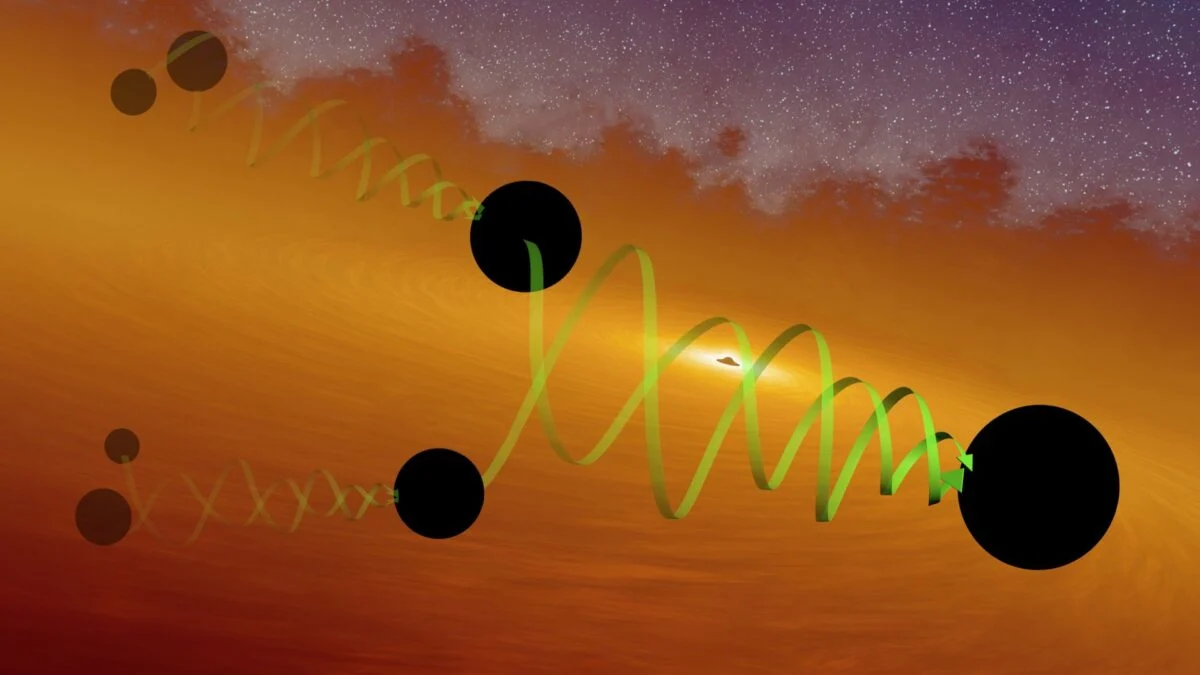
NEW YORK, July 8, 2026 — More than half a century ago, Sir Roger Penrose envisioned a scenario in which energy could be extracted from a black hole spinning at extreme speeds. He proposed that a particle entering its ergosphere—a region of space dragged around by a rotating black hole— could split into two. One part could fall into the black hole while the other escaped carrying more energy than the original particle. Building on this theory, physicist Yakov Zel’dovich later predicted that a wave interacting with a sufficiently fast, rotating object could extract energy from it and become amplified.
Inspired by this theoretical construct, researchers at the Advanced Science Research Center at the CUNY Graduate Center (CUNY ASRC) have published a paper in Nature demonstrating a new approach to wave amplification through interaction with rotating bodies. Rather than mechanically rotating matter, however, the team engineered a radio-frequency device with properties modulated in space and time to mimic spinning. The device creates a synthetic form of ultrafast rotation that enables access to rotational speed far beyond what can be achieved mechanically, allowing researchers to overcome limitations that have long hindered experimental studies of ultrafast rotational dynamics.