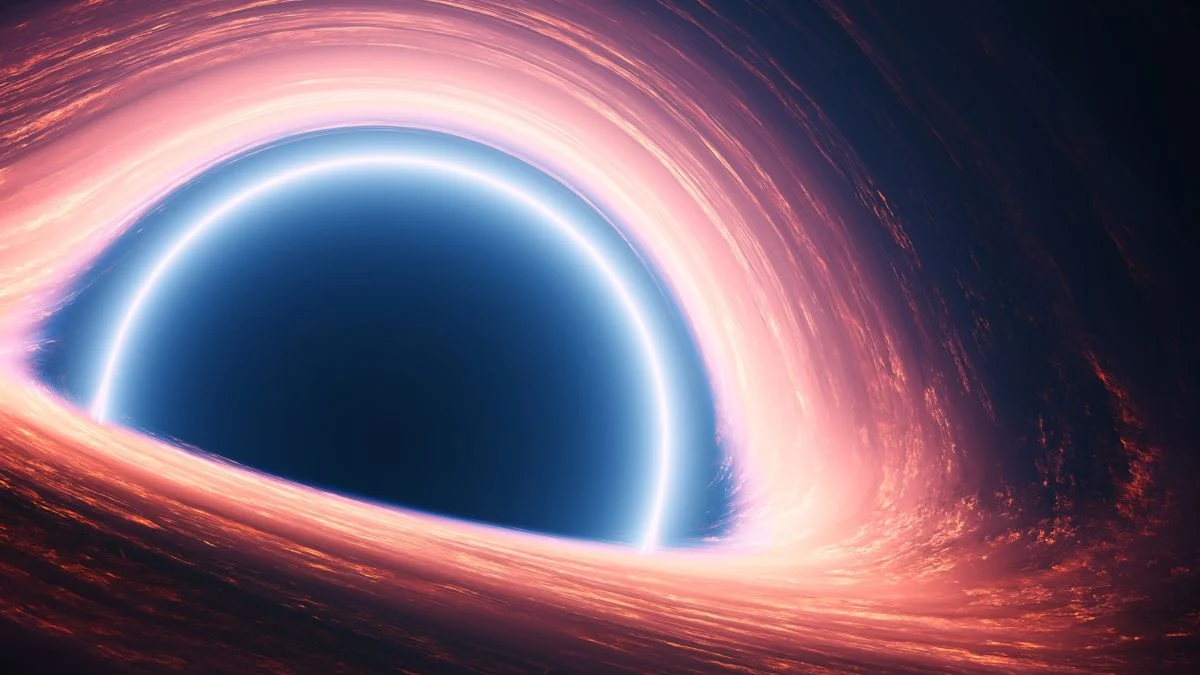
The one thing we all 'know' about black holes is that nothing escapes their ineluctable grasp.That is mostly true – but since the 1970s, physicists have predicted that black holes could slowly lose energy in the form of thermal radiation.This is Hawking radiation, and while it has been recreated in laboratory analogs, the mechanism whereby it siphons energy from a black hole, known as backreaction, has remained elusive.Now, in a black hole analog made of – ironically – light, a team of physicists led by Lorenzo Procopio of Paderborn University in Germany has observed an analog of Hawking radiation backreaction.Their findings have been published in the journal Nature.
"This simplifies the theoretical understanding and opens up new ways of calculating effects in such systems," Procopio says. "It might even shed light on how Hawking radiation arises in the context of gravity."Black holes are the strangest, most extreme objects in the Universe.They're so incredibly dense that, once you get close enough, there's no escaping their gravitational pull. Think of a rocket leaving Earth. It needs to achieve a certain speed known as escape velocity to break free of the planet's gravity.From a black hole, there's nothing in the Universe that can achieve escape velocity, not even light. The distance from a black hole's center that marks the point beyond which light can no longer escape is the event horizon.Hawking radiation, first proposed by physicist Stephen Hawking in 1974, is black-body radiation predicted to arise from quantum effects near a black hole's event horizon.However, while Hawking radiation is a robust and widely accepted prediction of quantum field theory in curved spacetime, exactly how the energy is transferred from the black hole to the radiation has remained an open question.The big problem is the same one we always have with black holes: Direct observation of Hawking radiation is currently impossible. In fact, the signal is expected to be so faint that we may never disentangle it from the background radiation that permeates the Universe.This is where physicists get creative.