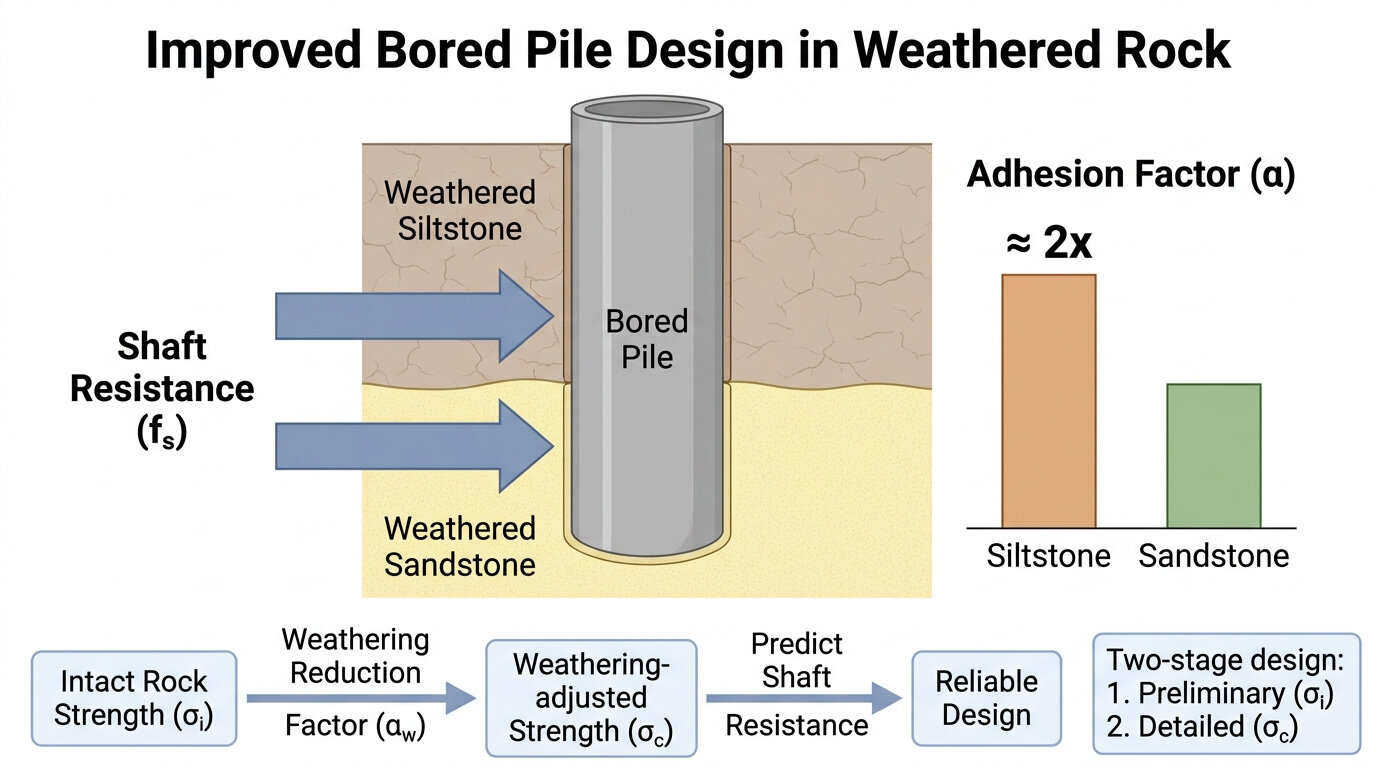
Researchers from Shibaura Institute of Technology analyzed instrumented load-test data from large-diameter bored piles in weathered siltstone and sandstone to develop practical adhesion factors and shaft-resistance correlations for foundation design. Credit: Professor Shinya Inazumi from Shibaura Institute of Technology, Japan
Large-diameter bored piles are essential for major infrastructure, from elevated railways and long-span bridges to high-rise buildings. Yet when these piles extend into weak, weathered sedimentary rocks such as siltstone and sandstone, engineers face a persistent design challenge: the rock behaves neither like conventional soil nor like strong, intact rock. Instead, its load-bearing capacity depends heavily on in situ weathering, fracturing, and the interaction between the pile and the surrounding rock.
Many current design methods estimate shaft resistance using the uniaxial compressive strength of intact rock. However, intact rock strength alone does not accurately represent the weaker, weathered rock mass surrounding a pile socket. As a result, engineers may adopt overly conservative designs, leading to larger pile diameters, greater pile lengths, increased material use and higher construction costs.