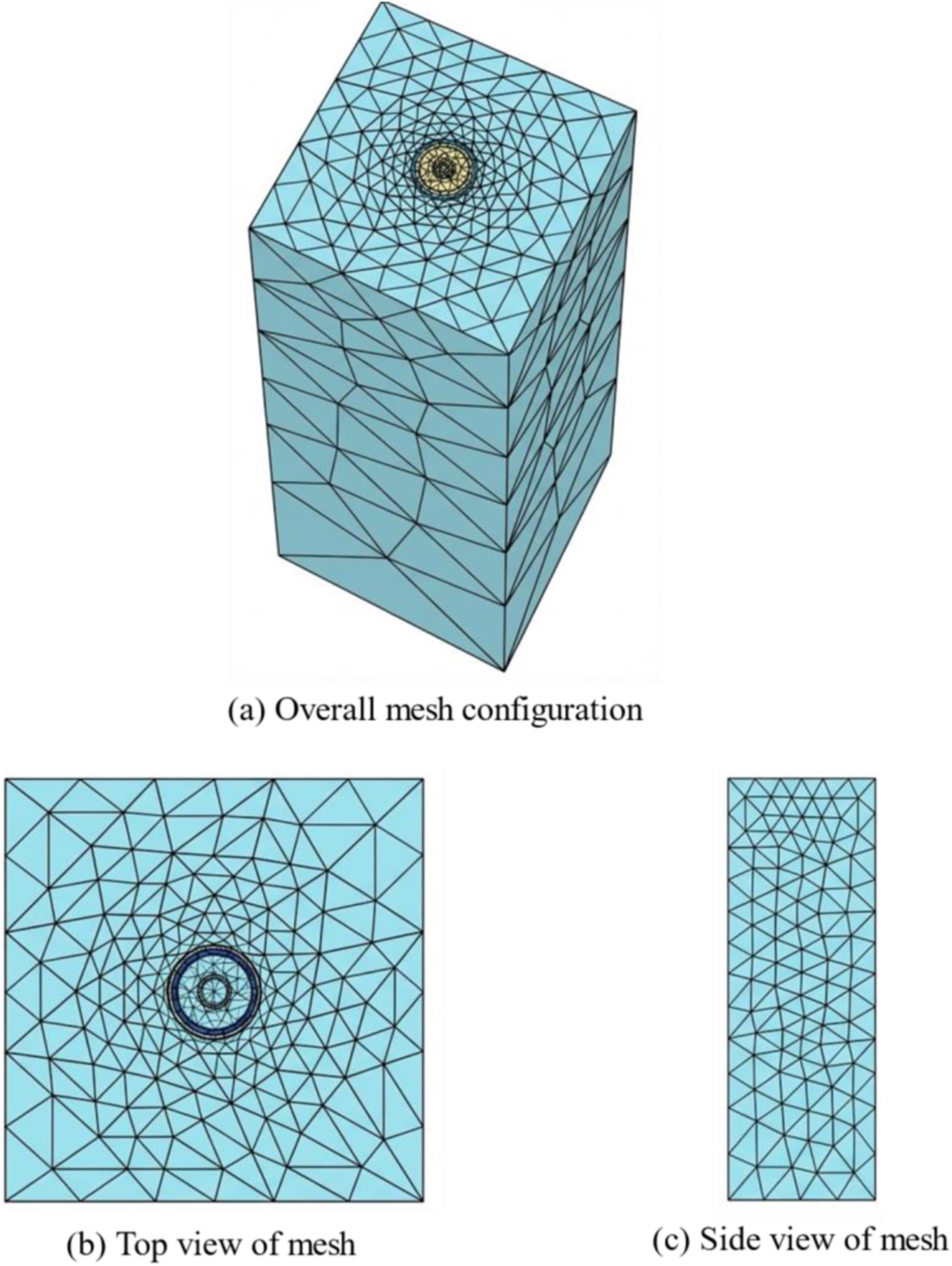
Three-dimensional finite element mesh: (a) overall configuration, (b) top view, (c) side view. Credit: Cleaner Engineering and Technology (2026). DOI: 10.1016/j.clet.2026.101244
Contemporary civil engineering practices highlight the need for safer, more reliable, uplift-resistant foundations for lifeline infrastructure and also seek solutions for environmental and social problems associated with surplus soil from construction projects. Using surplus construction soil, researchers have developed a winged composite pile system that can enhance uplift resistance. This approach supports cleaner and safer construction practices, helping projects achieve environmental goals without sacrificing structural integrity.
Management of surplus soil, often produced in large volumes at construction projects, represents a significant challenge in Japan. National statistics and recent incidents reveal that the utilization of surplus soil onsite lags far behind that of other construction byproducts. Improper disposal of surplus soil has resulted in slope failures, groundwater contamination and land subsidence in residential areas, underscoring soil waste as a real environmental concern rather than a simple logistical issue.