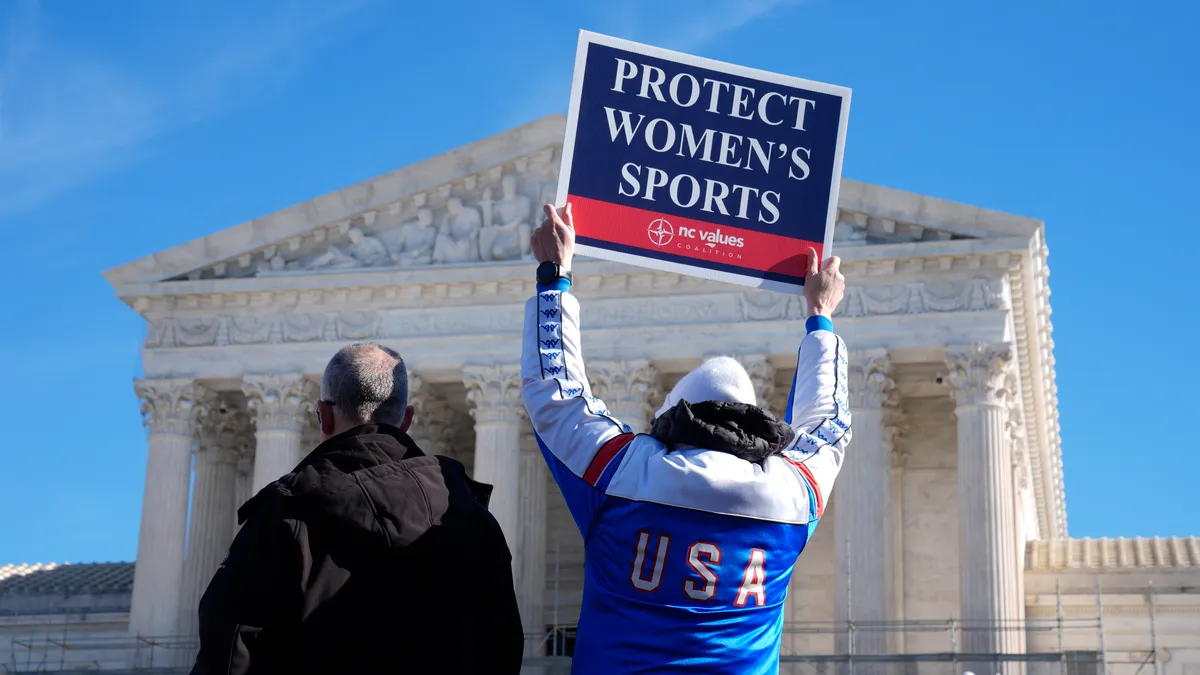
The U.S. Supreme Court’s recent holding that neither Title IX nor the Equal Protection Clause of the 14th Amendment forbids states from conditioning eligibility to participate in sports on sex identified at birth has spurred intrigue into whether the Court might be open to revisiting other applications of Title IX—namely the three-part test for compliance—though a close reading of the ruling casts doubt on that possibility.
The three-part test is used by the federal government and courts to assess if a school has provided equitable athletic participation opportunities for male and female students. A school can comply by meeting one of three criteria.
Those three are usually coined “substantial proportionality” (the percentage of men and women playing sports is roughly the same as the percentage of undergrad men and women), “history and continuing practice of expansion” (the school has expanded athletic opportunities for the underrepresented sex), and “fully and effectively accommodating interests” (the school is meeting the athletic interests of the underrepresented sex).
Although the three-part test is widely accepted by courts and has become integral to higher ed and college athletics compliance, it is not expressed in the Title IX federal statute as enacted through the Education Amendments of 1972. Nor was it addressed in the executive branch’s 1975 regulations that followed.