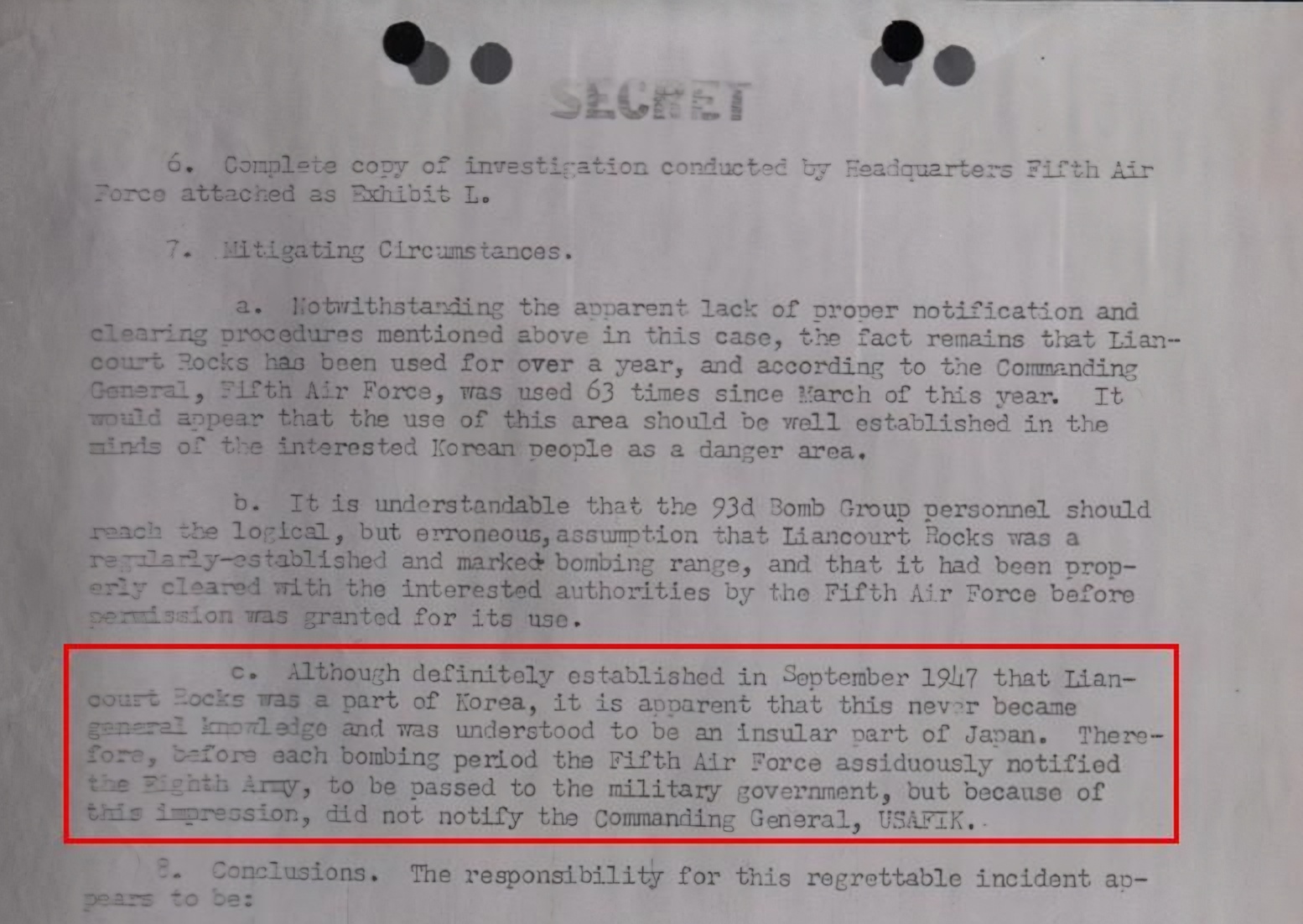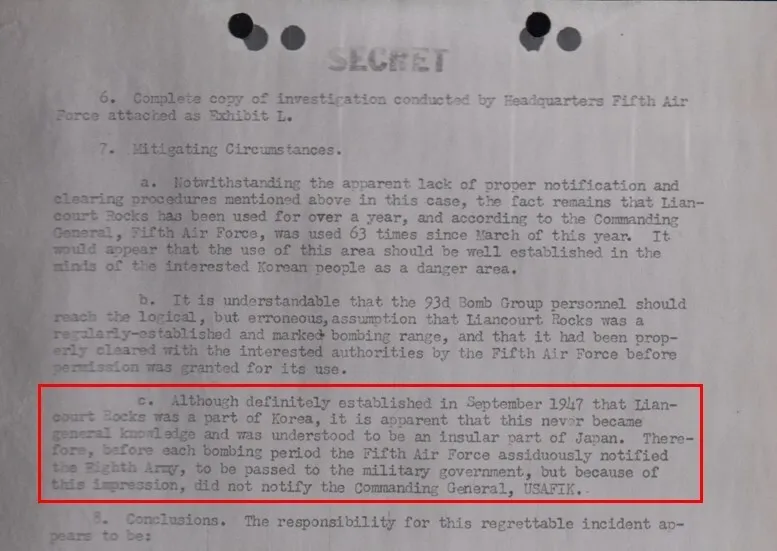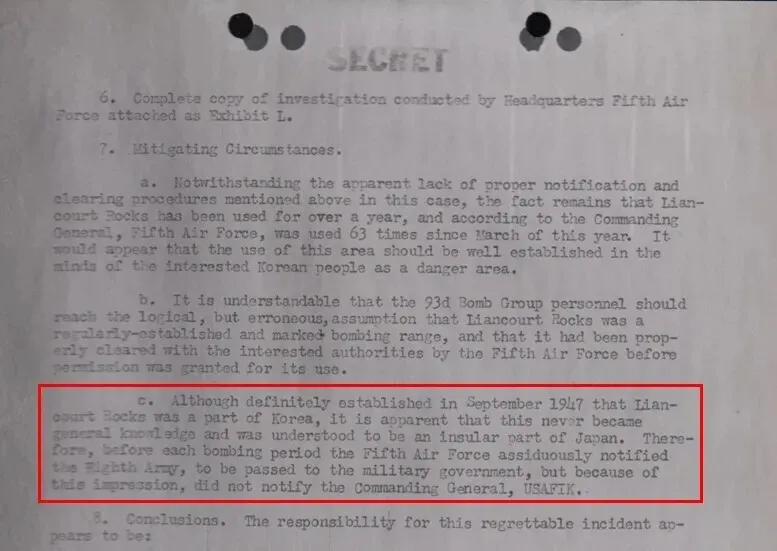
A portion of a report on an investigation by the US Far East Air Forces. (courtesy Northeast Asian History Foundation)
A previously classified US military document confirming the islets of Dokdo as Korean territory has been made public for the first time.The Northeast Asian History Foundation in Seoul on Tuesday said it received previously undisclosed records related to Dokdo kept by Washington. The US Far East Air Forces, which investigated the 1948 bombing of the islets, said in a classified document that it had been “definitely established in December 1947 that Liancourt Rocks was a part of Korea,” a clear American recognition of Dokdo as part of Korea immediately after liberation in 1945.The cited collection of materials consists of 222 pages of documents verified and collected from the US National Archives and Records Administration by Jeon Gab-seang, a research professor at the Institute for East Asian Studies at Sungkonghoe University in Seoul, who recently donated them to the foundation. Primarily studying the period before and after the 1950-53 Korean War, the scholar found the materials while examining 1,060 boxes of documents gathered by the US military between 1948 and 1952.The collection is considered to have high historical value as documents not only from American military authorities, but also those submitted by Korea on its sovereignty over Dokdo. “This collection of documents possesses high value because it contains overlapping investigations and reports from six units including the US Far East Command, Far East Air Forces and 1st Air Division that intersect about a single incident: the bombing of Dokdo,” Jeon said. The most notable document is a report of the bombing of the Liancourt Rocks prepared by the Far East Air Forces on June 24, 1948, which contains the passage confirming Korean sovereignty over Dokdo. Liancourt was the name of the French whaling ship that came across Dokdo in 1849, and the name “Liancourt Rocks” refers to Dokdo.This report is considered the final account of the investigation into the incident on June 8, 1948, in which 14 fishermen working around Dokdo were killed and many others injured by a US Air Force bombing drill. The report also mentioned a provision that the commander of the US Army Forces in Korea had to be notified 15 days in advance to use each bombing range for such exercises. The foundation said this could be interpreted as stipulating an obligation to notify relevant Korean authorities in advance given that Dokdo was considered Korean territory.“This material is key evidence that debunks Japan’s baseless claims,” said Hong Seong-geun, the head of the foundation’s Dokdo research office. “These historical records objectively prove that [William J.] Sebald’s 1949 proposal and the 1951 [Dean] Rusk Letter that claimed Dokdo as Japanese territory were merely the results of temporary distortions and misrepresentations.”Sebald was Washington’s chief political adviser in Japan during the post-World War II era. Rusk was an assistant US secretary of state who sent the letter to Yang Yu-chan, Korea’s first ambassador to the US, saying Dokdo was part of Japan.In addition, a 1946 document discovered along with the military report is also seen as highly significant. Sent by the governor of Ulleung Island to his counterpart in North Gyeongsang Province, this is considered the first official document to mention Dokdo’s situation after liberation.The document confirmed that Dokdo belongs to Ulleung Island (also known as Ulleungdo) and requested that the US Army Military Government in Korea negotiate to have Japan publicly declare this.By Cho Il-joon, senior staff writerPlease direct questions or comments to [english@hani.co.kr]