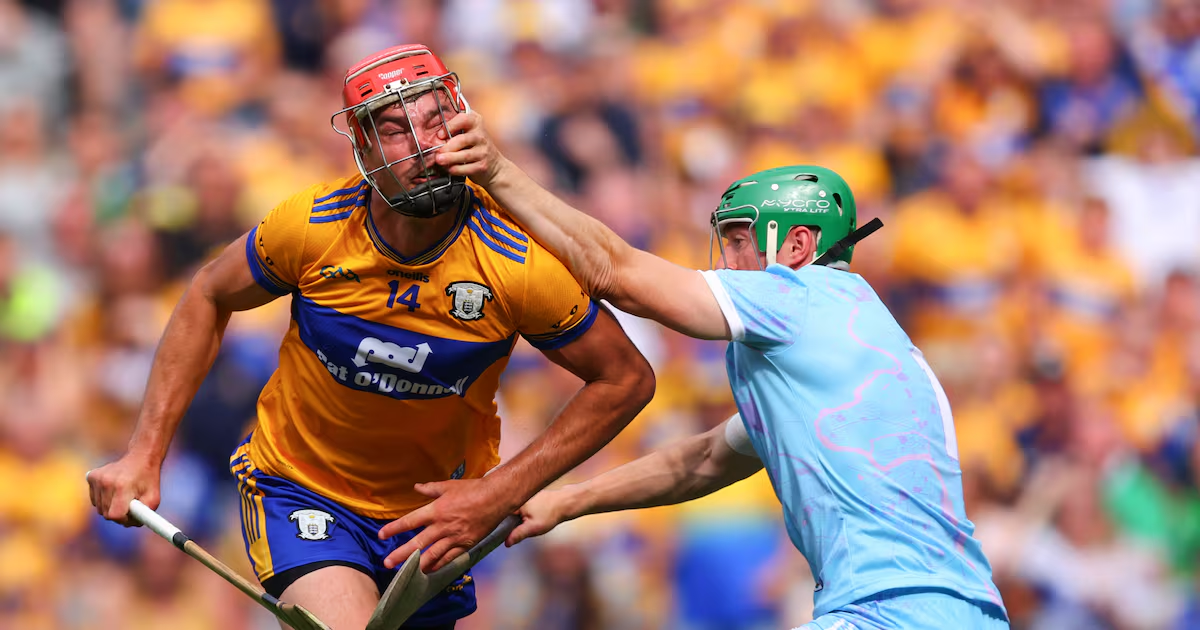
With a timeliness you sometimes get in the world of the GAA, the Limerick-Clare All-Ireland semi-final was five years to the weekend after the first denial of a goalscoring opportunity officially arose in a championship match.The reaction to James Owens’ award was so raucous that the concept lay undisturbed for ages. In fact, it was a bugbear for Clare that they appeared to be the only county to whom it was applied – as vocalised by manager Brian Lohan as recently as after this year’s Division 1B final.In 2021, Clare’s Aidan McCarthy was sinbinned for bringing down Tipperary’s Jake Morris. Controversy arose because the infraction took place some distance to the left of the square and opinions differed on whether it was a goalscoring opportunity. One aspect lost in the whole penalty decision controversy is what set up the scenario where Aidan McCarthy had to tackle Jake Morris? Morris lost possession after excellent work by McCarthy to track back and Morris used an excellent high hurl to get a block and turnover the ball pic.twitter.com/RyqheGhuAn— Sean Flynn (@SeanFlynn85) July 6, 2021
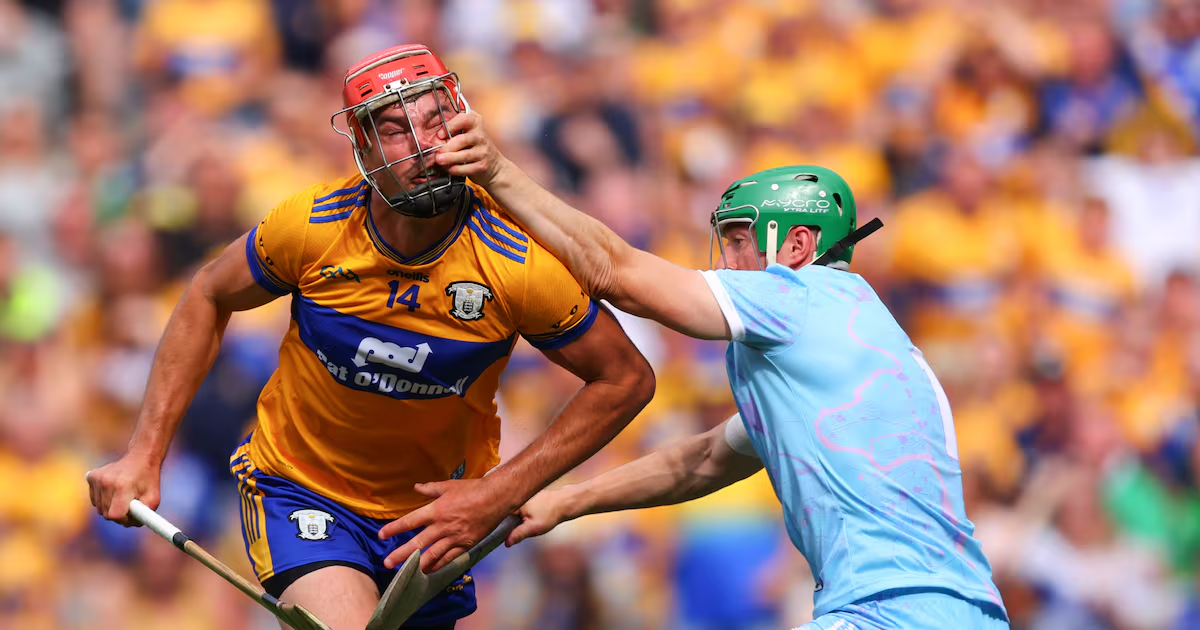
For those who agreed with the decision, it wasn’t as if Morris couldn’t have run in on goal had he not been upended. During his 10-minute exile from the field, Clare who had been leading at the time, were outscored 2-4 to 0-2. The idea had been introduced as a probationary measure at the 2021 annual congress. A year later, it was adopted permanently but with a few tweaks, including taking a deep breath and punishing the misbehaviour with a black instead of a yellow card – despite Hurling Man’s insistence that hurling did not share with football the problem of cynical play and therefore had no need of its fancy remedies.Of the substantive changes, one narrowed the area in which the opportunity might arise – bringing it in 25m from either sideline – so that the Morris case could not arise again.The other introduced in the Important Terms and Definitions index, an entry on “goalscoring opportunities”, which stipulates that the “attacking player fouled” must be “in possession” of the ball.It was widely accepted that on Sunday, when Limerick goalkeeper Nickie Quaid deliberately collided with Peter Duggan, the Clare forward was not in possession at the time. He had flicked the ball past Quaid and was running on to it when fouled.This was crucial because it meant the black card rule was not triggered. Had it been, Quaid would have been sinbinned and Limerick reduced to 14 for more or less the remainder of the match. There was also the argument that the Limerick ‘keeper should have been red-carded for making head contact with Duggan, an admittedly glancing touch off the helmet, which was missed or overlooked by the referee, but which looked obvious in Tom O’Hanlon’s vivid photograph of the incident.Anyway, a penalty was given, which Tony Kelly converted.Clare appeared to be agitating for a goal to be awarded, as the ball had gone into the net, off Limerick’s Barry Nash. Referee Thomas Walsh awarded the penalty but didn’t invoke the black card sanction because Duggan hadn’t been in possession.The purpose of the rule when introduced was to deter the rising incidence of cynical play and fouling calculated to prevent goal chances materialising. It appears, though, that the worthwhile intention to discourage such activity has been effectively sabotaged by the perceived need to define everything connected with the infraction.The text obscured by the footnote.During the league, a broader interpretation appeared to be in force and earlier in the championship, Waterford’s Mark Fitzgerald was black-carded against Cork in a decision that was criticised at the time because the player fouled, Brian Hayes, had not been in control of the ball.It is not clear what the purpose of the definition is. Maybe it was designed to avoid an overextension of the rule, such as in the words of one senior official at the time five years ago: “Goal scoring opportunity doesn’t necessarily lie exclusively with the guy who is in possession. It’s not as straightforward as people might think. For instance, a player running towards goal is rugby tackled and there’s a guy inside unmarked.”Clare's Peter Duggan is fouled by Nickie Quaid of Limerick in the hurling championship semi-final. Photograph: Tom O’Hanlon/Inpho Even the attempt to define everything has left ambiguity. In the section on goalscoring opportunity, the following is stated.“Possession shall include a player being in control of the ball as specified in any one or more Rule 1-The Play subsections 1.3,1.4,1.7 (Hurling)”These subsections refer to soloing, catching, carrying within the rules and hand-passing.Surely, though, the operative phrase is “shall include,” clearly suggesting the possibility of other ways of being in possession.Hurling is such a fast, fluid game that it is hard to argue that a player like Duggan, flicking the ball forward and past an opponent with a view to gathering or striking it, is not “in possession”. He would have been had he not been poleaxed.Obviously, this is not how referees have been encouraged to apply the rule even if, as is sometimes the case in Gaelic games, the rule looks capable of bearing an alternative interpretation.Better to change it so, but to what?The tweaked advantage rule has worked well in football. It allows a referee to play on for an unlimited period until he believes that there is no further point and instead, goes back to the free. That type of discretion has its merits.It would be more satisfactory if match officials were to keep uppermost in their minds the need to penalise the unfair prevention of a goalscoring opportunity. In that context, a referee should be empowered to award the penalty and sinbin the offending player when they believe that such a prevention has taken place – and without the need to tick off well-meaning but counterproductive “definitions”.email: sean.moran@irishtimes.com