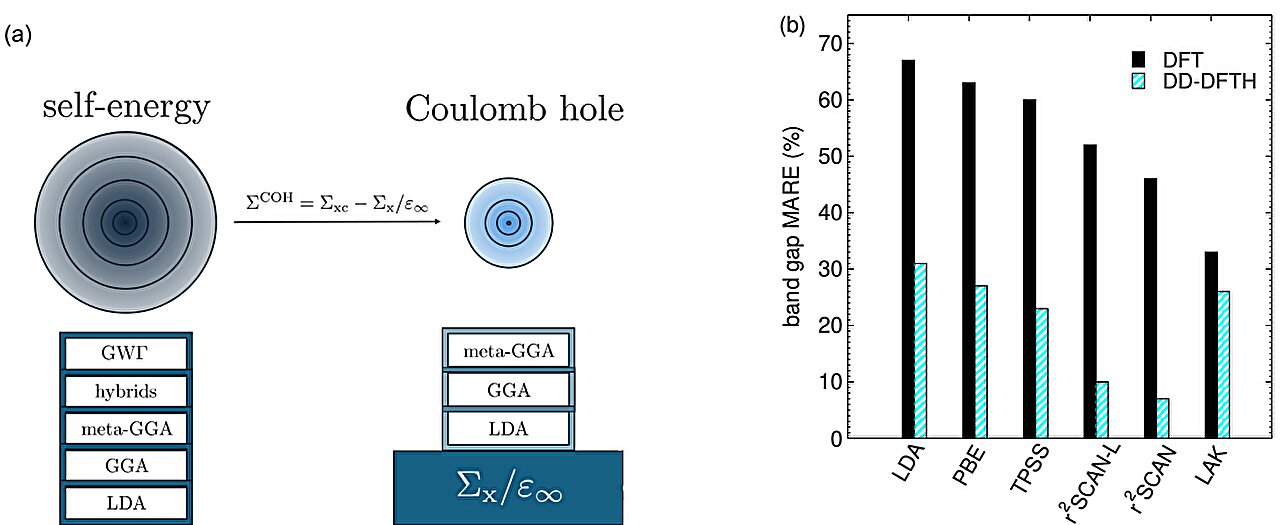
Improving DDH with a meta-GGA remainder functional. Credit: Nature Communications (2026). DOI: 10.1038/s41467-026-75146-x
Semiconductors are central to modern technology. They are used in computer chips, solar cells, sensors, LEDs and communication devices. Before researchers make new semiconductor materials in the lab, they often test them first using quantum mechanical simulations. One of the main tools for this work is density functional theory, or DFT, a computer-modeling method that skips tracking every single electron and instead uses their overall cloud density to quickly calculate a material's atomic structure and energy.
DFT gives researchers a practical way to calculate how electrons behave in materials and is widely used because it balances accuracy with computational cost. But it has a long-standing weakness: It generally underestimates the material's band gap.
The band gap is the energy difference that controls how easily electrons move through a material. It helps determine whether a material acts as a metal, a semiconductor or an insulator. It also shapes how a material absorbs light. This matters for technologies such as solar cells, photodetectors and other electronic devices.