AI and ML
But doing so doesn't necessarily meet business needs
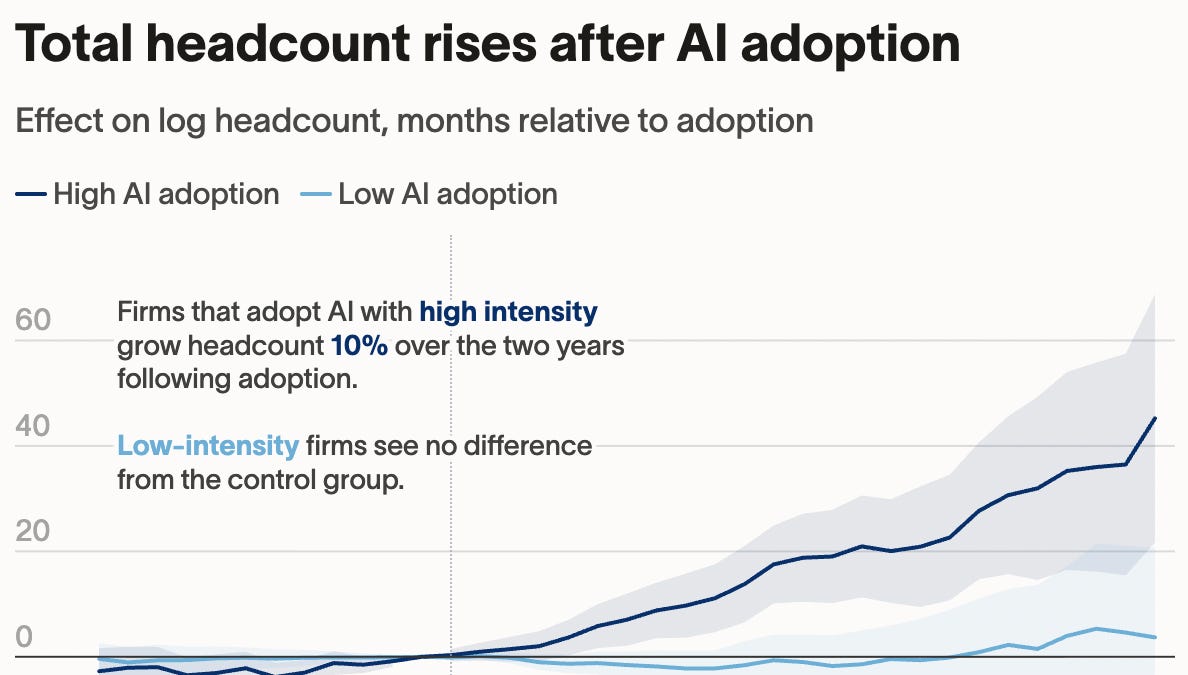
AI leads to job losses, or so the conventional wisdom goes. But a new survey of over 21,000 US firms implies the exact opposite: When companies invest in AI, they add positions, but not immediately.According to Ramp, an AI finance biz, and Revelio Labs, an HR biz, companies making a significant financial commitment to AI add jobs at a higher rate than low-intensity adopters. But job gains don't appear until six to 12 months later.One might be tempted to interpret this as the amount of time it takes to assess the resources required to clean up after AI mistakes, but the Ramp study argues that the lag reflects the time required for best practices to filter through organizations.
"Firms that adopt AI grow headcount 10.2 percent over the two years following adoption, but these gains are entirely driven by high-intensity adopters," Ramp's report on the subject claims. "Low-intensity adopters see no statistically significant change."
High-intensity adopter here means average per-employee AI spending of about $33.67 per month in the first three months of adoption (and rising over time), compared to low-intensity adopters spending just $2.78 per employee.That's far less than the roughly $86,000 in severance and restructuring charges Oracle incurred for each of the 21,000 employees laid off last year as a wage-shedding counterbalance to its AI capex costs.In a social media post, Ara Kharazian, lead economist at Ramp, cautioned that some skepticism is warranted because companies adopting AI are already faster growing. But he insists that the analysis accounts for that by comparing early adopters against firms that haven't adopted yet, where the growth trajectory is assumed to be more similar."Entry-level headcount grows even faster, 12 percent over two years," said Kharazian. "This is our first evidence that high-AI-adopting firms are hiring different kinds of employees. "We believe they are selecting for a new set of skills, specifically, people who know how to use AI and use it well. Entry-level workers, especially recent graduates and college students, are a natural place to look."That may be the case at the companies surveyed, but other sources suggest that the trend hasn't really improved the lot of those entering the job market. The unemployment rate for recent college graduates in March 2026 was 5.6 percent, compared to 4.3 percent for all workers, according to the Federal Reserve Bank of New York.