Show Caption
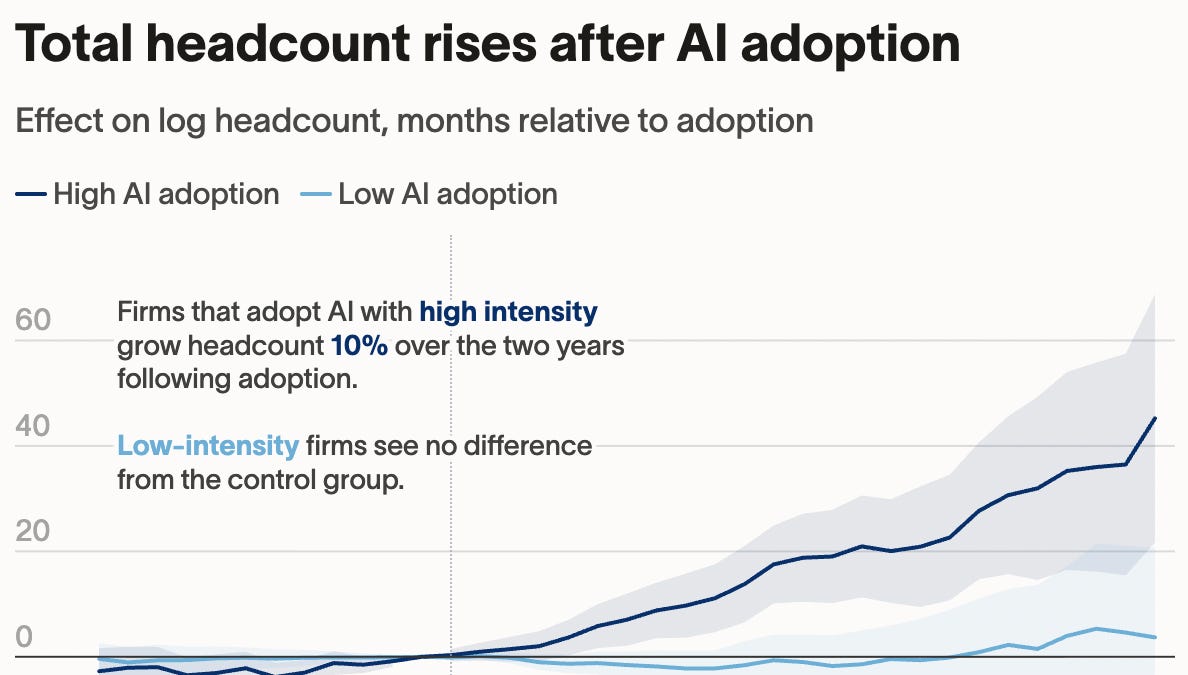
Companies that heavily invested in artificial intelligence hired more workers than those that invested little, new research suggests, challenging the narrative that large-scale adoption of the technology would lead to job losses.At 53%, most Americans worry AI could cost them or someone in their household a job, according to a Reuters/Ipsos poll released in June. To find out if they’re right to be concerned, researchers from the financial technology company Ramp and the workforce intelligence company Revelio Labs compared AI spending and employee data at 21,559 U.S. firms.They found that over a two-year period, "low-intensity" adopters – or those who spent an average of $2.78 per employee on AI – saw little change in their head counts. Meanwhile, "high-intensity" adopters who spent an average of $33.67 per employee grew their head counts by 10.2%.Over the same period, entry-level head count at the high-intensity firms rose 12%, contradicting predictions and fears that young or inexperienced workers would be most at risk of losing their jobs to AI.The scopeThe research sample is not nationally representative as it focuses on tech-forward companies and white-collar workers. The research does not include, for example, drivers who may be put out of work by self-driving cars, or roles lost due to manufacturing automation, Ramp Economics Lab’s lead economist Ara Kharazian said.However, Kharazian said their findings are important because while previous research has focused on AI-exposed industries, it hasn’t been able to compare AI spending with staffing levels at the same firms.Still, the researchers haven’t ruled out the possibility that head counts may change after the two-year period they tracked. They plan to update their results regularly as more data becomes available.What it means for workersAmericans’ fears about AI haven’t come out of nowhere. Several major companies including Amazon, Meta and Salesforce have announced layoffs tied to AI adoption. However, an October Yale Budget Lab study found the broader labor market had not experienced "a discernible disruption" since ChatGPT’s release, noting that widespread technological impacts are typically felt over decades, rather than months or years.Kharazian said AI’s unknown long-run impact has put job seekers in a confusing position today."If you’re an entry-level employee in the job market, or you’re just graduating college, it’s really hard to know what should I do," Kharazian said. "Join the firm that uses AI, and then worry about getting laid off because that’s the narrative out there? Or do I join the firm that doesn’t use it at all, and then risk not learning this new technology that everyone’s telling me to use?"After crunching the numbers himself, he said he would tell that job seeker to join the company going all in on AI."The one thing we know for certain is that jobs are changing," ZipRecruiter economist Nicole Bachaud said, adding flexible and adaptable fast learners are in demand. "A clerical or administrative clerk maybe needs to have more technical literacy today than they did five years ago, but a software developer maybe needs to have more interpersonal skills than they did five years ago."So, is AI taking people's jobs?One research paper can’t definitively answer this question, but economists seem to feel more optimistic than American workers about AI’s impact on jobs.In January, a World Economic Forum report estimated that new technology, alongside other economic and demographic trends, will create 170 million roles and displace 92 million others by 2030.Kory Kantenga, head of economics for the Americas at LinkedIn, said companies that heavily invest in AI increasing head counts makes sense for a few reasons.First, if a company has more to spend on new technology, it likely also has more money to spend on labor. Second, if business is booming at AI startup companies, they naturally need to hire human resources, marketing and sales staff as they grow. Third, if AI adoption goes according to plan and creates new growth opportunities at preexisting companies, they will need to hire more workers to pursue them.Kantenga gave an example of a company using AI to research and identify potential clients. Once the AI agent spits out a list of new prospects, "you need someone working in business development who can call them and actually make a deal," he said.Kantenga added that concerns about workforce re-skilling and development should still be taken seriously, given how fast AI is changing workflows."That said, do I think that there’s a prospect that we’re staring down the barrel of 50% unemployment in two years?" he said. "No. I do not."What it means for businessesThe widespread adoption of AI has come with big promises, particularly around productivity. Bachaud says those promises made without hard data to back them up give her reason to pause."A lot of these businesses have yet to actually be able to measure what the impact is and how AI is actually leading to this massive productivity gain that people are expecting," Bachaud said. "We have this excitement. We have the capabilities. What is it actually doing, and how are we measuring that to really be able to determine: Is all of this worth it?"Kharazian said business owners shouldn’t be surprised if they aren’t seeing positive results just yet."The vast majority of firms that use AI, according to our work, don’t see the results today," Kharazian said. "What we found is that you only see the results when you use AI with some high intensity. There’s probably some threshold requirement that you have to use AI a certain amount, and you have to use AI for a sustained period before you start to see the results."He added that successful AI deployment likely requires organizational change and employee-level learning to understand how to use it effectively."But if you’ve tried it and you haven’t found those gains and you’re wondering what you’re doing wrong, I’d say that is quantitatively backed," Kharazian said. "But there is still growth to be found."Reach Rachel Barber at rbarber@usatoday.com, follow her on X @rachelbarber_, and subscribe to her newsletter "Making More of Your Money" here.