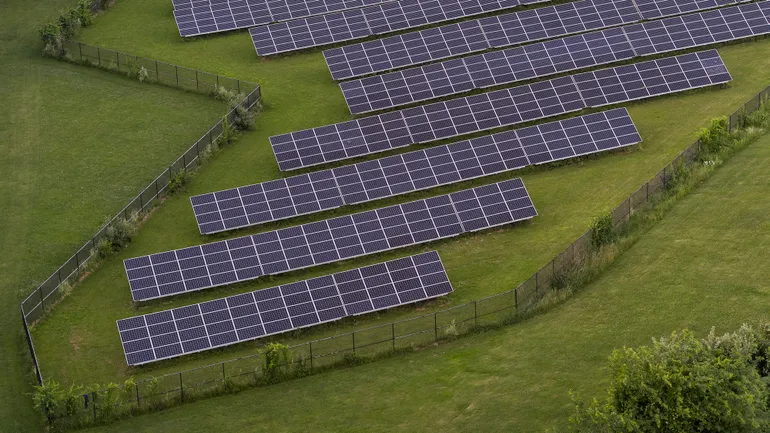
“That farmland is being permanently lost,” said Tom Bullock, executive director for the Citizens Utility Board of Ohio, a consumer advocacy group. In contrast, building solar on leased land “doesn’t destroy the ability to make it arable land once again.”
Calls to protect farmland from solar also tend not to acknowledge the fact that a significant amount of active farmland is, in fact, being used to produce energy already — just in a far less efficient manner.
Ohio farmers harvested corn from more than 3.1 million acres last year, Department of Agriculture numbers show. About 40% of that is used to make ethanol, most of which is blended into gasoline. Corn ethanol biofuels require about 30 times the land per unit of energy as solar, according to a 2025 study by Cornell University researchers.
The increasing pushback against solar on farmland comes as Ohio and other states face growing electricity demands that are pushing energy bills ever higher.
“With energy demand rising at a historically fast rate, Ohio needs every electron it can get, as soon as possible,” said Andrew Linhares, Midwest state affairs director for SEIA, noting that solar and storage accounted for 91% of new capacity added in the U.S. for the first three months this year.