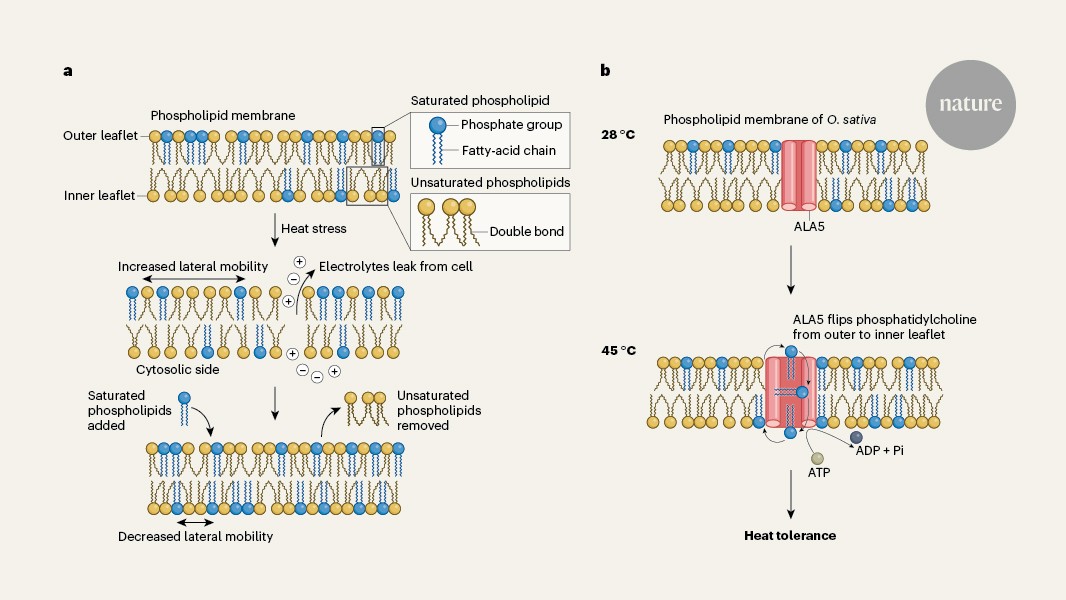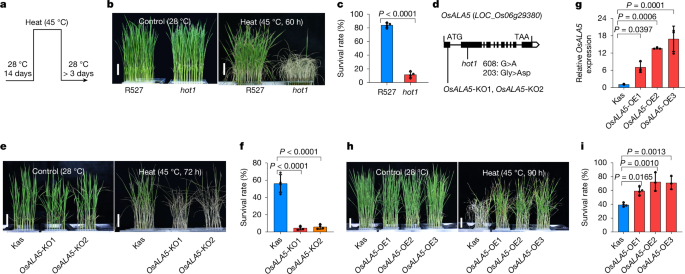
MainFrequent episodes of extreme high temperatures increasingly threaten agricultural productivity and global food security3,4. Heat stress from extreme high temperatures triggers rapid cellular disturbances5,6, among which plasma membrane hyperfluidization is particularly damaging1,2. This hyperfluidization disrupts membrane integrity and promotes ion leakage and can precipitate cell death1.To mitigate heat-induced damage, organisms have evolved strategies to modulate the saturation degree of membrane phospholipids, thereby maintaining membrane fluidity within a range that is conducive to biological activity2,7. Saturated fatty acids—owing to their ability to pack tightly—decrease membrane fluidity in phospholipid bilayers, a phenomenon observed in bacteria, archaea and eukaryotes2,7,8,9. Several known heat tolerance mechanisms in eukaryotes have linked the regulation of membrane fluidity to the extent of lipid desaturation7,8. A study of Caenorhabditis elegans revealed a heat stress-induced regulatory pathway that drives expression of the lipid desaturase gene fat-7, ultimately promoting lipid saturation and reducing membrane fluidity8. In the model plant A. thaliana, heat stress destabilizes FAD8, a chloroplast-localized α-linolenic acid desaturase, leading to reduced synthesis of polyunsaturated fatty acids and decreased membrane fluidity7.P4-ATPases are transmembrane proteins that transport specific phospholipids from the exoplasmic to the cytoplasmic leaflet of biological membranes to generate and maintain lipid asymmetry in eukaryotic membranes10. Structurally, P4-ATPases typically heterodimerize with a β-subunit from the CDC50 family (also referred to as ALA-interacting subunit (ALIS) in plants) for protein folding and formation of a functionally active P4-ATPase complex10. P4-ATPases have been implicated in plant high-temperature responses11. In A. thaliana, seedlings carrying a null mutation in the AMINOPHOSPHOLIPID ATPASE6 (ALA6) were sensitive to high temperature12, and studies of reproductive development reported that ala6/ala7 double mutants exhibited decreased seed set under heat stress13 and that null mutants of ALA3 (localized to the trans-Golgi network) showed temperature-sensitive growth and impaired pollen fitness under hot day–cold night diurnal conditions14.Here we show that the P4-ATPase OsALA5, together with its β-subunit OsALIS2, functions in the plasma membrane to deliver a minute-timescale, heat-dependent shift in transport activity that selectively enriches saturated phosphatidylcholines (PCs) in the cytoplasmic plasma membrane leaflet, thereby rapidly stabilizing plasma membrane fluidity and limiting membrane damage. We also demonstrate that this heat-responsive function is conserved beyond rice and identify a rare haplotype of OsALA5 for heat-tolerant breeding.
Heat-triggered phospholipid flipping stabilizes plasma membrane fluidity - Nature
In rice, the P4-ATPase complex OsALA5–OsALIS2 rapidly stabilizes membrane fluidity in response to high temperature by flipping saturated phosphatidylcholines to the cytosolic leaflet of the plasma membrane.
20,646 words~94 min read