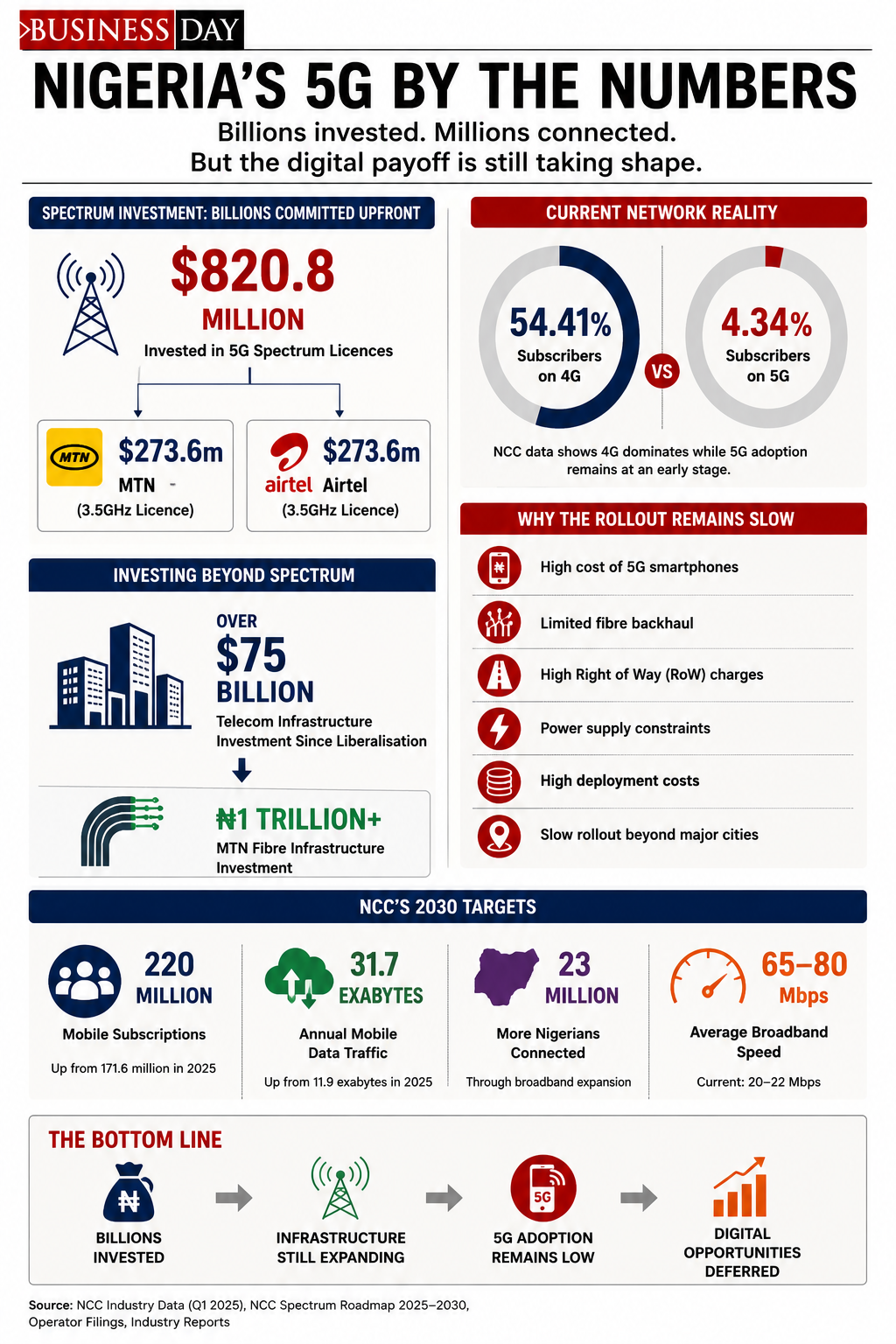
Nearly five years after Nigeria conducted one of Africa’s biggest 5G spectrum auctions, the country’s next-generation mobile revolution remains concentrated in a handful of cities, leaving billions of dollars in investments waiting for returns and delaying the wider economic gains government hoped would come from faster broadband.
The challenge is no longer simply about allocating radio spectrum.
Instead, industry executives, regulators and analysts say the bigger obstacles lie beneath the surface: inadequate fibre infrastructure, high deployment costs, expensive 5G smartphones, inconsistent Right of Way (RoW) policies across states, unreliable electricity and the enormous capital required to build nationwide networks.
The result is that while government has generated significant revenue from spectrum sales and operators have committed billions of naira to network expansion, the broader digital economy dividend expected from 5G remains largely unrealised.
For a country targeting a $1 trillion economy and positioning technology as a major growth engine, the delay is becoming an economic issue as much as a telecommunications challenge.