Let us begin with a number that should end any argument about whether Nigeria’s telecommunications regulatory environment is performing at the level the economy requires.
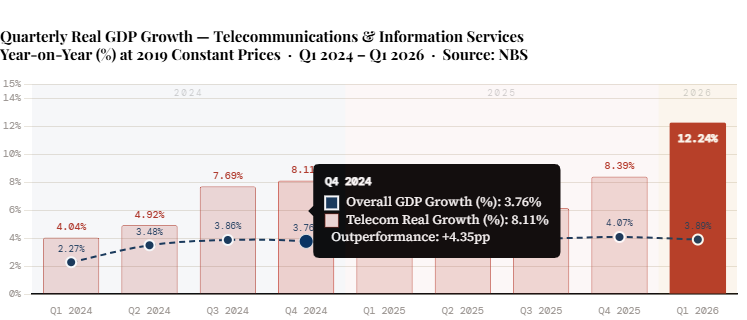
In Q1 2026, Nigerians spent N3.33tn on internet data. The telecoms sector contributed 9.19 per cent of Nigeria’s real GDP — its second-highest quarterly contribution in two years. In full-year 2025, the sector contributed N18.5tn to the economy, growing at 26.34 per cent year-on-year in Q4 alone. Telecommunications is now the fourth-largest contributor to Nigeria’s real GDP, behind only crop production, trade, and real estate.
A sector of this size and growth rate deserves a regulatory architecture built for what it has become. What it has instead is a framework built for what it was in 2000 — a market of basic voice calls and early-stage internet access — updated in patches, administered through instruments that were never designed for a digital economy, and defended by a regulator that has spent the past five years explaining why it missed its own targets rather than restructuring the framework that produced those misses.
The NCC’s proposed National Telecommunications Policy 2026, currently in public consultation, is a genuine attempt to address this. The regulator deserves credit for initiating the review. But a review that does not confront the structural contradictions in the existing framework will produce a document that is sophisticated in language and inadequate in outcome. Nigeria cannot afford another cycle of that.