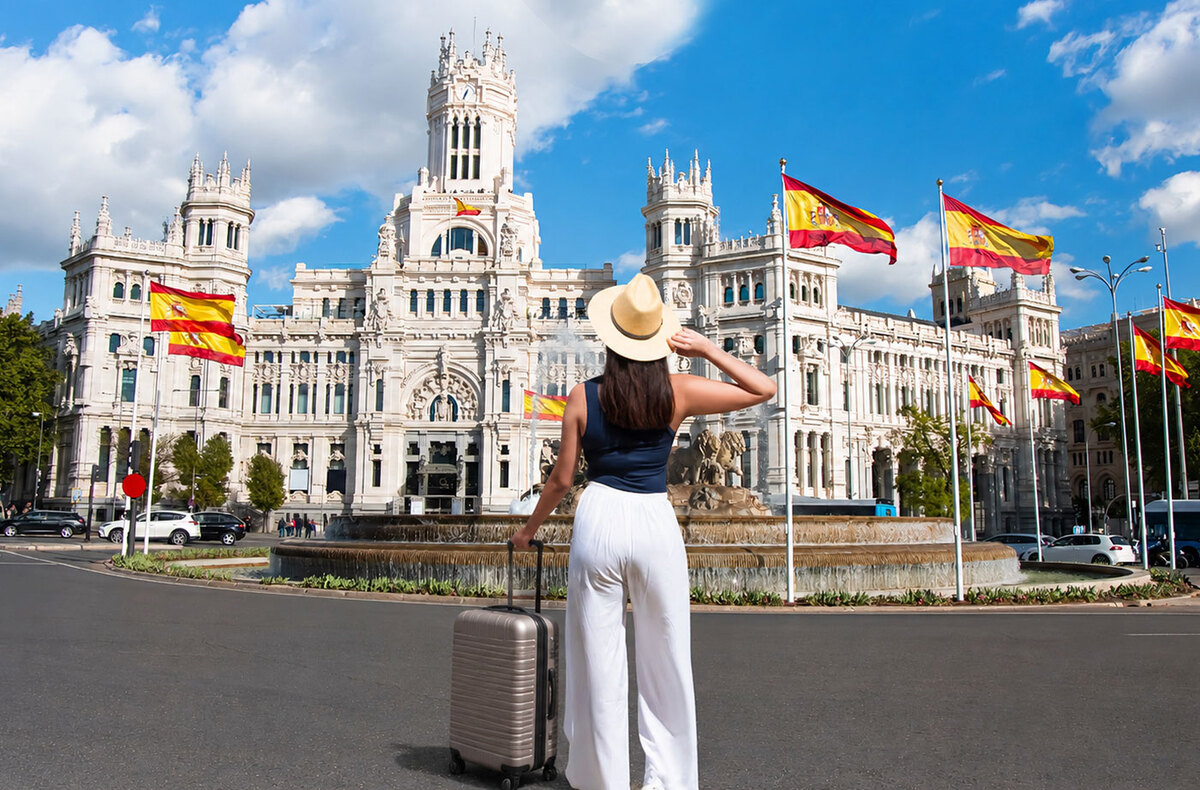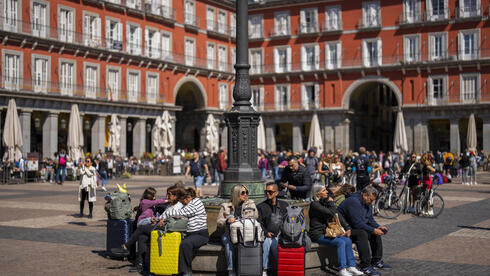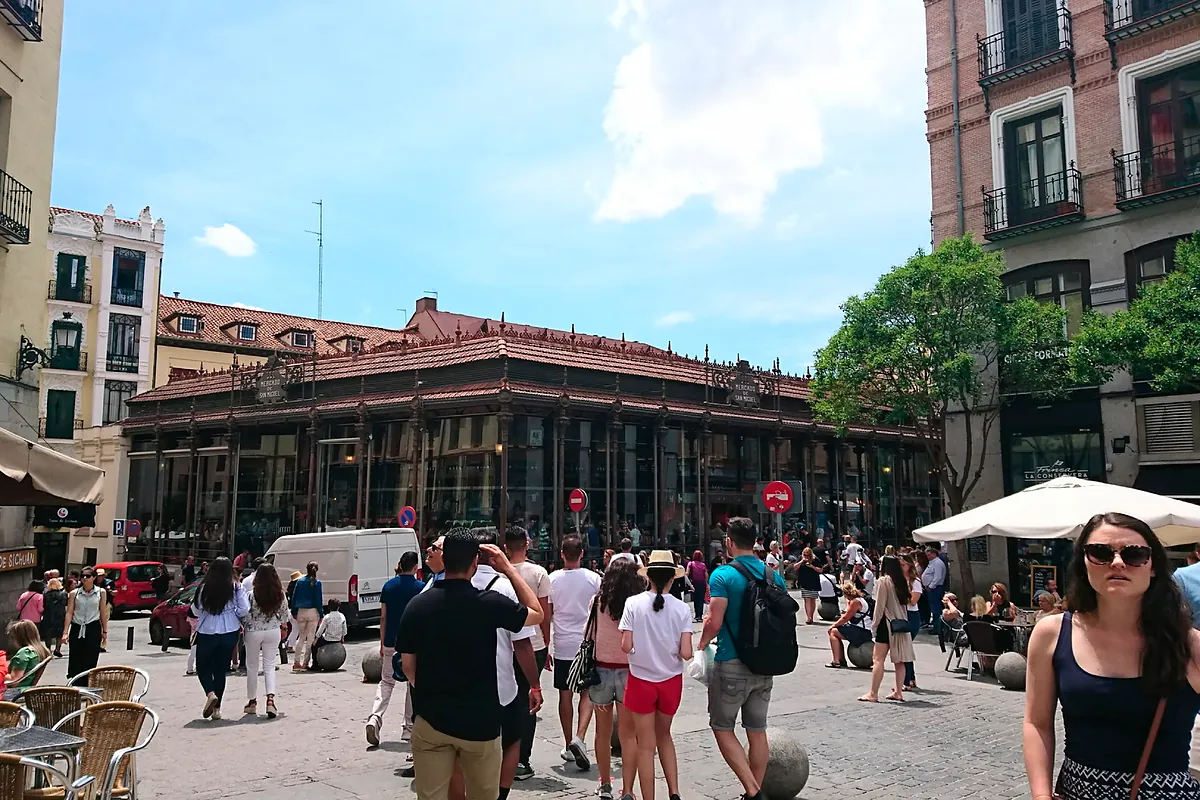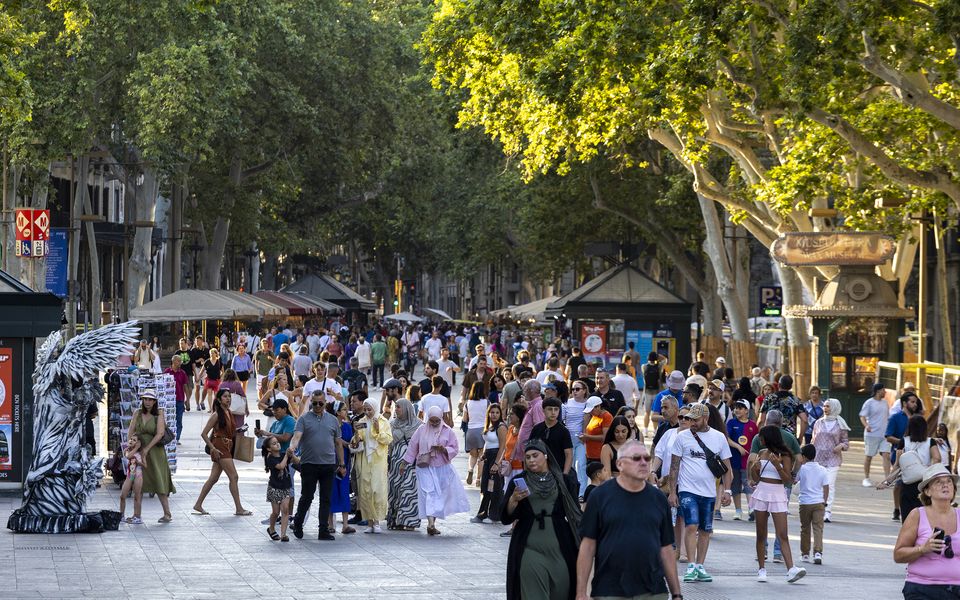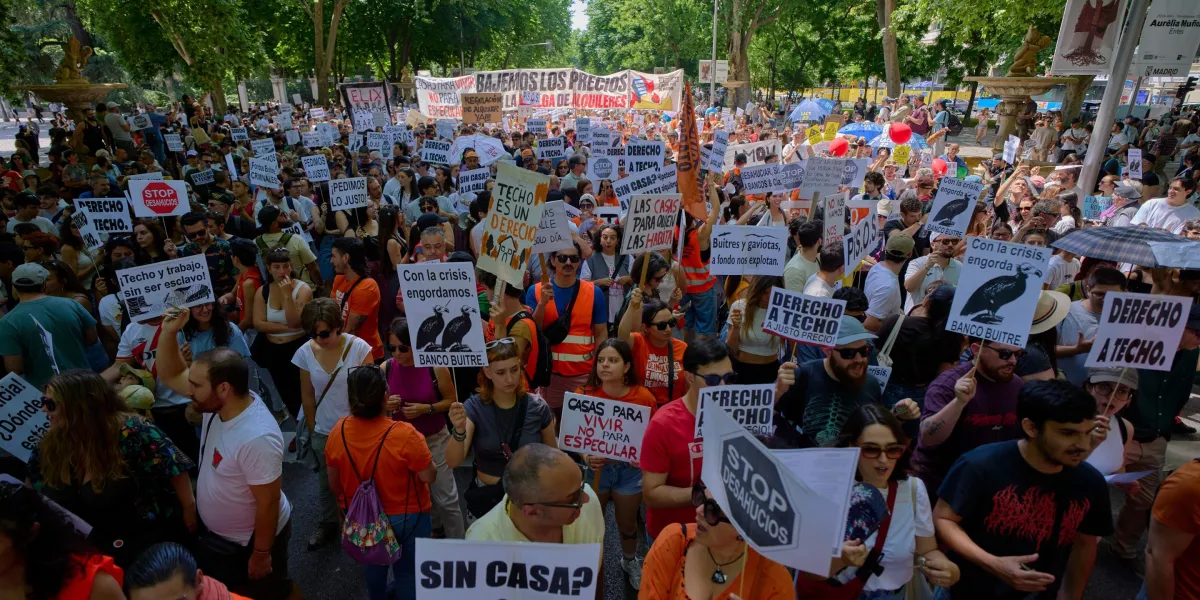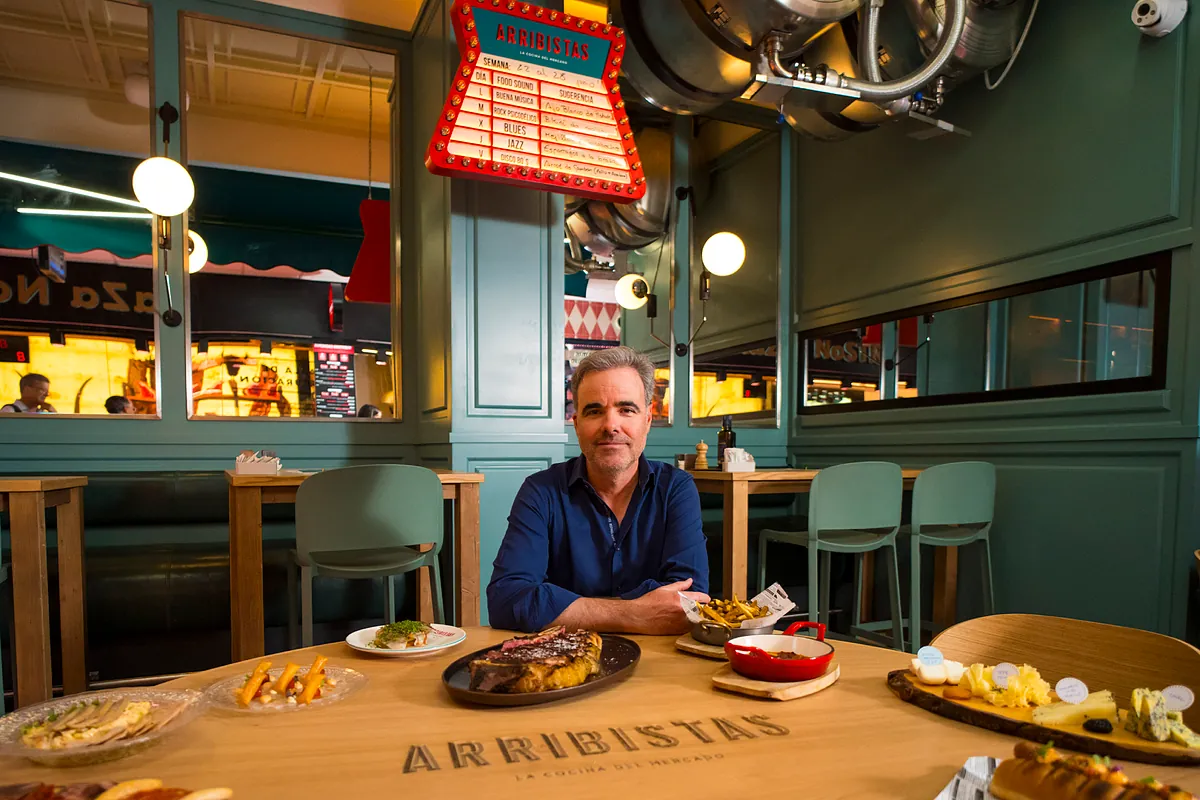
Under the wrought iron rafters of Madrid’s San Miguel market, the feasting is accelerating. Long gone are the locals who used to do their grocery shopping at the market, buying whole fish and ruby-red slabs of meat from stallholders they had known for years. Instead, on a recent Friday night, throngs of tourists are clinking glasses of ice-cold beer and gorging on salmon tartare tacos and chorizo hot dogs.As a gourmet food hub, the market has become a must-see for many visitors to Madrid, one of Europe’s buzziest capitals. Since the Covid-19 pandemic, the city has become a magnet for tourists, investors, digital nomads and wealthy plutocrats in search of a bolt-hole. The San Miguel market is just one beneficiary, a money-spinner ultimately owned by the Brenninkmeijer family, the Dutch founders of the C&A clothing chain.But not everyone is happy. On the narrow streets outside, Sonia de Gregorio dodges honking tuk-tuk drivers and laments a mother’s struggle to navigate her pushchair through the crowds. De Gregorio, a 57-year-old architecture professor who has spent her whole life in Madrid’s historic centre, says: “Sorry, but I feel rather uncomfortable with the atmosphere here. The tuk-tuks are whizzing past half a metre away. There are people touting things to tourists. And the smell.” Heavy in the air hangs the aroma of fried chicken.Neighbours who used to shop at the market now have to walk 20 minutes to find fresh fish, de Gregorio says. “You’ll tell me that I’m a nostalgic and that I don’t understand the spirit of the times. But for me, it’s very painful. The fact that it’s no longer a place for the locals.”Water misters cool customers in the San Miguel market during high temperatures in Madrid, Spain. Photograph: Andrey Rudakov/Bloomberg via Getty Images Such are the growing pains of a superstar city. Wealthy Latin Americans were already an established presence here. Now affluent US citizens are enjoying Madrid’s stucco facades, piercing sunlight and art museums too. The city is more cosmopolitan than ever. But the change is stoking pockets of discontent. Madrid is simultaneously proud of its newfound popularity and afflicted by angst.Björn Beam, a former CIA officer who is now head of tech research at Arcano Partners, a Madrid investment bank, says the city felt distinctly “more Spanish” when he moved there in 2018. “The amount of English and other languages I hear on the street now has changed dramatically,” he says. “Madrid is having a little bit of an identity crisis about that transformation.” Vox, a rightwing populist party rising in the national polls, complains that Madrid’s traditional essence is being erased.The biggest fear is “Barcelona-isation”. Earlier this century Madrid’s great Mediterranean rival was chasing growth at all costs. But the influx of foreign people and capital turned sour, leaving its historic centre both trashier and more expensive. There was a backlash from locals who complained about their home becoming an amusement park. Only now is Barcelona recovering.Mateu Hernández, director-general of Turisme de Barcelona, an agency promoting the city, says: “Madrid would do well to look at the Barcelona of 10 or 15 years ago, when a disconnect was beginning to emerge between the growth of tourism and public sentiment. What happened in Barcelona is likely to happen in Madrid — or is happening already.”Tourists pull their suitcases past the Royal Palace in Madrid. Photograph: Oscar Del Pozo/AFP/ Getty Images Jeff Bezos’s stag With about seven million people living in the wider capital region, Madrid is the EU’s second-biggest metropolitan area after Paris. But its size has not been correlated with connectedness. The French capital, London and New York have long been the epitome of “global cities”. The documentary maker Ric Burns described New York as “an experiment to see whether all the peoples of the world could live together in a single place”. But Madrid, landlocked at the centre of a vast peninsula, remained for centuries a creature of the arid Castilian plateau, caricatured as a city of bureaucrats, aristocrats, military men and clerics.Fernando Vilches, a retired Spanish language professor, notes that the city was to a large extent shut off from the world for some 40 years due to Spain’s 1936-39 civil war and the Franco dictatorship. “We were very inward-looking, engaged in navel-gazing,” he says.EU accession in 1986 brought a huge injection of European funds. Barcelona’s coming-out party was the 1992 Olympics. People moved to Madrid from poorer parts of Spain and the 1990s privatisations of big businesses based in the capital — Telefónica, Repsol and later the airline Iberia — added a new economic dynamism. But because their international presence was mostly in Latin America, the corporate ties did not change the face of the city. The same went for immigration: because most new arrivals were Spanish-speaking Catholics from former colonies, they integrated reasonably smoothly. Madrid was growing but retained an air of provincialism well into this century.Now the vestiges of isolation have been blown away. Last year, the Madrid region received a record 9.1 million international tourists, marking an increase of 60 per cent since 2016. One was Jeff Bezos, Amazon’s billionaire founder, who chose the city for his stag do.The population of the Madrid region — including scattered towns outside the capital — has increased by more than 100,000 people per year since 2023, as immigrants take advantage of prime minister Pedro Sánchez’s open-door policy. Many are still low-income Colombians, Venezuelans and Peruvians. But they include 9,700 people on “digital nomad” visas, which were introduced in 2023 and have lured high earners from the US tech sector.Foreign investment is ratcheting up too, in part because Spain is one of Europe’s fastest-growing economies. In the past 12 months in the finance sector alone Vanguard, State Street, Monzo, N26 and Octopus Investments have announced new offices in Madrid. More than 50 foreign feature films, TV series and advertisements were filmed in the city last year, according to the Madrid Film Office. And international restaurants are multiplying. Dalia Nahas, who has opened three premium Lebanese eateries under the Mune brand since 2020, says: “Madrid is still cheaper than Paris and London, and still with less competition.”Other great cities plugged into globalisation’s flows of capital and people in earlier eras. Madrid’s exceptionalism is that it is doing so in the age of Instagram-led tourism, remote working and a widening US-Europe wealth gap, not to mention self-described US “refugees” seeking respite from president Donald Trump. Those factors are also the root of its incipient tensions. “For the families that have been in Madrid for generations, of course this is all surprising,” says Vilches. In the global cities league, “we’re the newbies”.Rich AmericansThe face of the city is Isabel Díaz Ayuso, a rightwinger who has been president of the Madrid region since 2019 and made “freedom” her rallying cry. As other conservatives get tougher on immigration, she continues to extol the virtues of openness — and in terms not unlike those of her leftwing adversary, Sánchez — while insisting it must be paired with law and order.Isabel Diaz Ayuso. Photograph: Diego Radames/Europa Press via Getty Images “It’s true that Madrid, among Europe’s capital cities, needed to take that final step towards becoming more international,” Ayuso says. “As someone who is from Madrid, and who has travelled widely and values being connected to the world, that was something I always felt was lacking.”The first weekend in June, she says, exemplified the benefits of her welcoming form of liberalism. A visit by Pope Leo XIV drew a million Catholics on to city streets and Bad Bunny, a Puerto Rican rapper, filled Atlético Madrid’s stadium, while the city simultaneously hosted a major book fair, a mixed martial arts competition and the I Love Reggaeton music festival. “There were no problems and there was lots of joy,” Ayuso says.Dabiz Muñoz, hailed as the world’s best chef for three years in a row, says 60 per cent of the diners at his DiverXO flagship are from overseas. Real Madrid boasts that its space-age Bernabéu stadium has become one of the city’s top attractions. In September, Madrid will begin a 10-year run hosting a Formula 1 Grand Prix.Isabel Pérez Moñino, Vox’s top politician in the capital, has accused Ayuso of “imposing a model that replaces life with spectacle, that turns Madrid into a display window for a select few, while ignoring the people who actually live in our region”.Ayuso’s response is that she is determined to preserve the city’s down-to-earth, unpretentious character. But that goal risks colliding with a key plank of its tourism strategy: attracting wealthy Americans.They have been lured in part by the opening or renovation of top-end hotels that are charging upwards of €1,200 for a two-person room this Saturday: the Four Seasons, the Mandarin Oriental Ritz and the Rosewood Villa Magna. The city has also sought out alliances with premium travel companies such as Virtuoso and Signature. “We have no qualms about pursuing excellence in luxury,” says Ayuso.Héctor Coronel, tourism director at Madrid city council, told an event in April that by focusing on “quality” tourism the city had altered the profile of its American visitors. “How did we bring about this change? By targeting tourists who were travelling to other destinations that we wanted to compare ourselves with, such as London and Paris,” he said. “American visitors to those cities were spending twice as much, or even more, as visitors in Madrid.”Mike Wylie, a moustachioed New Jerseyan, began his first day in Madrid with Goya masterpieces at the Prado art museum. It ended with the bounty of a four-hour food and drink tour, including a Rioja and Ribera del Duero wine tasting, crispy artichoke dipped in honey and an introduction to the “comfort food” of the Spanish croquette.“There’s an overwhelming amount of things to see and do — in a good way,” says Wylie, an empty nester travelling with his wife. The city, she adds, is “accommodating” and “clean”. Noting that Madrid remains “reasonably priced” despite a weak dollar, Wylie says it is exceeding his expectations. “But I was in bad need of a holiday.”People relax in Puerta del Sol square in central Madrid. Photograph: Danil Shamkin/NurPhoto via Getty Images Housing crisisMadrid’s wealthiest new foreign residents have brought an eclecticism worthy of a global city. First came rich Mexicans, Venezuelans and Colombians in the 2010s, buying multimillion-euro apartments in the posh Salamanca neighbourhood — Madrid’s equivalent of Mayfair — and turning it into a showy “little Miami”. Ayuso sympathises with entrepreneurs fleeing “the narco-dictatorships of the Bolivarian left” in Latin America and says anyone from anywhere can become a madrileño.Now it is the Americans. “We have quite a lot of parents who have made money in tech and moved to Madrid because it’s beautiful, peaceful and safe,” says Frank Powell, headteacher of the family-run Runnymede College, one of the city’s top international schools. “And they are very low-profile ... They wear T-shirts and don’t look particularly affluent.”There are also American students studying at the private IE University or the Madrid offshoots of US institutions such as New York University, Schiller International and Saint Louis University.José Manuel Calvo, the city council’s urban development chief under a previous leftwing administration, notes that foreign buyers at the top end of the market include non-resident investors — among them the parents of some US students.“Madrid is experiencing a phenomenon that Paris and London experienced 25 or 30 years ago,” he says. “A square metre is no longer of interest because it offers you a home or office space. Instead it’s of interest as a haven. Investors know that a square metre in the centre of Madrid is never going to lose value.”The foreign money has contributed to a broader surge in house prices that has triggered an affordability crisis. Tourist apartments have made it worse by reducing supply. Property prices across the city have leapt by 62 per cent over the past five years to €5,984 per square metre, according to Idealista, a real estate website. Rents have jumped by 64 per cent over the same period. Locals complain of being priced out of their neighbourhoods. Thousands took to the streets one Sunday last month to voice their anger.Ayuso is taking heat for the city’s property woes. Vox has called for tax penalties to deter “mass purchases by foreign funds and wealthy individuals”. Sánchez last year proposed charging non-resident, non-EU property buyers a purchase tax equal to 100 per cent of the transaction price, but the measure has not got through parliament.To tackle housing shortages, the city council led by mayor José Luis Martínez-Almeida says it is simplifying the planning permission process, allowing for higher-density developments and supporting the conversion of offices into affordable homes.A protest over the housing crisis in Madrid last year. Photograph: Aldara Zarraoa/Getty Images In the Salamanca neighbourhood, Ángel Bahamonde, a 78-year-old historian, gazes across four lanes of traffic at a marquess’s former house that now contains a Loewe luxury store. A woman in pink yoga wear with a fluffy pooch breezes past. “Having known Spain as such a poor country, I still marvel at the number of cars, the consumption, the beautiful homes, the well-kept museums,” he says.But many Spaniards are suspicious of “this mysterious affluence that comes from you don’t know where”, Bahamonde says. “There’s an instinctive rejection. But it’s also full of admiration,” he says. “Because people want to be like them in the future — a rich person who just loafs around.”Two-hour dining The newest frontier of gentrification in Madrid is the chichi Chamberí neighbourhood, which has gained the Forbes House and Monteverdi private members’ clubs since 2021, as well as an American school named Brewster, whose €21,000 average annual fees make it one of the city’s most expensive. It is also where Ayuso calls home and lives with her partner.On Chamberí’s residential streets, which mix white Beaux-Arts mouldings and Franco-era stone utilitarianism, ground-floor units are filling with smashburger joints, high-intensity gyms and nail salons. More restaurants are doing something once unthinkable to Spaniards used to late meals: they run two sittings per night and impose a two-hour time limit on diners.The interior of an award-winning restaurant in Madrid, Spain. Photograph: Alberto Ortega/Europa Press via Getty Images The old and new continue to coexist for now. Nati Gely, who was born on the street where she runs a down-home coffee shop, says there are still residents of modest means living in small, light-starved apartments. She serves them cups of coffee for €1.60. But she cannot ignore the proliferation of expensive “specialty coffee” bars around her. “Four euros for a coffee is science fiction,” she says.Beam, the former CIA officer, notes that prices run even higher, creating a stark impression of wealth disparity. “The average worker in Madrid has an annual wage of €34,400. They are probably not going to be buying an €8 pistachio latte,” he says. London and New York have a long experience of such income differences. “Here they are not accustomed to them.”Ayuso is sanguine about the neighbourhood’s transformation. “What did Madrid have in the 1970s?” she asks. “A restaurant with a set menu that stayed the same for a whole year.” In the 1980s, it experienced an explosion of music, nightlife and a devastating heroin epidemic.“Every generation has its own habits and ways of spending money,” she says. “Yes, globalisation brings changes. People didn’t use to take care of their nails the way they do now. People didn’t use to spend as much on travel.” But there is one constant. “Life changes.”- Copyright The Financial Times Limited 2026
‘It’s no longer a place for locals’: Madrid’s boom brings riches but stirs tension at home
The Spanish capital is changing before its residents’ eyes. Restaurants are even imposing a two-hour limit on diners
2,588 words~12 min read