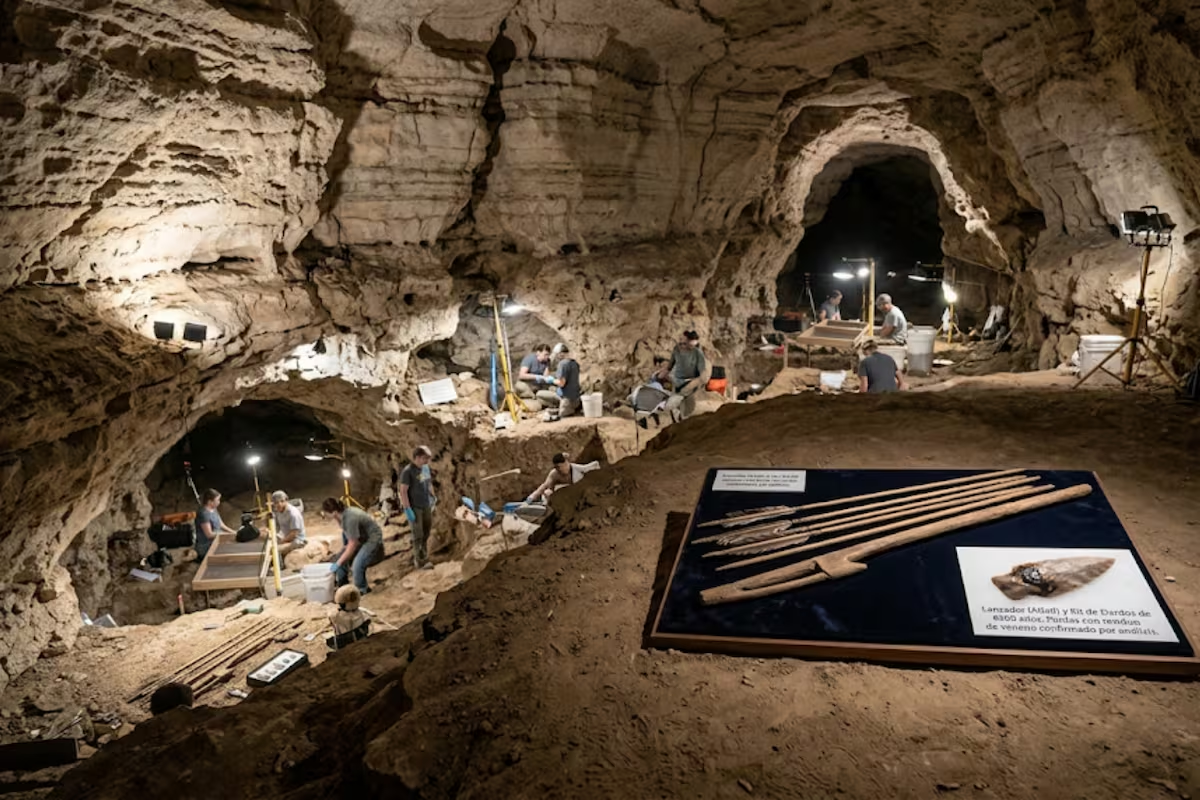
When archaeologists encounter a site of interest or a collection of artifacts, they piece together a narrative to explain why and how they ended up there. And while experts do their due diligence to arrive at a reasonable interpretation, sometimes these can end up being hasty conclusions. At least, that appears to be the case for atlatl use by Clovis hunters, according to a new study published today in the Proceedings of the National Academy of Sciences. Atlatls are handheld, rod-shaped devices used to throw flexible spears and darts. For a long time, archaeologists believed that Clovis culture, who occupied the Americas around 13,340 to 12,710 years ago, primarily used atlatls to hunt a variety of species, including large mammals. However, a statistical analysis using 66 radiocarbon dates for known atlatls strongly suggests that this hypothesis is poorly supported. “Well, we’ve never found a Clovis atlatl—ever, in the archaeological record,” Metin I. Eren, the study’s first author and an archaeologist at Kent State University, told Gizmodo during a video call. “What our data shows is that the likelihood of finding an atlatl [from that era] is low, and there’s a 3,000-year gap between the projected earliest use of the atlatl and Clovis people.”
Archaeologists Can't Find Evidence for a Weapon Long Linked to America's Earliest Hunters
New research is forcing archaeologists to confront an inconvenient truth about atlatls, a weapon that's been linked to Clovis hunters for decades despite the dearth of evidence.
755 words~3 min read