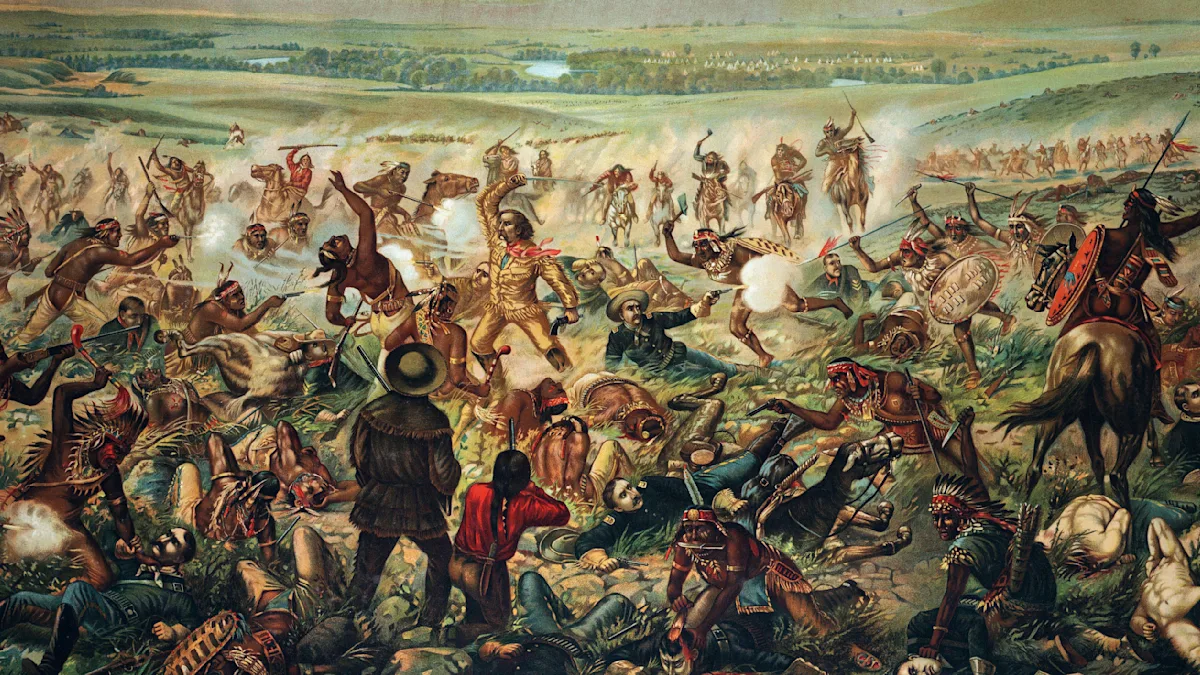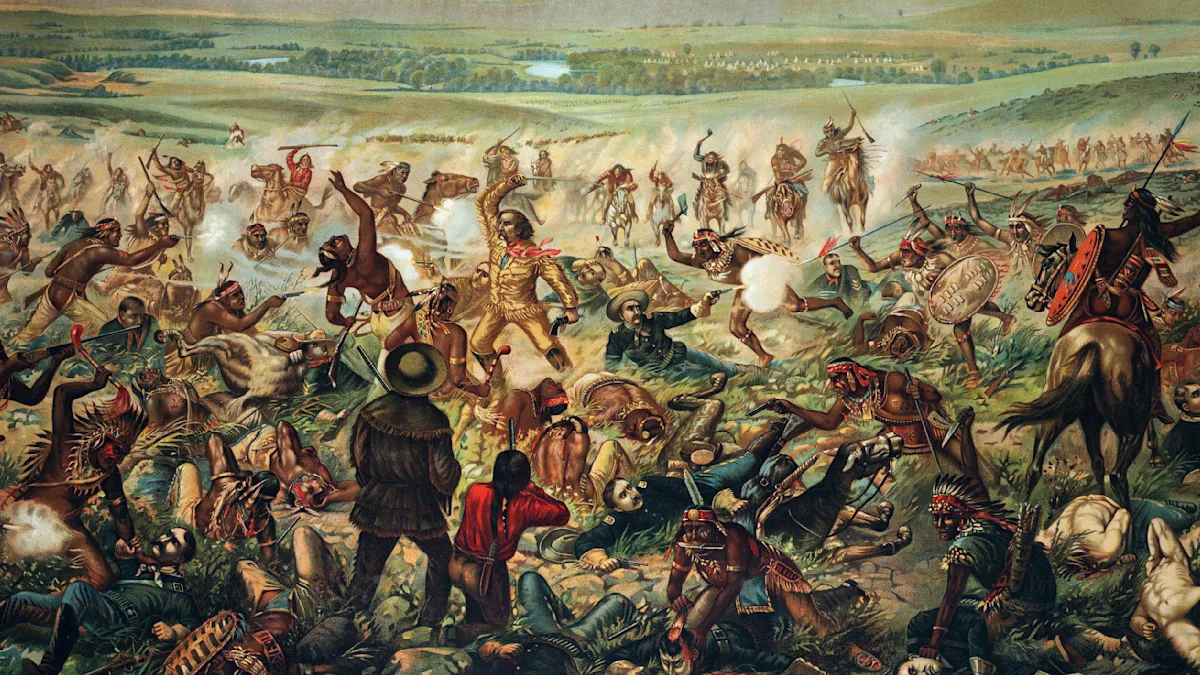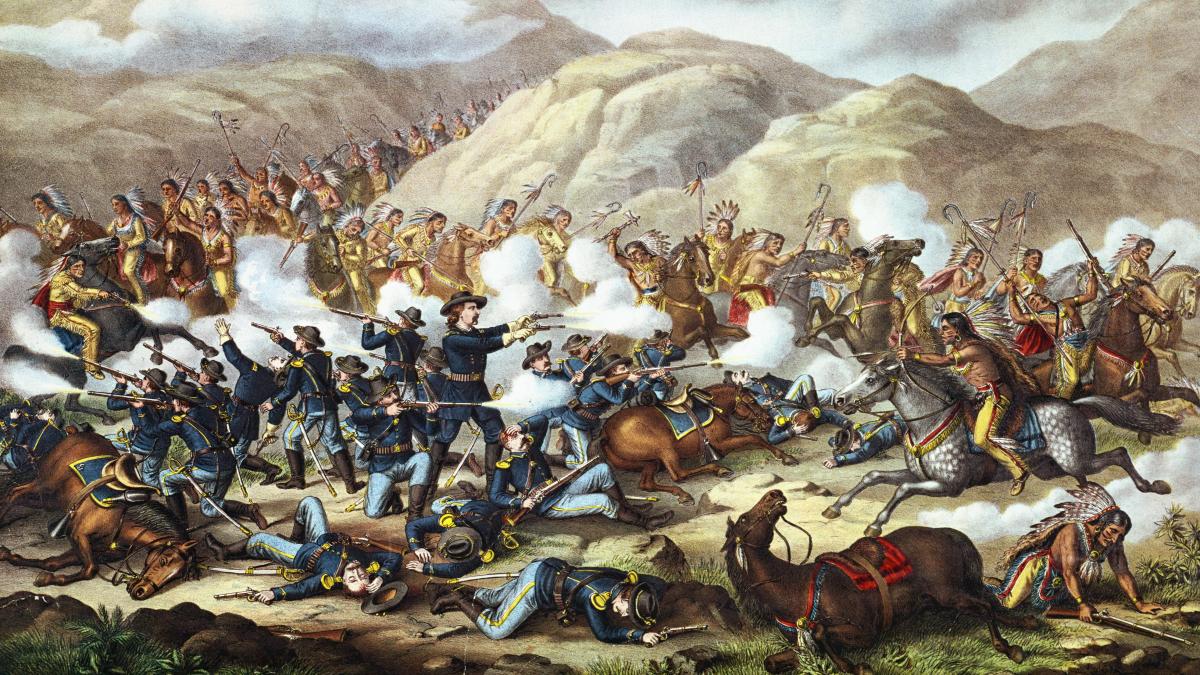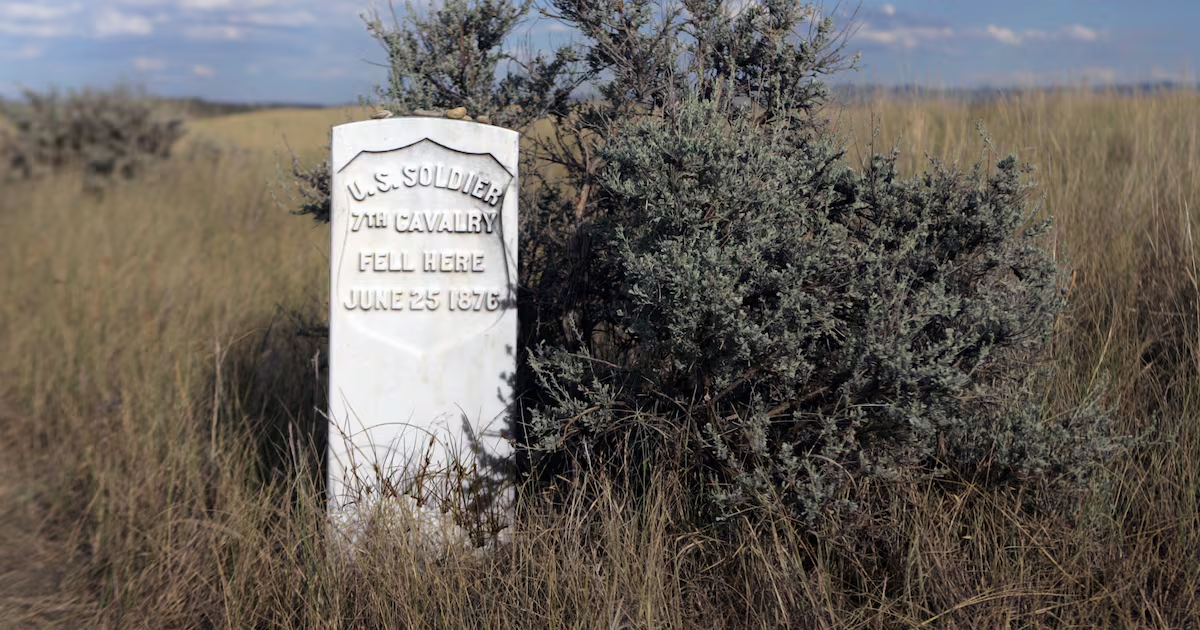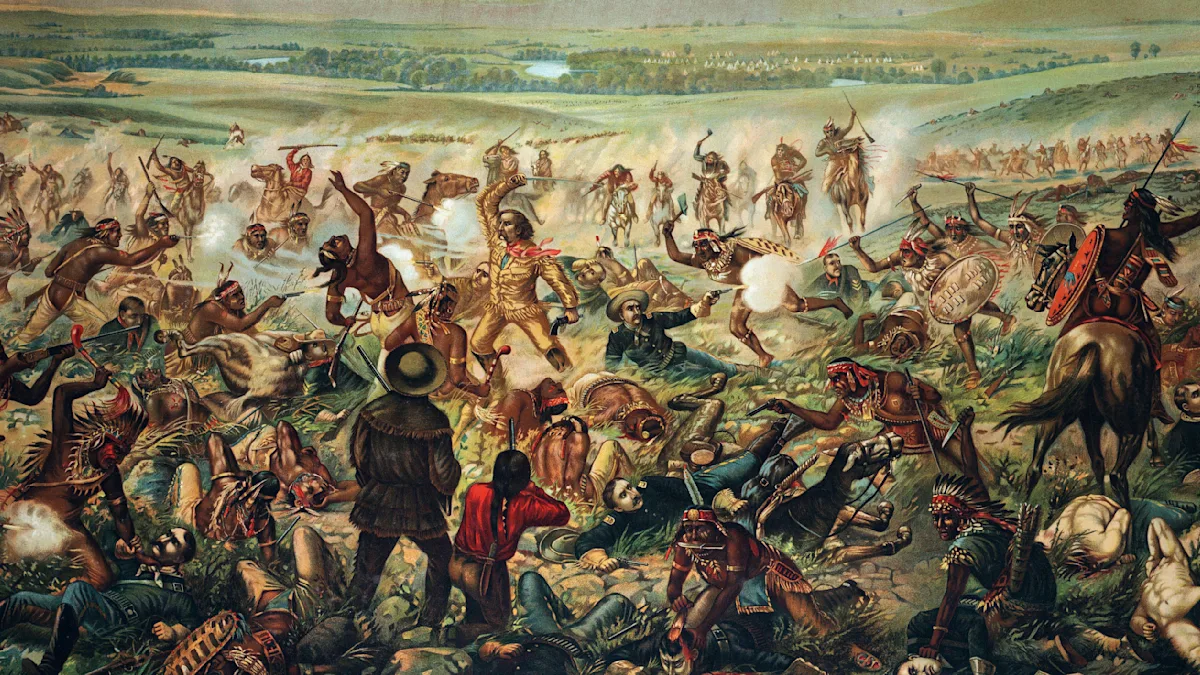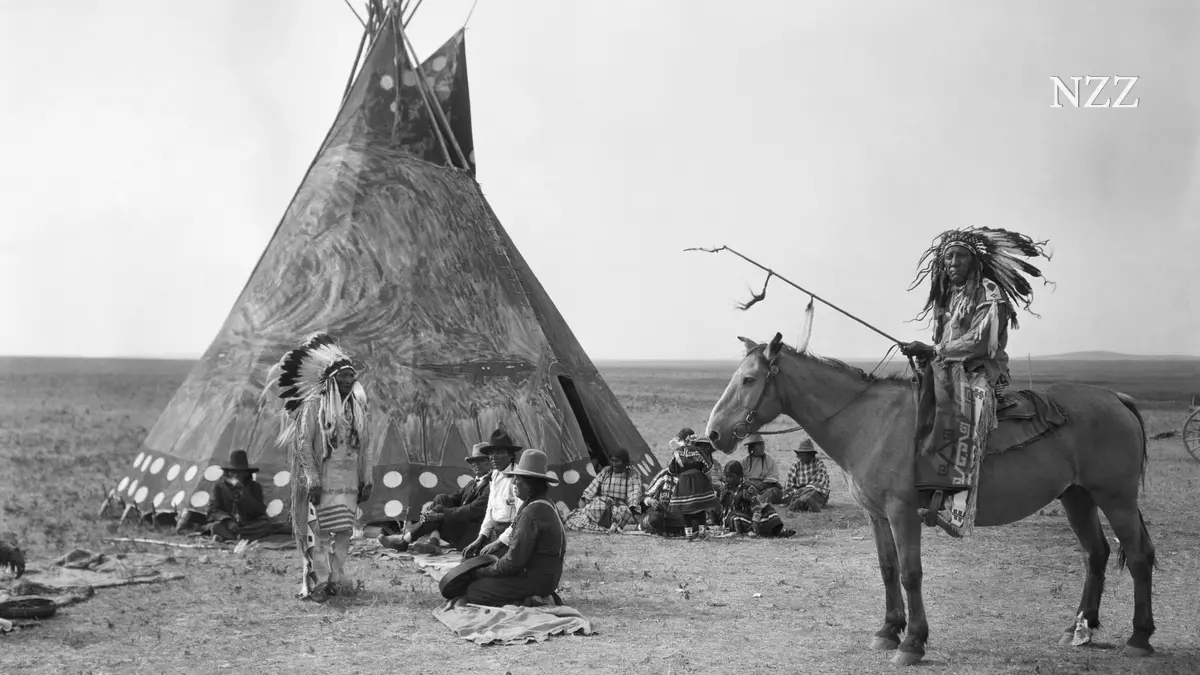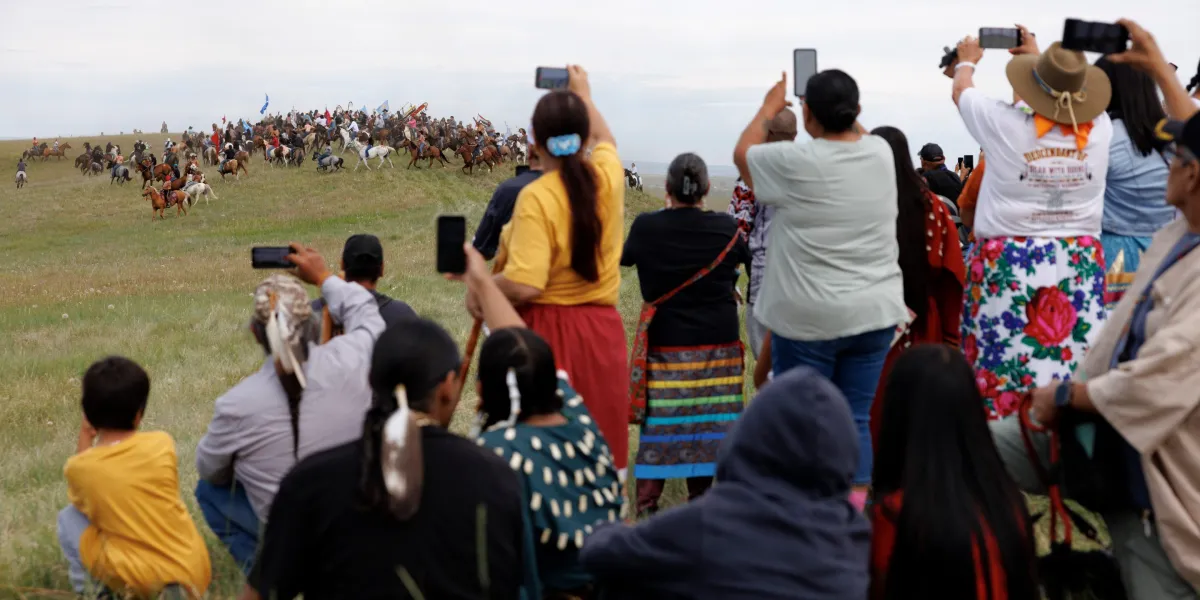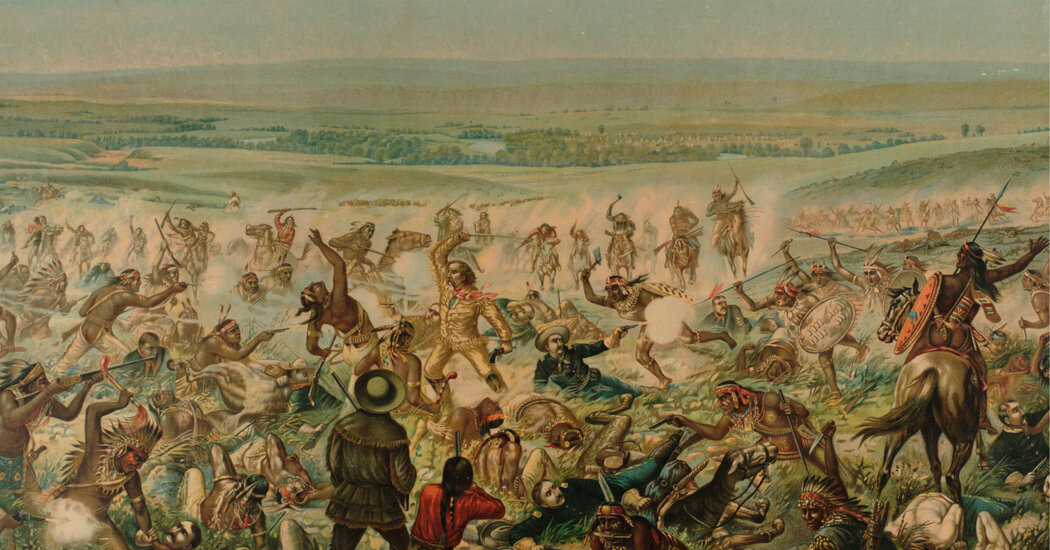
A painting of a battlefield filled with fighters. On June 25, 1876, the U.S. Army attacked a Native American encampment in what is now Montana, unleashing a bloody battle that ended in victory for an alliance of Lakota, Cheyenne and Arapaho warriors. It became the stuff of legend on both sides of the fight.A closeup of a painting of a battlefield filled with fighters. The Battle of the Little Bighorn, as it is known today, quickly took on a mythic quality, in large part because of Lt. Col. George Armstrong Custer, the swashbuckling cavalry commander who died on the battlefield along with more than 260 of his men.A portrait of a man in a military uniform. A celebrity even before his death, Custer became a folk hero, immortalized in paintings, films, novels, comic books, music and poetry. But the fawning depictions of him would not last. As America went through change, the image of Custer also shifted for many.A newspaper headline declaring “Massacre.” News of the rout was not widely disseminated for more than a week and shook the confidence of a country celebrating its centennial.A newspaper headline declaring “Massacre.” Reports depicted the victorious warriors as barbaric, the primary way Native Americans in the battle were portrayed for decades.A poem as published in a newspaper. Custer, a celebrated commander in the Civil War, was quickly cast in art and literature as a heroic victim. An elegiac poem by Walt Whitman was published in newspapers around the country in July 1876.A poem as published in a newspaper. The poem depicted the Native Americans as vicious aggressors; the U.S. soldiers as brave, ill-fated patriots.A large painting of a battlefield. Years later, John Mulvany’s giant, 11-by-20-foot painting toured the country in the 1880s, drawing crowds who paid to view it.A closeup view of a soldier on the battlefield. Called “Custer’s Last Rally,” its focal point was the lieutenant colonel with a pistol and sword, defending himself and his horse against a faceless storm of warriors.An image of soldiers standing atop a hill. Frederic Remington, a painter known for capturing the Old West, imagined Custer cornered and surrounded by his wounded soldiers. A closeup of the soldiers standing atop the hill. Its title, “The Last Stand” (1890), captured the sense that Custer resiliently fought to the bitter end against an overwhelming force. The hill continues to be known as Last Stand Hill.A large painting of a battlefield with fighters. Edgar Paxson’s painting from 1899 was marketed as a highly accurate depiction of a battle that had not been photographed but that Americans were clamoring to understand. Custer is shown wearing his trademark fringed buckskin coat.A closeup of the battlefield. For his research, Paxson said he spoke to Native Americans and U.S. soldiers with firsthand knowledge of the battle. Custer’s widow, Elizabeth, who helped cement her husband’s heroic reputation, was said to have been moved to tears at the sight of the painting. Like much having to do with the battle, this story is unverified.An image of the battle created by a Native American artist. Lakota and Cheyenne artists also depicted the battle, though to less fanfare. Known to them as the Battle of Greasy Grass, it was viewed as a great victory over a government seeking to relegate them to reservations.A closeup of the battle scene. The pictographic drawing on muslin, “Custer’s War,” was made around 1900 by Henry Oscar One Bull, who was Hunkpapa Lakota and fought in the battle. It reflects his firsthand account of the events.An advertisement for a Wild West show. Buffalo Bill turned the battle into theater in his famous Wild West show. Sitting Bull, the Lakota leader whose followers secured the victory, toured with the production for several months.A closeup of the advertisement. In the show, none other than Buffalo Bill rode in once the fight was over, too late to save Custer. A poignant, if untrue, ending.A scene from a silent film about the battle. The battle was a natural subject for the silent film era. In 1912, “Custer’s Last Raid” thrilled cinemagoers with its galloping horses and gunfights.In a scene from a film, an actor is shown portraying Custer. Hollywood cast Errol Flynn as a young, strapping Civil War-era Custer in “They Died With Their Boots On” (1941). Released only weeks before the United States’ entry into World War II, the film depicts Custer as a hero and a bold symbol of patriotism.In a second scene from that film, the U.S. calvary charges full speed. The film traces the arc of Custer’s fame by showing him in action at the Battle of Hanover, where he won plaudits at 23 as a “boy general” for the Union Army.A brightly colored comic book cover showing Custer in the battle. After World War II, as comic books continued to chronicle the adventures of Superman and Batman, Custer was also depicted as something of a superhero, albeit one whose powers would not ultimately save him.A page from inside the comic book, with several panels of drawings. In this comic from 1950, published by Avon, Custer is sharp-jawed, golden-locked and the last of his men to die.The final page of the comic book. The final panel spins Custer’s defeat into a victory, suggesting — as was the case — that the disastrous outcome of the battle fueled increased efforts by the U.S. government to force Native Americans onto reservations.An album cover with a singer dressed in Native American garb. The displacement and mistreatment of Native Americans increasingly became a focus of concern in the 1960s. In Johnny Cash’s song “Custer,” released in 1964, the lieutenant colonel is no longer a hero.The album cover. Now, I will tell you, buster, that I ain’t a fan of Custer’s And the General, he don’t ride well anymore To some, he was a hero, but to me, his score was zero And the General, he don’t ride well anymoreA man making public remarks. During the Vietnam War, Fred Hampton, the Black Panther leader, used the term “Custeristic” to describe what he viewed as poor leadership decisions that drove 1969’s “Days of Rage.”A painting that depicts Custer as a tiny figure. Art about Custer became darker and more abstract, as in this 1969 painting by Fritz Scholder, a member of the La Jolla Band of Luiseño Indians.A painting of the battle scene with obvious suffering. Taking inspiration regarding size – but not tone – from the large-scale epic works of the battle from the 19th century, Eric von Schmidt in 1976 painted the Seventh Cavalry’s defeat with brutal realism.A closeup of the figure depicting Custer. In “Here Fell Custer,” he is no longer a man with flowing blond hair, stage managing his own death. He’s a beaten-down soldier close to collapse.A scene from a film depicting Custer fussing with his mustache. The movie “Little Big Man,” released in 1970, took a view of Custer as a vain megalomaniac who ignored advice in leading his troops to slaughter. A scene from a comic film with Custer in full uniform. Unflattering portrayals would persist in Hollywood. In the sequel “Night at the Museum: Battle of the Smithsonian” (2009), Bill Hader plays Custer for laughs as an egotistical, overconfident bumbler.A sculpture of Native American warriors riding horses. In recent decades, more recognition has been given to art that represents the voices of those who succeeded in the battle, but also suffered many deaths.A sculpture of Native American warriors riding horses. The Indian memorial at the battle site, which includes a sculpture designed by Colleen Cutschall, an Oglala-Sicangu Lakota artist, was dedicated in 2003.A scene of the battle created by a Native American. In 2000, a panoramic drawing of the battle in pencil, ink and watercolor was put up for auction.A closeup of the Native American artwork. The work on muslin was by Standing Bear, a Minneconjou Lakota artist who had fought in the battle as a teenager, and recreated it more than four decades later.A closeup of the Native American artwork. With the Lakota warriors in regalia, the detailed drawing evokes the chaos of battle.A closeup of the Native American artwork that depicts Custer. At the center, a figure who appears to be Custer in his fringed buckskin is shown stuck with two arrows. In 2017, the Metropolitan Museum of Art acquired the work.
Warrior, Hero, Villain or Fool? 150 Years of Reassessing Custer
Few American military commanders have had as complicated a legacy as George Armstrong Custer, who died at the Battle of the Little Bighorn in June 1876.
1,385 words~6 min read