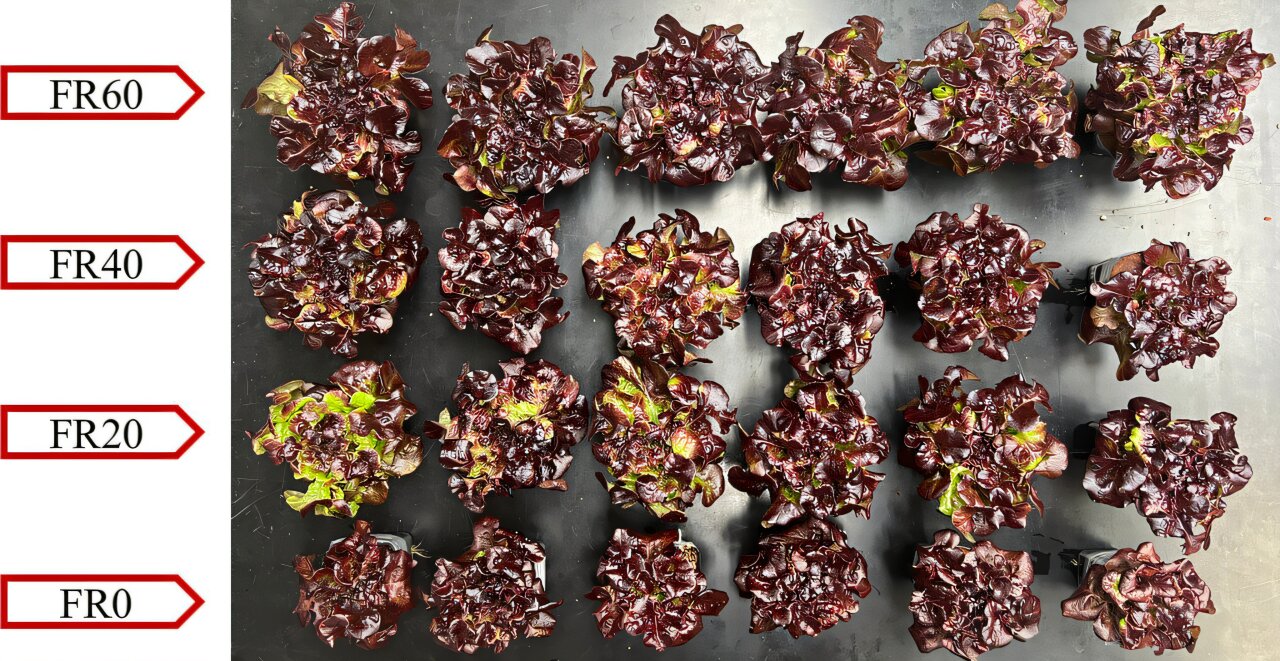
Six representative lettuce plants after 26 d under each of four far-red (FR) radiation (FR = 700–750 nm) substitution treatments with a total photon flux density (400–800 nm) of 400 µmol·m−2·s−1 and a CO2 concentration of 800 µmol·mol−1. Credit: Journal of the American Society for Horticultural Science (2026). DOI: 10.21273/jashs05550-25
A new study from scientists at Purdue University reports that far-red radiation, in combination with increased carbon dioxide (CO₂) concentration, significantly enhances biomass production in young leaf lettuce grown under controlled environments, offering practical guidance for indoor farming operators enthusiastic about including far-red in their sole-source lighting recipes.
This study was the second phase of a previously published study in which the interaction of these two important environmental inputs was investigated under a more limiting light level commonly used in commercial CEA. Under a light intensity of 200 mol m-2 s-1, the CO2 effect was more pronounced as a main effect. However, findings of the current study indicated that the effect of far-red is enhanced under a moderate total photon flux density of 400 mol m-2 s-1.
Biomass accumulation varied at different stages of development depending on the level of CO2 at which lettuce was grown. While growers often focus on the amount of light delivered to crops, the study demonstrates that which wavelengths are included can be just as important as total light quantity.