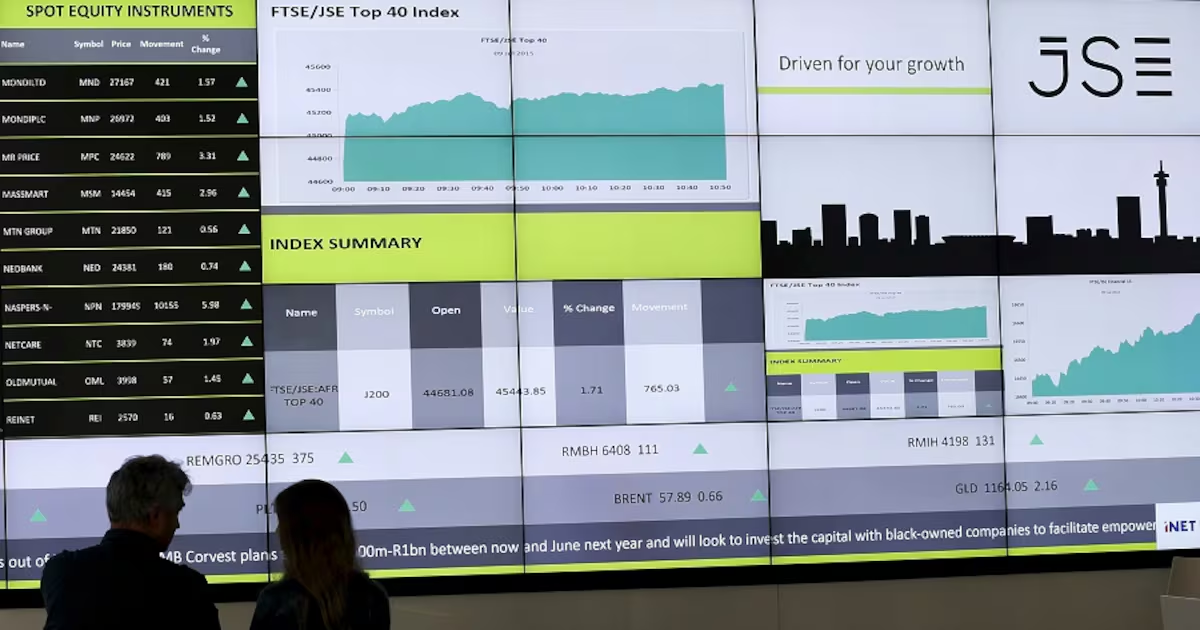
Over the past decade, South Africans have become confused by the dramatic differences between reported statistics on black ownership on the JSE. There is now a bewildering maze of conflicting statistics at the levels of the whole JSE, sectors such as mining and finance, and individual companies. In 2015, during a reply to questions following his state of the nation address, then president Jacob Zuma said black people owned 3% of companies on the JSE. The next day, the JSE released a study that said black people owned 23% of the shares on the exchange. Zuma stood by his assertion and said it was based on an analysis of direct black ownership conducted by the National Empowerment Fund. A few days later, the JSE said Zuma was correct and that direct black ownership was indeed 3%. In 2015, research and advisory firm Krutham said there was black ownership of R209bn in the top 100 JSE-listed companies at end-December 2014. It was equivalent to 1.9% of the R10.8-trillion market capitalisation of these companies on that date.(Karen Moolman) In 2017, a report commissioned by the National Treasury found that there was black ownership of 1% in the top 25 JSE-listed companies at end-December 2016. In July 2022, the Broad-Based BEE Commission said JSE companies had an average black ownership of 39%. If one applied the 39% statistic to the JSE’s market capitalisation of R20.5-trillion at end-December 2021, it implied that black people owned shares worth R8-trillion, which was clearly impossible. In his 2024 state of the nation address, President Cyril Ramaphosa said black people owned 39% of the mines.Pick n Pay has not implemented a BEE transaction. Yet, its 2025 BEE certificate said it had black ownership of 22.18%. Nedbank’s 2024 annual report said it had 0.6% black ownership. Yet, its 2025 BEE certificate said it had black ownership of 36.59%. In a paper for The Transformation Lens, I say that reporting on black ownership on the JSE has lost all credibility. This is due to fatal policy design errors, political compromises made by the government during the development of the BEE codes and its decision to cave in to bullying by companies in mining and finance during the drafting of sector charters. There is now a “voodoo system” of accounting for black ownership, which provides companies with free BEE points even if they do not transform their ownership structures. It inflates the scores of all JSE-listed companies and makes the measurement of BEE a joke. The BEE codes allow companies to exclude mandated investments by pension and provident funds and state ownership up to a maximum of 40% each. Using both rules, Telkom could exclude 80% of its shares, and 6% black ownership by the Elephant Consortium became 28%. The department of trade, industry & competition has not explained the rationale for this strange rule that creates an effective 15% target for JSE-listed companies, which choose to exclude mandated investments. There is also a backdoor route towards compliance that allows companies to count indirect black ownership in pension and provident funds when calculating their ownership scores. This is a black box in the BEE codes because few people know how indirect ownership is calculated. There is no code with rules or measurement principles on what can and cannot be counted. The farce of this policy, which explains the bizarre ownership scores of listed companies, becomes evident when one looks at the Public Investment Corporation (PIC), the asset manager of the Government Employees Pension Fund (GEPF), the Unemployment Insurance Fund (UIF) and other smaller fundsThe PIC is the government’s means of financing its obligations to pay pensions and unemployment benefits, and the workers do not own its shares. Since the GEPF is a defined benefit fund, government employees do not benefit when the value of its shares increases or suffer losses when they decline. The UIF has a formula to calculate unemployment benefits that is not related to the performance of the fund. Real shareholders have rights to capital appreciation and dividends. GEPF and UIF beneficiaries have no rights to capital appreciation or dividends.The PIC owned shares worth R1.1-trillion in the top 60 JSE-listed companies at end-December 2024, equivalent to 6.7% of their market capitalisation. Excluding the foreign assets of these JSE-listed companies, the PIC’s shares were equivalent to 31.2% of the value of South African assets that were worth R3.7-trillion ― well above the 25% ownership target in the BEE codes. JSE-listed companies can thus get free BEE points and full compliance in many cases even if they do nothing to transform their ownership structures.The Transformation Lens paper found that there was direct black ownership of R255bn in the top 60 JSE-listed companies at end-December 2024. This was equivalent to 1.5% of the market capitalisation of these companies. After excluding the value of foreign assets of the top 60 listed companies — 78.5% of their market capitalisation — black ownership was 6.9% of the value of South African assets. Mining and finance accounted for 77% of total black ownership. As a percentage of South African assets, there was black ownership of 8.4% and 8% in mining and finance, respectivelyAdding 6.9% direct black ownership to the PIC’s 31.2% indirect ownership, the result is 38.1% — almost the same as the BEE Commission’s finding of 39%. This backdoor route towards compliance awards companies BEE points for doing nothing. They benefit from the PIC’s ever-increasing assets, which doubled to R3.7-trillion in 2025 from R1.8-trillion in 2015. Allowing passive indirect ownership to count is also a betrayal of the spirit of true empowerment, which is to encourage direct ownership by active black shareholders who can influence company strategies.In mining, the “once empowered, always empowered principle” makes a mockery of empowerment. An analogy to explain this absurd principle is that companies can continue to recognise black directors in perpetuity after they have left a board. Any measurement of black ownership that uses the mining charter is not credible. In finance, the charter has a 10% target for direct ownership — lower than the effective 15% target for listed companies that choose to exclude mandated investments. Companies have a “get out of jail” card that allows them to meet their ownership shortfalls by providing black-business growth funding. This is an odd target since providing funding is the core business of a bank. The PIC’s ownership was 19.5% of the value of South African assets in 14 finance companies in the top 60 listed companies. This is above the 15% target for indirect ownership. This means that the average finance company gets full compliance for doing nothing. The present review of BEE policies must reverse the political compromises the government made when it was drafting the codes and sector charters. The ownership scorecard must measure effective direct ownership.• Gqubule is an adviser on economic development and transformation.
DUMA GQUBULE | ‘Voodoo system’ of accounting creates confusion over black ownership
Codes allow companies to inflate black ownership figures, often resulting in high compliance scores without substantive direct transformation
1,139 words~5 min read