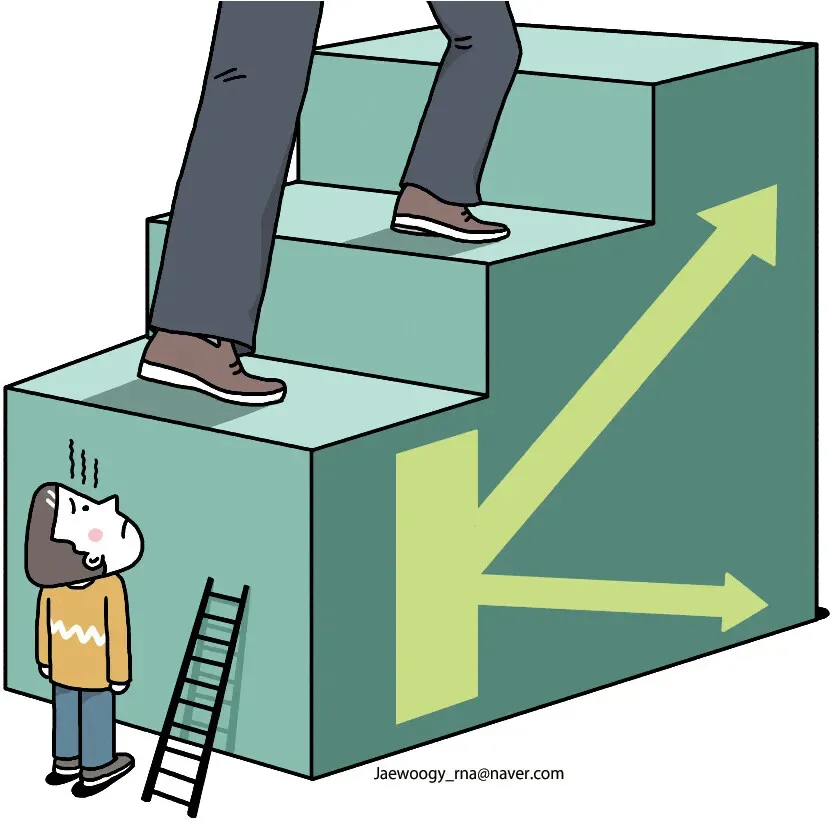
Income concentration among South Korea’s top 1% is returning to a peak “only observed during the colonial era,” a revised report on the country’s income inequality published last year by the World Inequality Lab concluded. Thomas Piketty, a French economist famous for penning “Capital in the Twenty-First Century,” was a key figure in establishing the World Inequality Lab. This report, which was co-authored by Hong Se-hyun, a PhD candidate at the Paris School of Economics, Kim Nak-nyeon, a professor emeritus of economics at Dongguk University, and others, delves into the structural inequality that lurks in the shadows of South Korea’s economic growth. According to these researchers, from 1933 to 2022, Korea’s average national income per adult grew at an average annual rate of 3.1%, achieving the “Miracle on the Han River.” Korea was also a model student on inequality issues. Those in the top 10% income bracket accounted for 50% of total income in 1933, but less than 30% in the 1960s. This reduction can be attributed to the expropriation of assets held by Japanese residents upon Korea’s independence and land reform policies. Even rapid economic growth in the 1970s, led by chaebols and export-driven corporate conglomerates, did not exacerbate income inequality. Korea’s growth deviated from the Kuznets curve hypothesis, which posits that inequality tends to rise in the early stages of economic development. South Korea entered a golden era of income distribution in the 1980s, as the increase in bottom 50% income shares was brought about by democratization, the repeal of wage suppression policies, and the introduction of the National Pension Scheme. However, the report analyzed that, as inequality continued to worsen after the 1997 financial crisis, the top 1% income shares in 2022 returned to heights only observed during the end of the colonial era. The authors attributed this change to the rise in non-regular employment and the concentration of tax-exempted capital income. As firms chose to retain earnings instead of choosing to distribute dividends or reinvest, such retained earnings were converted into capital income, leading to a concentration of wealth at the very top among high-income majority shareholders. This report is significant in that it provides a longitudinal analysis, enabling us to step back and examine the concentration of capital and trends of inequality over a considerable period of 90 years. The authors of the paper were the first to use a methodology that consolidated tax tabulation data, household surveys, and national accounts as provided by the Bank of Korea to investigate income.It’s time that we began thinking about whether we should be tabulating a corporation’s retained earnings as personal income. At a time when we grapple with the challenges of a K-shaped economy in which certain sectors like AI and semiconductors are having their heyday while others struggle to survive, the warning sent by the report is clear: it’s time for us to take inequality seriously again.
[Column] Inequality in Korea hits high not seen since colonial era
The dark side of the AI boom is growing inequality
481 words~2 min read