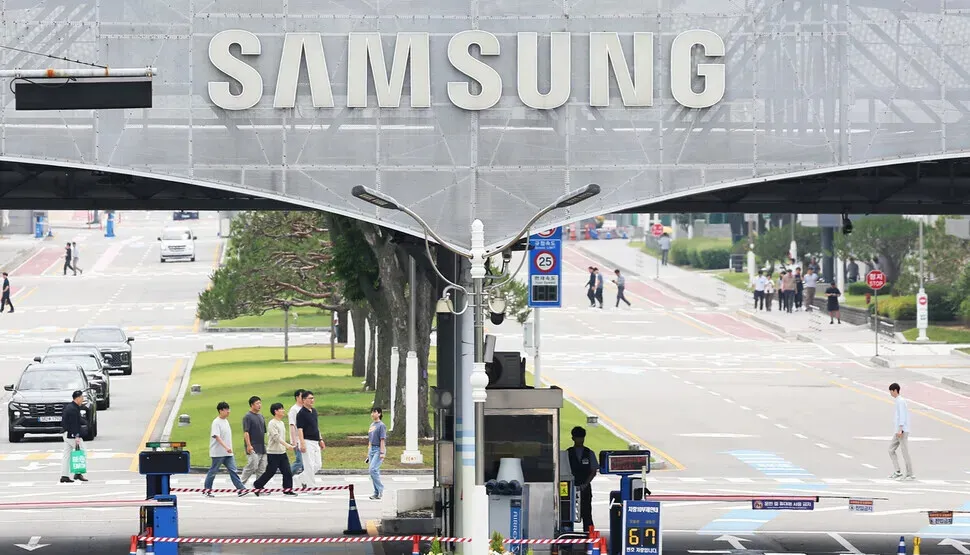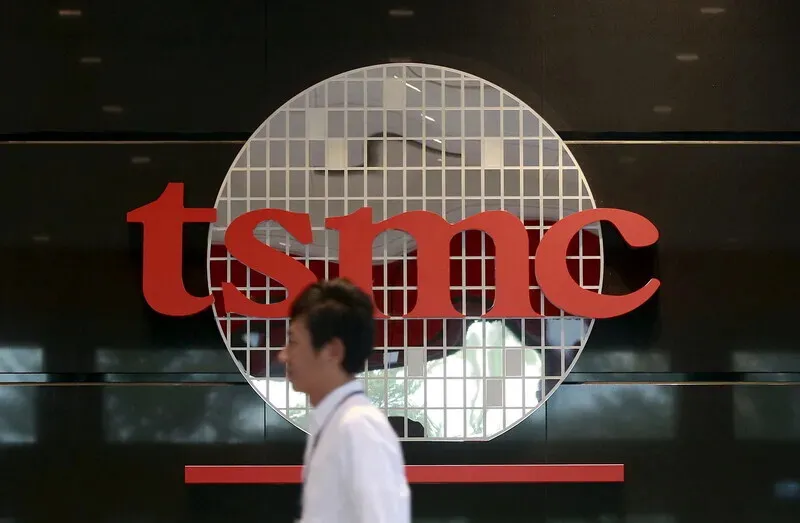
A person walks by the TSMC logo at its headquarters in Taiwan. (Reuters/Yonhap)
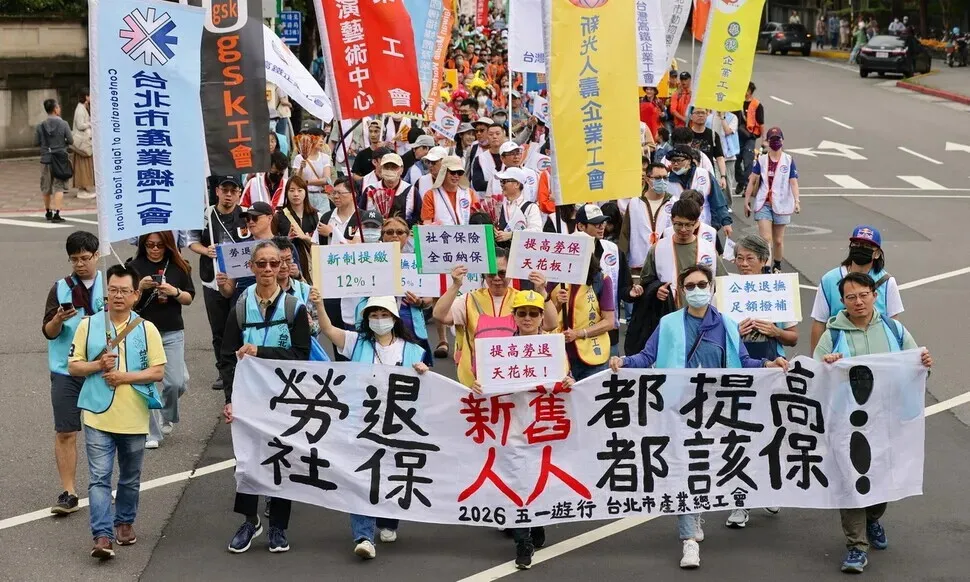
“You get the impression that Korea is no stranger to those issues,” a Bank of Korea researcher who has been studying economic polarization in Taiwan recently told the Hankyoreh.The researcher said that the issues of growing inequality and polarization in the Taiwanese economy, which has been seeing abnormally rapid growth because of the boom in chip exports, appear to offer a preview of what is in store for the Korean economy.Just like Taiwan, the Korean economy is undergoing an export boom and robust growth in the semiconductor sector. Observers are warning that unless Korea moves quickly to establish an institutional program of redistribution, it could face not only worsening economic sentiment but also structural imbalances including economic polarization, entrenched disparities in the labor market, and wealth inequality.According to figures released on Thursday by the Directorate-General of Budget, Accounting and Statistics with Taiwan’s Executive Yuan, Taiwan’s real economic growth rate for the first quarter of this year (that is, the year-over-year GDP growth rate) was a stunning 14.55%.The Taiwanese economy had been growing slowly in recent years, at a rate of 2.68% in 2022 and 1.08% in 2023. But that rate jumped to 5.27% in 2024, and observers have been shocked to see double-digit growth since the fourth quarter of last year.There’s a simple reason for such stunning economic performance in Taiwan, which has just one-half of Korea’s population and one-third of its land mass: its semiconductor exports are surging.Taiwan possesses an industrial ecosystem that covers all phases of semiconductor production, including design, fabrication and back-end processing. That ecosystem is organized around TSMC, the world’s biggest chip foundry company. (A foundry is a semiconductor plant that produces chips commissioned by other companies.)Amid explosive investment in AI and the resulting growth in demand for the chips on which AI relies, Taiwan’s semiconductor industry is functioning as a key dynamo for national growth.The problem is that the benefits of the semiconductor boom are not reaching all corners of the Taiwanese economy. Instead, a gap has widened between Taiwan’s semiconductor and non-semiconductor sectors as shown by major indicators such as exports and production. Economic polarization is intensifying as wages remain low and private consumption stays sluggish.According to the World Inequality Report 2026 by the World Inequality Lab, the top decile of Taiwanese income earners took home 48% of total income. Meanwhile, the bottom half of income earners only received 12% of the total.Those figures show that income concentration in Taiwan is worse than in Korea, where the top 10% of earners claim 37% of total income and the bottom half makes 18% of the total.Taiwan’s minimum wage is also much lower than Korea’s. As of last year, Taiwan surpassed Korea in terms of per capita gross national income (GNI), but Taiwan’s monthly minimum wage was 28,590 new Taiwan dollars (1.38 million won), or just 65% of Korea’s minimum wage converted to a monthly basis (2.15 million won).So while Taiwan’s economy has been galvanized by the semiconductor boom, analysts say many young people and middle-class households feel left behind.There’s also an inherent risk in Taiwan’s dependence on the semiconductor sector: If and when the boom ends, there would be serious repercussions for the entire Taiwanese economy.When chip exports are subtracted from Taiwan’s 14.55% real economic growth rate in the first quarter, that rate drops to the low 4% range. Among industrial output indicators published by the Taiwanese government, the indicator for semiconductors (integrated circuits) was 152.80, far above the indicator for the entire manufacturing sector (127.81).What that means is increased production in the semiconductor sector is driving manufacturing as a whole.Given Korea’s dependence on the chip sector, the situation here is not much different. In the first five months of the year, semiconductors accounted for around 37% of the value of all exports, representing a major increase from last year (24% on an annual basis). And when chipmakers are excluded, Korea’s real economic growth rate for the first quarter (1.8% from the previous quarter) drops below 1%.Chipmakers and other IT manufacturing companies only employed 1.9% of Korea’s total workforce in the first 10 months of last year, which is much lower than Taiwan (10.5%). As a result, only a small number of workers — permanent employees at a handful of conglomerates in particular — will reap the rewards of the semiconductor boom.“As a result of Taiwan’s overconcentration in semiconductors, the traditional manufacturing and service sectors (aside from those areas related to semiconductors and AI) are facing underinvestment and a labor shortage. Korea needs to be alert to the possibility of greater polarization between industries and income brackets, just as in Taiwan, because of the overconcentration in the chip sector,” the Korea Center for International Finance argued in a report last month.By Park Jong-o, staff reporter; Bae Ji-hyun, staff reporterPlease direct questions or comments to [english@hani.co.kr]