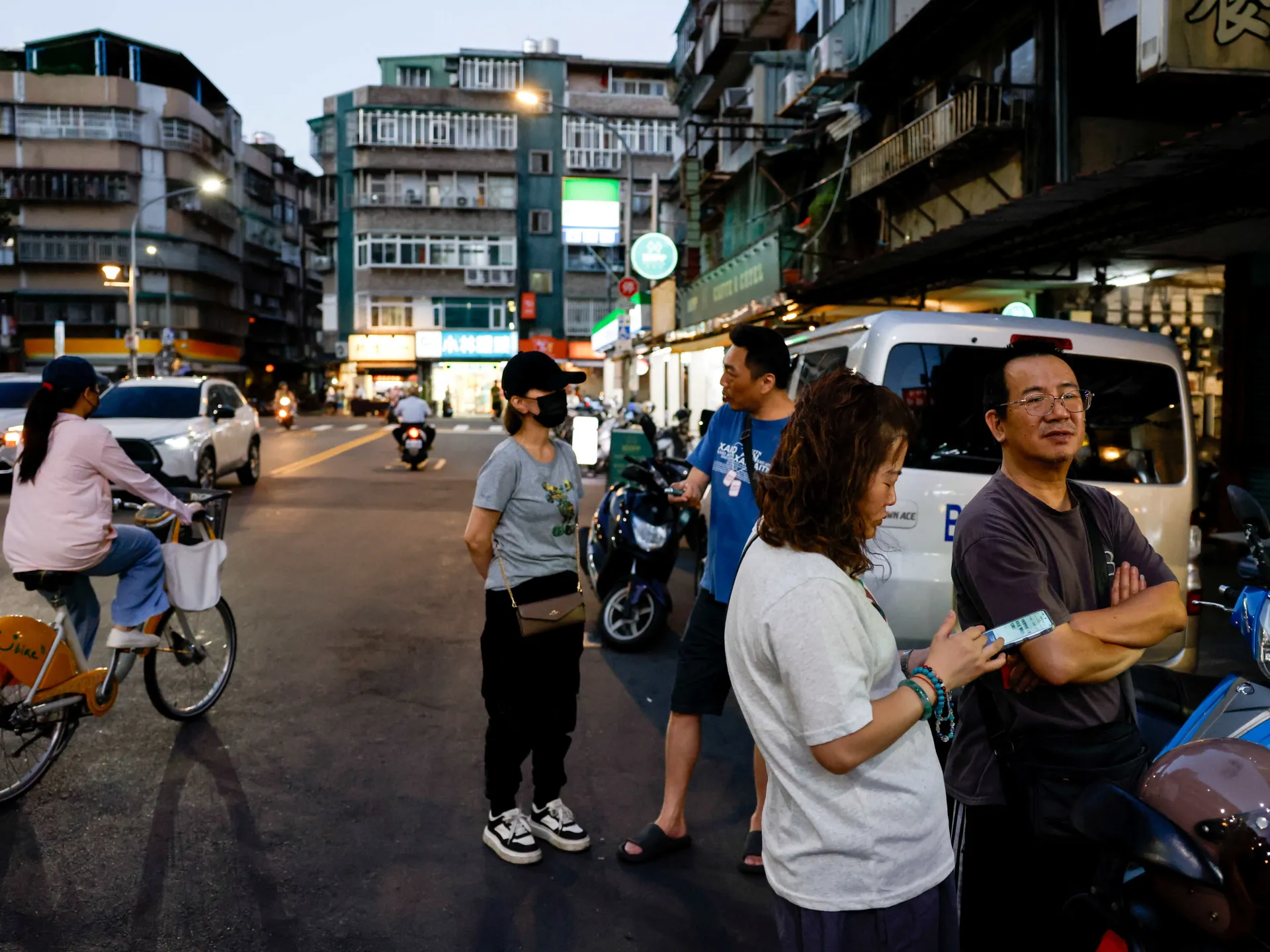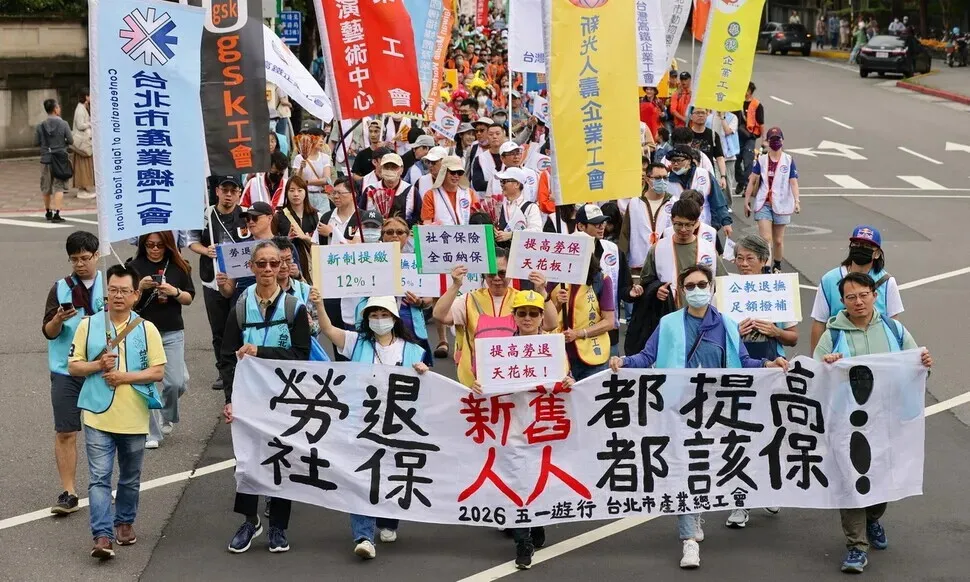
Workers in Taiwan’s Taipei march on May Day 2026 carrying signs with various demands. (EPA/Yonhap)
“Whenever I hear news that the Taiwanese economy is booming, I always want to stop people on the street and ask, ‘Is it really that good? Are the conditions in places with clusters of semiconductor firms and factories getting better?’”Spurred by the artificial intelligence and semiconductor boom, the Taiwanese economy has entered an era of rapid growth for the first time in 16 years. However, everyday life is growing tougher for Chien, who works at an SME in Taipei. As a member of the “kangaroo tribe” who live with their parents, the 35-year-old Chien says independence is a bridge too far.“To live in a one-room house, monthly rent and living expenses would come to 25,000 Taiwan dollars,” he said. Although he has been working for seven years, Chien earns just 45,000 Taiwan dollars (around US$1,420) per month. He has all but given up on marriage or having children. Behind the rosy figures of a wealthy Taiwan buoyed by TMSC, the world’s largest semiconductor foundry, the Taiwanese people are being squeezed by steep housing costs, low wages and a high cost of living, cynically referring to their homeland as a “ghost island.”The boom is evident from Taiwan’s economic indicators. Data released by Taiwan’s Directorate General of Budget, Accounting and Statistics show that first-quarter gross domestic product (GDP) growth amounted to 14.55% year over year. This is the highest figure in 48 years. On June 18, Taiwan’s Central Bank elevated its growth forecast for this year to 9.45%. If this comes true, Taiwan would record its highest growth rate in 16 years since reaching 10.25% in 2010.AI is the driving force behind this growth. Taiwanese exports in May jumped 51.7% year-on-year, posting the second-highest value by month of all time. Exports of electronic components and IT products spiked by 66.9% and 118%, respectively. This is the result of Taiwan’s semiconductor and ICT industries being prime beneficiaries of the global AI fervor.However, these numbers do not align with the economic experience of most Taiwanese people. Taiwan’s consumer confidence index fell to 62.08 in May from the previous month’s figure of 62.47, reaching the lowest level since January 2023. Produced by the Research Center for Taiwan Economic Development at Taiwan’s National Central University, this index measures composite consumer expectations toward the domestic economy, household economy, employment and consumer prices. A number below 100 indicates prevalent pessimism. This matches the economic outlook of Mao, who runs a beauty services business. “The economy seemed to have improved since last year, but I haven’t seen an increase in customers,” she said. Although she was keen to expand her operations if business picked up, those plans were ultimately canned.“It’s clear to me that just because things are going well for a small minority of well-known companies doesn’t mean everyday people have more in their pockets,” she said. As it turns out, Mao’s complaints are borne out by the numbers. The scale of Taiwan’s economy is rapidly expanding, but the portion returned to workers has stagnated. Labor income share, which measures employee remuneration as a proportion of GDP, has failed to improve. Labor income share in Taiwan sat at 50% up until the 1990s, but then entered a state of gradual decline to bottom out at 43% in 2024. In 2025, the average monthly wage in Taiwan stood at 64,000 Taiwan dollars (around 3.1 million won) in 2025, just 73% of the corresponding figure in Korea. Taiwan’s gross national income per capita breached the US$40,000 mark last year, overtaking Korea, but workers remain worse off than their Korean counterparts.The disparity between industries is also slowly widening. Employees at cutting-edge firms such as TSMC, MediaTek and Foxconn are able to enjoy the fruits of AI, while young people employed in services, traditional manufacturing and part-time or low-wage industries are excluded from the benefits of rapid growth. While certain industries and social classes experience rapid growth, those on the other side are stagnating or being squeezed out. This is why the expression “K-shaped economy” has emerged to describe the Taiwanese economy. In response to such criticism, Taiwan’s Central Bank explained, “It’s not that traditional industries are doing poorly, it’s that growth in the electronics industry is excessively strong.” However, this fails to sufficiently explain the gap that has emerged between aggregate economic indicators and public sentiment.Nowhere is this discrepancy more prominent than in housing. The phrase “eggshell suburbs” is commonly heard among Taiwanese youth these days. In this metaphor, where central Taipei represents the yolk and the surrounding areas are the egg white, young people unable to afford a house are increasingly being pushed into more fringe districts known as the “eggshell suburbs.” Growing numbers of young Taiwanese claim that far from buying a house, they are struggling just to cover the cost of rent and commuting. In the capital of Taipei, the housing price-to-income ratio sits at 16, even higher than London and New York.