AFP, TOKYO
Runaway profits and sky-high valuations for microchip companies have fueled worker demands over pay packages in South Korea, raising the question: who profits from the artificial intelligence (AI) boom? In the US, some employees with stock options have made it rich and retired early, while in Asia chip engineers are now using their “immense” leverage over companies to get their way, analysts said.After memorychip giant Samsung Electronics reached a deal with its biggest union over bonuses, averting a major strike, Agence France-Presse looks at what the dispute might mean for the industry.
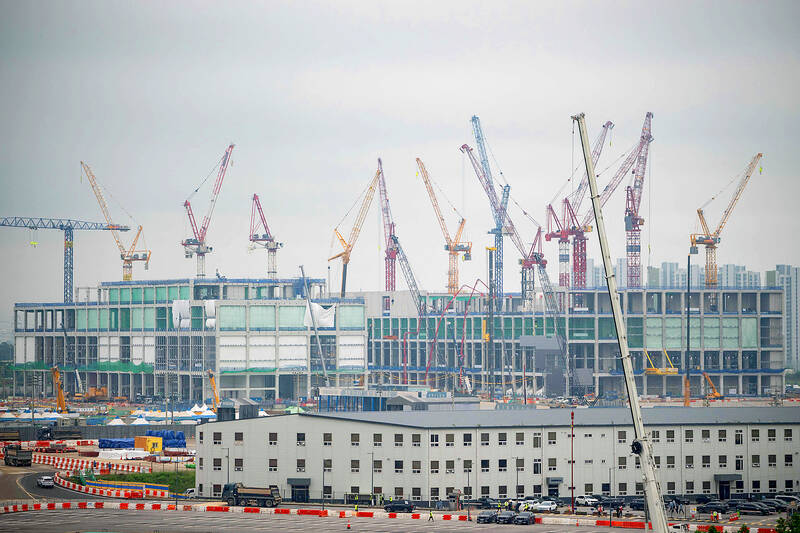
Tower cranes are pictured at a construction site of the Samsung Electronics factory in Pyeongtaek, South Korea, yesterday.
Why are chipmakers suddenly so flush? Rapid advances in AI systems since text generator ChatGPT’s 2022 breakthrough have sparked a gold rush for tech companies.
Massive demand for the silicon components used in AI data centers — especially memory chips, which are in short supply — has sent revenues soaring for firms that design, produce and assemble them.Samsung’s value topped US$1 trillion this month, followed by South Korean rival SK Hynix and US chipmaker Micron — newcomers to a previously exclusive club of about a dozen companies, nearly all American.“An unprecedented wave of insatiable demand” for advanced memory chips has made SK Hynix and its peers “an indispensable backbone of the global AI infrastructure buildout,” said William Keating, head of semiconductor research firm Ingenuity.Do workers see the benefits? In the US, employees often get stock options, a form of so-called “golden handcuffs” allowing workers to profit from share price gains over a set period of time.Asia’s huge chip sector “is more dominated by labor unions,” Counterpoint Research cofounder Neil Shah said.With Taiwan and South Korea home to most of the world’s chipmaking talent pool, engineers there hold “immense” leverage, Shah said. “This skilled labor force know they are indispensable, they are contributing to these larger margins,” he added.Under the union deal, about 60 percent of Samsung’s domestic workforce is eligible to receive a bonus of roughly US$370,000 this year, based on a market estimate of operating profit.Workers at SK Hynix received bonuses more than three times larger than those paid by Samsung last year, according to Samsung’s union.Will the Samsung deal inspire others? A Samsung strike “would almost certainly have been the biggest work stoppage in the history of the global semiconductor industry,” South Korean writer and researcher Kap Seol said in an article for US magazine Jacobin.In the chip world, “high pay and generous benefits often foster a sense of privilege and prestige” among workers, “despite their experience of chemically drenched working conditions, cutthroat competition, and long, risky working hours,” he wrote.There have also been reports of discontent over bonuses at Taiwan’s chip production giant Taiwan Semiconductor Manufacturing Co (TSMC, 台積電), where AI demand has brought record profits.“As the company continues to grow, we are highly confident that the full-year growth percentage of our employee profit-sharing ... will surpass that of last year,” TSMC said in a statement.TSMC chairman C.C. Wei (魏哲家) on Wednesday held a meeting to explain the bonus situation to staff, and the atmosphere was “calm and friendly,” a company spokesperson said, adding that annual bonuses were set to grow “more than 30 percent” year-on-year.The Samsung agreement is fueling labor demands in other sectors across South Korea — with workers in industries from biotech and autos to shipbuilding asking for a larger share of corporate profits through bonuses.Who else is cashing in?Shah said that in general terms, company shareholders are reaping the most from booming profits, followed by senior company executives and then employees who have stock options.Fourth are the actual chip engineers, some of whom are now demanding a greater share of the pie.In the case of Californian AI chip titan Nvidia — now the world’s most valuable company at more than US$5 trillion — many employees with stock options became millionaires very quickly, Shah said.“Many of them actually left and became investors” or simply chose to retire “on the beach,” he said.