(Getty Images Bank)
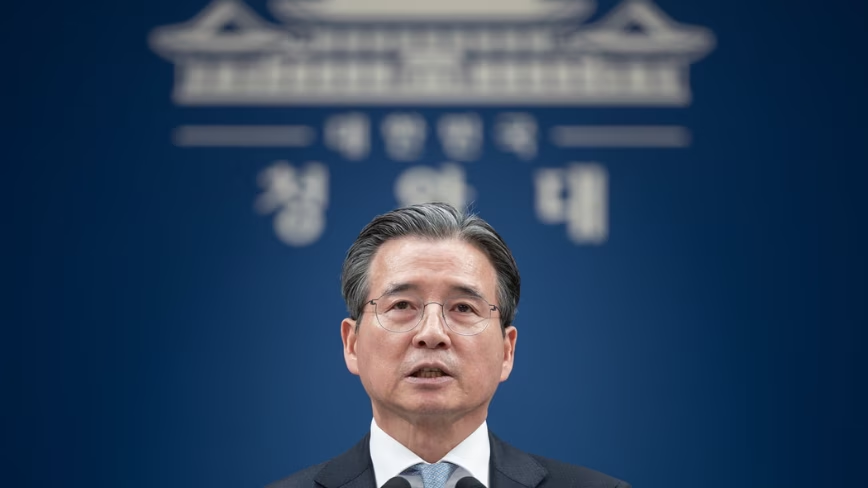
The first-quarter earnings announced by SK Hynix last month contained a hidden secret. The financial statements listed roughly 4.2 trillion won in employee bonuses between January and March as “unpaid expenses (unpaid liabilities).”As the company is obligated by its collective agreement to pay 10% of the year’s operating profits as employee bonuses early the following year, it made the decision to subtract those costs ahead of time and only announce the remainder as its operating profits for the first quarter. As a result, the operating profits of 37.6 trillion won that SK Hynix announced fell considerably short of market projections estimating that they would top 40 trillion won.Based on these figures, the average bonus payment per employee for the first quarter would be approximately 120 million won, or around US$78,000. In other words, the bonuses that have accumulated to date amount to 40 million won per month, on top of salaries that are already in the range of hundreds of millions of won.The figures illustrate an extreme wage gap of proportions unheard of in South Korean history.Based on consolidated financial statements for this year, the average projected annual operating profits estimated by securities firms came out to 361 trillion won for Samsung Electronics and 261 trillion won for SK Hynix.Estimates for the 2026 bonuses to be paid to employees associated with these operating profits (the memory division of the semiconductor sector in Samsung Electronics’ case) were between 600 and 700 million per person on average.The amount far exceeds the total global annual average compensation for employees at Big Tech firms, including salary along with bonuses.According to figures announced by the US Securities and Exchange Commission, the median compensation for an employee at Nvidia — ranked first worldwide in terms of market capitalization — stood at US$282,050 for the 2026 accounting year. In the case of Alphabet, Google’s parent holding company, median employee compensation came out to US$310,826 last year.The explosion in bonuses at semiconductor companies signifies the arrival of a new class of ultra-high-salary workers on par with physician groups in South Korean society.Samsung Electronics’ semiconductor sector and SK Hynix as a whole have a total of around 113,000 employees between them, an amount roughly equivalent to the nationwide total of medical specialists (approximately 114,000 in 2024).According to physician wage trend figures drafted recently by the Ministry of Health and Welfare, the average pay for physicians employed at clinics and hospitals in 2022 was around 310 million won.Many have begun voicing concerns about the possible side effects that the sudden emergence of this new class of worker could bring about. In particular, they worry that it could exacerbate the three major divides that have deepened in Korea since the Asian financial crisis of the late 1990s: the gaps in wages, income and assets.Fanning these concerns are predictions that the accelerating shift toward artificial intelligence may end up cementing a minority of ultra-high-income workers at the few companies that benefit, while the remaining majority experiences losses of jobs and income.The strong economic performance associated with semiconductors in Korea also means that interest rate hikes appear likely to come. That situation stands to only intensify the differences perceived between the ultra-high-income workers and employees at smaller businesses, precarious workers and the self-employed.In a Facebook post on Saturday, Kim Yong-beom, the Blue House national policy director, described the situation as one where “the country as a whole is performing well, but people are not actually happy.”He also predicted that “the boom will not last long if the national wealth earned through semiconductors ends up absorbed into real estate-related unearned income and the benefits of growth are concentrated only among a minority.”By Park Jong-o, staff reporter; Bae Ji-hyun, staff reporterPlease direct questions or comments to [english@hani.co.kr]