Thursday 25 June 2026 5:28 am
| Updated:
Wednesday 24 June 2026 11:50 am
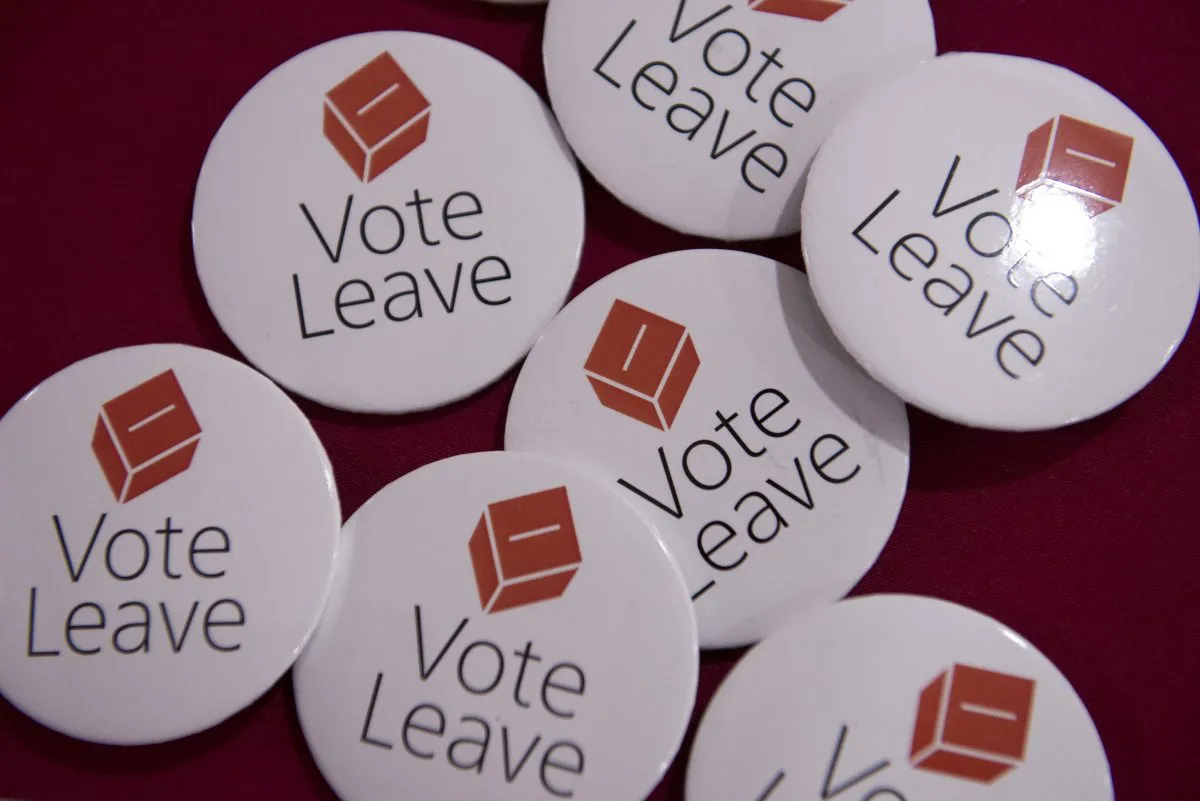
LLANDUDNO, WALES - FEBRUARY 27: Vote Leave Badges at the UKIP Spring Conference on February 27, 2016 in Llandudno, Wales. UKIP's annual national Spring Conference is being held for the first time in Wales during the Welsh assembly election campaign. The elections for the National Assembly will take place on May 5 with polls predicting UKIP could win nine seats in the Senedd. (Photo by Richard Stonehouse/Getty Images)
I voted Remain despite having serious reservations about the EU. A decade on, I believe Brexit has strengthened Britain, says Nigel BiggarI am an icon of Brexit, it seems. In 2019, Richard Drayton, Rhodes Professor of Imperial History at King’s College London, contributed ‘Biggar vs Little Britain’ to a collection of essays entitled Embers of Empire in Brexit Britain. In this, he wrote: “[A] journey into the mind-world of Biggar can help us to understand the larger, and less articulate and visible cultural currents in late twentieth and twenty-first century Britain. It may provide insight into how some of the embers of empire continue to burn, and even to kindle obscure new flames … The Biggar phenomenon is a sign of the times to which we should pay attention.Awfully flattered as I am by the cultural importance Professor Drayton attaches to me, I regret to say that he is mistaken. First of all, I am not aware of any hard and comprehensive empirical data that substantiates the claim that voters were generally moved to vote Leave in the June 2016 referendum by “imperial nostalgia”, in the vain hope that Brexit would liberate Britain to recover the kind of global dominance it enjoyed in 1900.Next, while Drayton claims that my 2016 blog, ‘The Nation State and the Case for Remaining in the EU’, comprised an argument for leaving the European Union, my concluding two sentences ought to have given him pause: “There may well be good reasons for Britain to remain in the EU. But if that is so, the unchristian nature, or the obsolescence, of the nation-state is not one of them.”Yes, it is true that I believe that Britain should continue its imperial tradition of playing a global role, sometimes deploying hard power in faraway places to uphold free trade and international order and to halt massive atrocities. I also believe in the value of the United Kingdom (UK) as a remarkably successful multinational state. But those are views shared by plenty of Remainers and repudiated by lots of ‘Little England’ Leavers.Finally, by far the largest fly in Professor Drayton’s narrative ointment is that I actually voted to remain in the European Union (EU) in 2016. Indeed, I went so far as to wager a lunch and a dinner on a 52 per cent to 48 per cent victory for Remain. (Even though I got the figures right, I mistook the bias. I had to pay up.)Let me explain.Reluctant RemainerI did vote Remain, but not with much enthusiasm. My perception was that Britain had not benefited much from membership of the European Economic Community, because the economic boom enjoyed by continental Europe during the period of post-war reconstruction had pretty much run out of steam by the time we joined. I also understood that, whereas free trade within the bloc served the interests of French agriculture and German industry, it had not served Britain’s proportionally larger service sector so well.In addition to economic reservations, I also had political ones. I was irritated by the extent to which unelected bureaucracies in Brussels could shape the lives of Britons without direct electoral accountability. Power at the top was too remote from those it ruled, too impervious to their needs and complaints.More fundamentally, I was sceptical about the political project of ‘ever closer union’. For starters, the claim that this was about transcending violent nationalism in order to create a pacific post-nationalist future was nonsense. On the contrary, it was about forging a new European national identity among the members of its constituent nations, thereby enabling the creation of a single, presumably federal, state – let’s call it the United States of Europe – to offset the Soviet Union/Russia and the United States of America. And, just like any other state, this one would need its own military forces, at the very least for its own defence. To be clear: I had no objections to this European nation-building project in principle; I just wanted it to be recognised for what it was.The political benefit of the forging of a new European national identity would be the creation of a European ‘demos’ that would directly elect a powerful central government – maybe in the form of a federal presidency along US lines – making European rulers suitably and directly accountable to their ruled. However, in the case of the United States, that had required a common crisis – a revolutionary war against Britain – to melt stubborn colonial loyalties and convince of the necessity of a transcendent federal union. Furthermore, in the American case, all the federalising colonies had had the advantage of sharing a single dominant English language, a Protestant religion and British political traditions.In contrast, the European elite decided to attempt the same result by strengthening economic ties between nations with different languages, cultures and histories, first through free trade and movement and then through monetary union. The result was that the project had got stuck in a dangerously unstable situation. The euro had been launched and the Eurozone created in advance of the creation of the European ‘demos’ and with it the democratic political will requisite for the establishment of the central institutions and fiscal coordination necessary for the Eurozone’s stability. The predicted result was a financial crisis in 2009 and a deflationary remedy imposed by the northern (predominantly German) centre on the southern periphery, which had – ironically – served to stoke Italian and Greek nationalist resentment. And it is in this unstable limbo that the Eurozone remains paralysed. Although, at first, I could see nothing wrong in principle with trying to forge a European national identity, its practice gave me pause for two reasons. One of the four fundamental freedoms of the EU is the free movement of peoples – the right of all EU citizens to move to another member country, to live and work there. As I understood it, this was less an economic requirement of the European free market and more a tool of European nation-building. My first reservation arose during the 2014 referendum on Scottish independence. As an Anglo-Scot and a natural Unionist, I had a dog in that fight. Consequently, I found myself resenting the fact that Poles and other EU immigrants resident in Scotland were given the right to vote, whereas I, a native Scot living in England, was denied it. Polish newcomers had the power to determine the fate of the UK, whereas deeply attached British Scots did not. It was then that I began to recognise the EU’s right of free movement as an intentional solvent of sub-European national identity and loyalty. And, since I regarded the integrity of the UK as important for the security and well-being of all its constituent peoples, I came to see the EU’s fourth freedom as a threat, not a benefit.Further, the right of free movement had given rise, since the late 1990s, to a high rate of immigration into the UK from other parts of the EU – not least Poland – that was unprecedented. One ill-effect of this had been to discourage British employers from training unskilled Britons, by providing them with a ready, alternative pool of immigrant labour. That seemed to me to be unjust, since I believed that the UK government had a primary duty to look after the welfare of British citizens and, in this case, to incentivise businesses in Britain to help them acquire skills, enter the labour market, earn wages, recover agency and become socially and politically engaged. Yet the EU’s fourth freedom prevented all this. Therefore, it was when the EU refused Prime Minister David Cameron’s appeals in 2015 to compromise and permit greater national control over immigration, thereby withholding from the British government a vital means of addressing the plight of some of its poorest citizens, that I first began to seriously consider voting Leave.Alongside my concern about the corrosive effects of the EU on British national identity and so on the integrity of the UK, I was also uneasy about Britain’s foreign and military policies being constrained by the EU’s dominant state, Germany. Historically and naturally, given its geographical location, Germany’s focus had been Eurocentric and Russocentric, whereas Britain’s, through its overseas empire, had been global. This was confirmed to me when a German colleague of mine at Oxford University commented that, having lived in the UK for a long time, he had come to realise how ‘parochial’ Germany was.And then there was the matter of defence. For entirely understandable reasons, post-war Germany had become virtually pacifist, imagining that international peace and the promotion of human rights could be secured by strengthening commercial ties with the likes of Russia and China – the strategy of so-called Wandel durch Handel (change through trade). Britain, however, had learned very different – indeed, opposite – lessons from the 1930s and 1940s: the folly of appeasement and the need to maintain a credible military deterrent. This was not only understandable, given Britain’s role in the Second World War, but I thought it wiser and more realistic than Germany’s naïve view. So, I did not want Britain’s retention of hard power to be unmanned by Germany’s commitment to soft power. And I noticed that it was concerns along these lines that had moved David Owen, a former Labour Foreign Secretary of intellectual substance, to come out in support of Brexit.The final cause of my unhappiness with Britain’s relationship to Europe was legal. Most of my irritation focused on the European Court of Human Rights in Strasbourg, to whose judicial overreach I objected. However, I believed at the time that the court had been persuaded to draw in its horns. Besides, I knew that it was actually independent of the EU, being authorised instead by the Council of Europe.Nevertheless, I was also unhappy with the Court of Justice of the EU, seated in Luxembourg, because it was not an impartial arbiter of European law but an instrument of the nation-building goal of ‘ever closer union’. In the name of that purpose, it had overridden the wording of the legal text of international treaties – for example, by extending the right to benefits of EU migrant workers. Such presumptuousness had two subversive effects. First, it undermined trust between the EU and its member states by removing confidence that the Union will be bound by the stated terms of treaties. Second, it undermined domestic confidence in national governments by exposing their impotence to uphold the democratic will expressed in parliamentary decisions.Now that I’ve compiled a comprehensive list of my reservations and irritations about the EU before the referendum, I am slightly surprised that I did not, in the end, vote for Brexit. But I am a cautious man.Uncertain economicsOne reason I voted Remain was that the economic benefits of leaving the EU seemed neither clear nor certain. Another was that it seemed to me that many important European leaders – at least, Mrs Merkel, if not Mr Juncker – recognised that there simply was not the popular trust and support for further political integration. The European ‘demos’ was too immature. Next, the EU’s future shape was indeterminate and open to be shaped by, among others, the UK. Further, an important part of the UK’s international diplomatic clout derived from the combination of a leading role in NATO and membership of the EU. Further still, the UK’s leaving would severely unbalance the EU, increasing its dominance by a reluctant Germany, and damage it at a time of fragility. Finally, an unstable and weak Europe would be bad both for the UK and for the West. In brief, as a Burkean conservative, tending not to believe in the Bright New Futures that revolutionary breaks promise, I thought that Britain still had room for fruitful manoeuvre in the EU, and I decided that we should stay in and fight to shape things our way. Accordingly,I did not vote for Brexit, but on a basis of being 55 per cent in favour of remaining and 45 per cent against.So, when I woke up in my Amsterdam hotel on the morning of 24 June 2016, to discover that the pro-Brexit side had won, I merely thought, “Well, that’s interesting: a different set of problems and a different set of opportunities.” Before casting my ballot, I had thought that Britain was bound to remain outside the eurozone on the EU’s outer tier and that it might, in due course, decide to drift out of the door altogether. Now, I thought that the British had merely moved from the outside of the inside to the nearside of the outside. I certainly did not think – as too many evidently did – that the End of the World had come.Ten years later, it is even clearer that the End of the World had not come, although a certain ‘progressive’, post nationalist vision of the future had suffered a shocking blow. Between 2016 and the present, I have become increasingly alienated from that ‘progressive’ vision and so, were another referendum on membership of the EU to be held today, I would probably cast my vote against rejoining it.In the immediate wake of Brexit, I was very struck by how viscerally some Remainers responded, and how inarticulate their response was. I remember one incipient Twitter-spat with a former student of mine, who was apoplectic over Brexit. I kept pressing him to explain what belonging to ‘Europe’ meant to him, because I wanted to understand what was so precious that he thought he had lost. Eventually he abruptly declared that he was not obliged to tell me, and the line went dead. This, from a man with an Oxford University education.I have been struck, too, by the lack of honest – no matter, generous – curiosity on the part of Remainers about why so many of their fellow-citizens voted to leave the EU. Too often, like Richard Drayton and Vince Cable, they reach for prefabricated tropes, such as ‘imperial nostalgia’. They do not care to look or listen. Neither the frothing inarticulacy nor the bigoted dismissiveness of Remainers has done anything to warm me to their cause.Nor have their prophesies of economic disaster. On the economic effects of Brexit, I am certainly no expert, but I read a lot. My settled impression is that the immediate economic effects of Brexit have been negative, but not severely so. It seems obvious that disruptions to trade with members of the EU have contributed to a lowering of the rate of economic growth. But, then, so has Covid, the war in Ukraine and President Trump’s tariffs. Quite what Brexit’s particular contribution has been is hard to isolate. As for the City of London, apart from losing a few thousand employees and some business to Paris and Frankfurt, it has maintained its position of European leadership. The advantages of the English language and corporate law, and the attractiveness of the city’s multicultural life, all remain.It seems entirely plausible to me that Britain could make up for its loss of European trade in the course of time. Its freedom to make independent trade deals has already enabled it to join, in March 2024, Australia, Brunei, Canada, Chile, Japan, Malaysia, Mexico, New Zealand, Peru, Singapore and Vietnam in the Comprehensive and Progressive Agreement for Trans Pacific Partnership (CPTPP). Then, in May 2025, the UK agreed an Economic Prosperity Deal with the United States, which gives British businesses a competitive edge vis-à-vis the EU in respect of car and steel exports. However, far more significant was the signing, in July 2025, of a comprehensive free trade agreement with India, which promises to give British service businesses entry to an economy on course to become the world’s second-largest.Moreover, Brexit is now enabling Britain to take a significantly less cautious and more venturesome stance toward AI than the EU. With a tech sector valued the third-highest globally (after those of the United States and China) and some of the world’s best research universities, Britain is well placed to exploit the next technological revolution that could treble global wealth. And Brexit gives it much greater freedom to do so.Politically, I welcome Brexit’s return of formal powers to Westminster, with its consequent closing of the distance between rulers and ruled. British governments have recovered the authority to determine the rate of legal immigration – which is vitally important for social and political cohesion – and, if the British electorate is not happy with government policy (as it clearly is not), it now has the freedom to change it by choosing a different government.Of course, regarding the problem of illegal immigration, successive British governments have discovered that their hands are often tied by, among other things, the judgements of the European Court of Human Rights. Not only because of that, but for more general reasons, I have come to the view that the UK should withdraw from the European Convention on Human Rights (ECHR). I now object to any charter of abstract rights, in principle, because their abstraction gives courts far too much room for expansive interpretation by an unelected, democratically unaccountable, judicial oligarchy. Rights formulated by a legislature, in contrast, are typically well defined, not least because they are created in response to a particular issue. Moreover, they can be revised through further parliamentary deliberation in a way that a right established by judicial fiat can not be. Further, I object, in particular, to the European Court’s explicit exploitation of this room for creative manoeuvre through its doctrine of the ECHR as a ‘living instrument’, whose growth it is the court’s asserted privilege to supervise and direct.But what has this got to do with the EU? After all, I have already admitted that the ECHR is a separate creation of the Council of Europe. It is now, but it shall shortly cease to be, since the EU is in the process of acceding to the ECHR. In due course, therefore, membership of the EU will entail subjection to the Strasbourg court’s jurisdiction.I also embrace Brexit, politically, because it places a major obstacle in the way of Scottish separatist nationalism. Before Some would argue that Brexit deepened Scots’ alienation from the UK, since a majority of Scots voted to remain in the EU. While that is true, the difference between voting patterns in England and Scotland was not vast: while just over five out of ten English voters opted for Brexit, just under four out of ten Scottish ones did, too.June 2016, separatists could imagine Scotland leaving the UK, and, upon re-entering the EU on its own terms, recovering free trade with by far its largest, English market. Now, however, since ‘Scoxit’ would erect a permanent trade barrier with England, Brexit helps keep the UK united. And I consider maintaining the integrity of the UK to be highly important for a host of reasons: Scottish independence is a dogmatic, delusory solution in desperate search of an adequate problem; its achievement would deepen political disillusionment in Scotland and embitter relations between the Scots and the English to an extent not seen since the eighteenth century; it would destroy a rare example of a successful multinational state; it would make more difficult the defence of NATO’s flank in the North Atlantic; it would threaten Britain’s independent nuclear deterrent – which is based in one of the UK’s few deep-sea ports at Faslane in Scotland – at a time of resurgent threat from Russia and uncertainty about American commitment to Europe’s defence; and it would damage the international standing and power of one of the liberal West’s important pillars. As Mark Lyall Grant, the UK’s ambassador to the UN during the final days of the Scottish referendum campaign in September 2014, has written: “My Russian opposite number sympathised with barely suppressed glee at the prospect of the UK dismembered and its permanent seat on the security council called into question. It was clear to me that Scottish independence would have had a devastating impact on the UK’s standing in the world, much greater than withdrawal from the EU ever would.”I accept, however, that, if Brexit has strengthened the UK, it has also damaged relations with the Republic of Ireland.In the immediate aftermath, it excited a storm of anti-British resentment among the Irish. I understand why, to some extent. The UK is a crucial trade partner for Ireland and its largest source of imports, and the erection of trade barriers would be to the Republic’s disadvantage. However, that does not put its finger on the visceral, emotional, enraged quality of the Irish reaction. A friend reported to me that he had overheard one of Ireland’s most urbane and judicious historians refer to Brexiteers collectively as ‘Those c**ts!’ Whatever was in his mind, I doubt it was trade. I speculate here, but my hunch is that Brexit exposed Ireland’s continued interdependence with – and so dependence upon – Britain, which offended Irish nationalist self-love. Certainly, I read Irish comments that assumed that the British should have taken Irish interests into consideration, when they voted in the referendum. To which my irritated (unspoken) response was: “Welcome to independence, folks!” Before 1922, the Irish had representation in the Westminster Parliament to the tune of 105 MPs out of a total of 707 (in 1918–22). One of the inevitable consequences of independence was the loss of that representation (apart from 13 MPs sent from Northern Ireland, which remained part of the UK). Why on earth would Irish citizens expect their concerns to be in British citizens’ minds when they voted in 2016?!Irish independence has never been absolute. Millions of Irish-born people live in the UK and go back and forth to Ireland at will. Irish citizens can vote in UK elections and serve in the British armed forces. British newspapers are widely read, and British media widely viewed, in the Republic. In the hearts of many native Irish, therefore, Irish and British identities are not completely separate. That would help to explain the visceral quality of the reaction of the Irish to Brexit: it was not merely commercially inconvenient; it was a rejection, a betrayal.Certainly, Brexit has disturbed Anglo-Irish relations, together with the stability of Northern Ireland. I assume, however, that, once the initial emotional flare has died down, pragmatic accommodations will be made – insofar as the EU’s inflexible rules permit them.I assume, too, that, once the EU’s resentment of Brexit’s spurning has faded, relations with the UK will settle down and improve. I expect that a common and urgent interest in fending off Russian aggression will speed the burying of Brexit hatchets and loosen the EU’s habitual inflexibility. After all, needs surely must. Britain’s contribution to European defence remains vital, especially at a time when Washington’s commitment is uncertain.Of course, Brexit does mean that the UK can no longer play the role of mediator between the United States and the EU, and it has consequently suffered a reduction in American interest and thereby a loss of influence and power. And, for sure, being outside the EU while exposed to an unpredictable United States feels lonely and vulnerable. But, then, if Canada and Australia can cope – as they appear to be doing – Britain can, too. What’s more, Britain remains an important partner of the United States in NATO, with special responsibility for North Atlantic defence. And its rare capacity to project military power overseas enhances its diplomatic clout in general and in particular secures its position as one of the five permanent members of the UN’s Security Council.After Brexit, British elites have greater freedom to stop being fixated with Europe, whose global power is declining, and to raise their eyes towards those parts of the world whose economic and diplomatic power is growing. I think they should consider the merits of reviving British interest in the Commonwealth, not out of any imperial nostalgia, but because Britain’s historical, cultural and institutional ties with Africa and Asia give it the ingredients of soft power, which its membership of the EU has led it to neglect. For that to happen, however, those elites will have to cease thinking of Europe as ‘the Future’ and stop being thoughtlessly allergic to the legacy of empire.Nigel Biggar is a member of the House of Lords and was Regius Professor of Moral and Pastoral Theology at the University of OxfordThis is an extract from The Brexit Effect 2016 – 2026 edited by Anthony Seldon, published by Cambridge University Press, price £16.99