Tuesday 23 June 2026 5:43 am
| Updated:
Monday 22 June 2026 1:59 pm
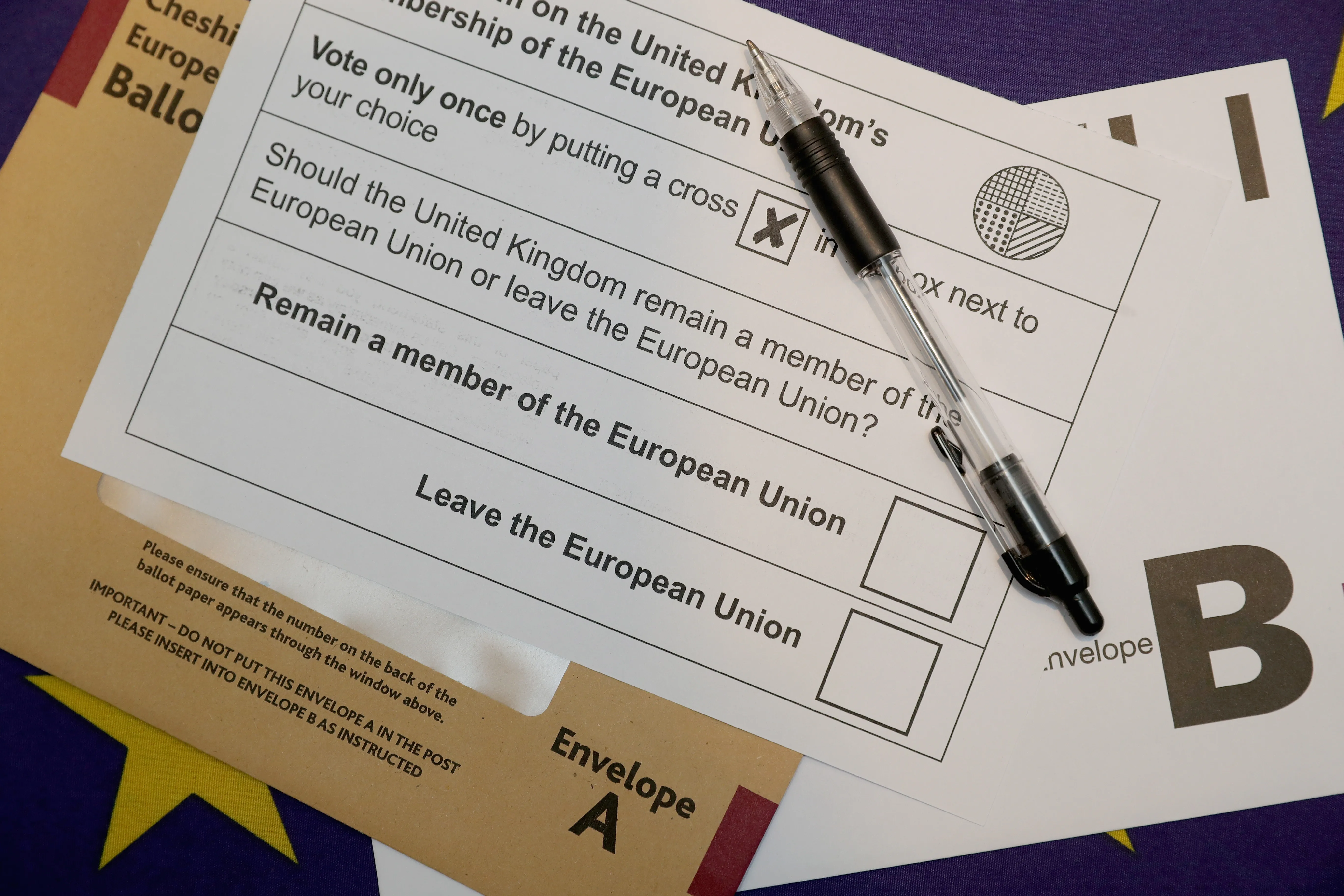
KNUTSFORD, UNITED KINGDOM - JUNE 01: In this photo illustration a European Union referendum postal voting form, waits to be signed on June 1, 2016 in Knutsford, United Kingdom. The United Kingdom will hold a referendum on June 23, 2016 to decide whether or not to remain a member of the European Union (EU), an economic and political partnership involving 28 European countries which allows members to trade together in a single market and free movement across it's borders for cirtizens. (Photo by illustration by Christopher Furlong/Getty Images)
The Brexit referendum was 10 years ago today. A decade on, very little has been resolved, says Eliot WilsonThere have only ever been three UK-wide referendums. Appealing directly to the electorate on a single issue through a plebiscite fits awkwardly with parliamentary government, as Enoch Powell told the House of Commons in 1972: “The essence of our own responsible parliamentary democracy is that the Government are held totally responsible to the House of Commons, and the House is held totally responsible to the electorate.”Referendums pass the buck. When Labour returned to power in 1974, it was split on the issue of the Common Market, and Harold Wilson had promised a referendum on the future of Britain’s membership to paper over his party’s cracks. In June 1975, the electorate voted 67-33 to stay in; there would not be another national referendum for more than 30 years.The 2011 referendum on the Alternative Vote system was a concession by David Cameron to his Liberal Democrat coalition colleagues, but it was an unloved child. Turnout was only 42 per cent and two-thirds of those opted against the new voting system.Ten years ago today, however, on Thursday 23 April 2016, came a simple Yes/No vote on whether the UK should remain in the European Union. David Cameron had seen, first as a special adviser to Chancellor Norman Lamont in 1992-93, how the Conservative Party had spent nearly 20 years in internecine warfare over Europe and wanted to end it.In 2012, with his Chief of Staff, Ed Llewellyn, and Foreign Secretary William Hague, Cameron raised the possibility of a referendum on EU membership as a concession to his party’s Eurosceptic wing, and to spike the guns of Nigel Farage’s increasingly successful UK Independence Party. In 2013, he announced that a referendum on renegotiated terms of membership would be in the Conservative manifesto at the next general election.Exceeding expectations, the Conservatives gained 24 seats and won the election outright. In February 2016 Cameron declared that the referendum would be held on 23 June: Her Majesty’s Government would formally advise the electorate to vote to remain in the EU, but, as in 1975, collective responsibility on the issue would be waived and ministers could campaign to remain or leave.For some Remainers, the very fact of the Brexit referendum is the original sin, the moment when the troubling of their lives began. But that view is formed in the light of the result; most would have been relaxed if Britain had voted to stay in the EU and the Eurosceptic fox had been shot.InevitableI take the view that, whatever the outcome, a crisis, a definitive judgement on EU membership was inevitable. It was more than 40 years since the confirmatory referendum of 1975, and the nine-member Common Market was a pale shadow of the 28-strong, highly bureaucratic and centripetal European Union of 2016.In the 2014 elections, UKIP had won 24 of the UK’s 87 seats in the European Parliament. This reflected a growing disenchantment with the EU, but also a rising tide of frustration that the organisation had transformed itself, yet for the opinion of the UK electorate had never been directly and specifically tested in 40 years. It added to an already-noxious sense of exclusion from public discourse, of voices ignored for saying the unfashionable thing. To assume that situation was sustainable was to ignore a fizzing fuse.The result was narrow but seismic: 51.9 per cent voted to leave the EU and 48.1 per cent to remain. It seemed shocking then: the government and all the mainland British political parties supported Remain, except UKIP and the neutral Conservatives; so did the majority of big business, The Guardian, The Financial Times and The Daily Mirror, most trades unions, NATO and the World Bank.Many saw what they wanted to see. But the opinion polls had pointed to a close and volatile contest. Although Remain had dominated 2015, by the following year the two sides were trading places regularly, Remain’s lead fluctuating between one and 19 per cent. Leave lagged slightly, but more than once outscored its opponents by 10 per cent. Matthew Elliott of Vote Leave was a formidable organiser and strategist, and Boris Johnson and Nigel Farage were the most eye-catching campaigners in politics. This energy contrasted with a fatal and seemingly presumptuous calm among some Remainers who took victory for granted.What can we say about the Brexit vote ten years on? There are two separate elements. On Britain’s relationship with the EU, it is simply too early to tell: the UK did not formally leave until 31 January 2020. The losing side will point to estimates of economic loss attributable to Brexit – the only hypothetical question some politicians will ever address – but the situation is dynamic, not fixed. Too little coordinated effort has been made systematically to reimagine the UK outside the EU, but even the real 10-year mark in 2030 will only provide initial indications on such a profound change.