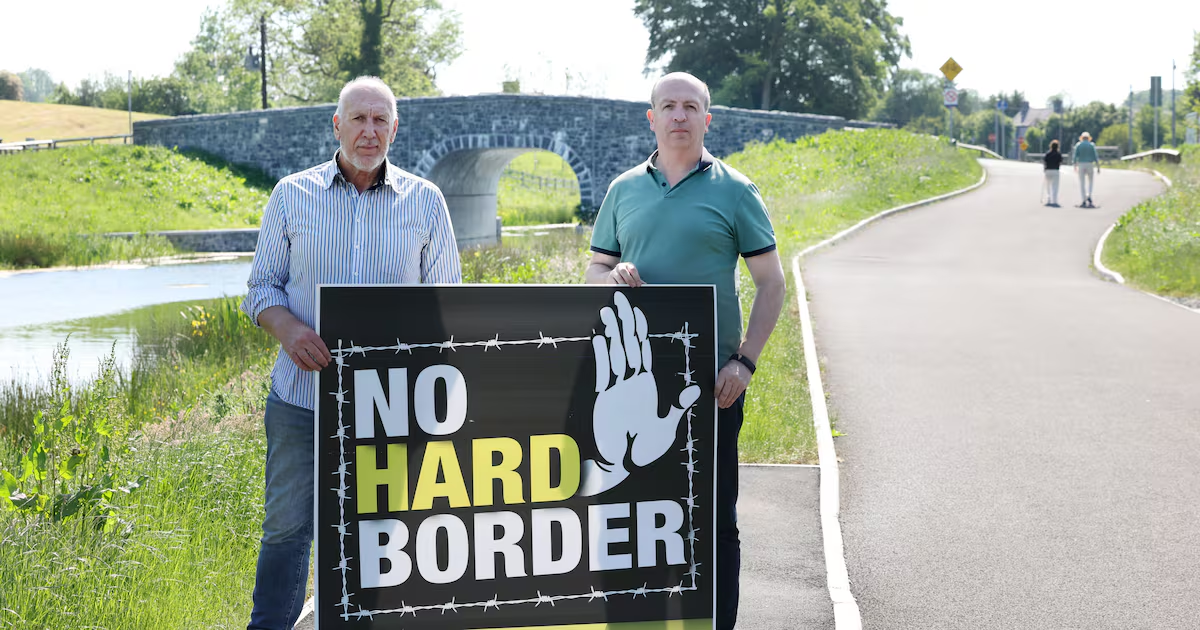
The Saturday night karaoke crowd arrive in the Rose and Crown in Holyhead, dapper older men with braces, young men in leather jackets, women in appliquéd frocks, cowboy boots and hats. Everyone we meet is a disillusioned Brexit voter who thinks things have got worse. A man called Alex sings Somebody to Love for an elderly Queen fan who clutches my shoulder with emotion then introduces me to the man next to him. It’s Jeff Evans, three-time mayor of Holyhead and, also, the town crier. He once glued himself to the Houses of Parliament to protest against drug-dealing in Wales but has lost interest in national politics since Brexit. Now he focuses entirely on community and family. He has a sick daughter and a tattoo with her name on it. He thinks things are worse than ever. “I wanted us to take back control,” he says, of Brexit. “But the world got so crazy.”Patrick Freyne travels across the UK talking to people about their reflections on the Brexit vote ten years later. Video: Enda O'Dowd Jeff sings The Fields of Athenry. Two girls in cowboy hats sing Shania Twain. Suzy, who works for a haulage company, explains that the cowboy contingent were planning to go to a country music event and when that was cancelled came here instead. “Everyone says we’re like a hen,” says Suzy. She voted for Brexit because she worried about migration. “Just the illegal migrants,” she stresses. Ultimately, she thinks Brexit did little for the town and was based on “propaganda”.An older man sings Dirty Old Town. The Irish Times photographer sings Outside by George Michael. I sing Kris Kristofferson. Aimee, a childcare worker, says Holyhead “is the best place in the world if you can find a job. It doesn’t have the problems of the rest of the world”. She adds: “But they’re reaching us now.”She believes Britain’s cities are filling with “illegal migrants”. She voted for Brexit but thinks it’s been “a disaster”. Her partner Tom, a welder, agrees, but he’d still vote the same “to get my country back”.[ The Brexit diaries: Patrick Freyne’s travels in 2016 BritainOpens in new window ]Since the EU referendum, I’ve travelled around the UK several times reporting. Ten years after the vote I’m revisiting three Brexit-voting locations – Holyhead, Boston and Dover – as well as Stoke-on-Trent, part of the former industrial heartland. A number of people we meet cite “illegal migration” as their key issue. There is a particular focus on those who come by boat. Net migration to the UK was 171,000 at the end of 2025, the lowest figure since 2012. In 2025, 813,000 people entered the UK and 642,000 left. The majority of those are on work, student or family visas. Some 41,500 came across the channel by boat. Holyhead is in Anglesey, one of the poorest regions in Britain. In the 2021 census the non-UK born population of Anglesey was just 3.3 per cent (this includes Irish people). In Holyhead, there are some vacant shopfronts, though a recent painting project has made things a little brighter. The Roadking Truckstop, where we stayed in 2018, is closed, replaced by a border force facility. People in Holyhead currently put hope in Anglesey’s new freeport status, a planned tidal power scheme and a long-heralded nuclear power plant.Alun Roberts in Holyhead. Photograph: Enda O'Dowd Alun Roberts, a Remain voter we met in 2018, recently left the community development group Môn Communities Forward (MonCF). After Brexit, he says, trade “dwindled significantly … That’s taken a number of years to recover. EU funds stopped coming to the UK ... the government stepped in to provide funding for areas that used to get EU funding.” Brexit is “the B-word now … Looking at the local economy, we have suffered ... Why would you break ties with your biggest customer?”Above the mirror in Danny Jones’s barber shop are the words “Iawn boy”. “It’s like the Welsh ‘Aloha’,” he says. He says it to everyone who enters. He has been running his shop for three years. His partner, Tasha Harper, a teacher, calls it “a safe haven for young men and old men”.Danny Jones in his barber shop in Holyhead. Photograph: Enda O'Dowd The country has, Jones believes, gone “a bit mental”. “Sometimes I feel like everyone just needs a joint and to chill a bit … The Green Party’s so far left and Reform is so far right. I just want someone that’s in the middle.”They both believe Brexit was “a scam”. “[Reform leader Nigel] Farage is a bit of a snake-oil salesman, really,” says Jones.“Us two travel a lot,” says Harper. “It’s so much harder now to get visas and all the correct paperwork.”“I was looking to work in a barbershop in Marbella and he was only taking Irish [workers] because they had a EU partnership,” says Jones.Former teacher and newly elected Reform party assembly member Helen Jenner (43 Plaid Cymru members and 34 Reform members were elected in the recent Senedd Cymru/ Welsh parliament election) feels people need to “move on” from Brexit. On the doorsteps people focus on cost-of-living issues and NHS waiting lists and, yes, migration. She thinks any disillusionment is because of politicians like Boris Johnson putting “£350 million on the big red bus … Some people perhaps felt shortchanged”. She believes the transition would have worked under Farage. She fondly recalls the day after the vote. Her Remain-voting colleagues were depressed but “I skipped into school ... It was quite funny”. Later she says: “It was about taking back control, and it was up to us to mess it up or not afterwards, wasn’t it? I rarely met anyone who says they regret it.”Neil Brownsword, artist and academic at Staffordshire University, beside a bronze recreation of a classic ceramic by Josiah Wedgwood, in Stoke-on-Trent. Photograph: Enda O'Dowd Neil Brownsword, potter, artist and academic at Staffordshire University, meets us at a statue of pottery pioneer Josiah Wedgwood in Stoke-on-Trent. “I started off employed at Wedgewood when I was 16 … I was surrounded by a group of guys with incredible embodied knowledge … It was in the early 90s things started to shift. Factories couldn’t compete with east Asia and most companies decided to outsource production. That was pretty much the death knell.”There is a lot of dereliction and vacancy in Stoke; empty shops and derelict old factories. Brownsword shows us part of a heritage trail he helped devise, with bronze recreations of classic ceramics and a downloadable audio-guide. At its peak, in 1948, the pottery industry hired 79,000 people. The biggest employer in Stoke now is gambling company Bet365. Labour held Reform at bay recently, but the area voted for Brexit in 2016.We stop to look at Charles Vyse’s frieze, Mining, Pottery and the Sciences, over the doorway of Staffordshire University’s Cadman building. Brownsword is appalled by the tattered St George’s flags flying around the city. He has visited Jingdezhen, the porcelain capital of China with a 1,000-year history of production. “Without cultural migration or exchange none of this history would have existed. The archetypal British cup of tea wouldn’t exist without China.” He says: “‘Bone China’ – ‘China’ kind of gives it away.”The Hanley car boot and market on Hinde Street is filled with people from all over the world selling second-hand shoes, clothes and wheelchairs. Phil Ridgway and his son Andrew rent tables to stallholders, with the money going to charity. Their retired friend Keith Jones starts recounting his employment history. “Tell him you did two days in the coal pit,” jokes Phil, who spent 22 years there.Stoke-On-Trent has a high level of dereliction after the collapse of local industries. Photograph: Enda O'Dowd They believe “illegal migration” is a big issue for Stoke. They don’t mean their immigrant friends who come to the market or who work in the NHS. “We’d be nothing without them,” agrees Jones. “We wouldn’t have an NHS without them.”“It’s the idle ones we don’t want,” says Phil.Boarded houses in Stoke-On-Trent. Photograph: Enda O'Dowd “Poverty” is the big issue for Stoke, says Jones. He has Welsh dragons tattooed on his arms as well as his own name (“In case he forgets,” says Phil). He came from Wales in the back of a lorry in 1971. “We said to the driver give a bang on the back of the lorry when we’re coming into Stoke ... Our David, my brother and I, stuck our heads out and you couldn’t see Stoke for smoke. The pits were going, the steel was going, the pottery was going. You could tell the boss on a Friday afternoon ‘stick your job up your arse’ and you could get a new job on Monday. And I did that.”“Every week,” says Phil.“You need A-levels now to clean the s**thouse,” says Jones.Their great hope for Brexit was that these industries would return, but “it’s worse since Brexit,” says Andrew. “We’re still governed by Europe,” says Jones.“I’d vote same way again,” says Phil.Etruria Canals Festival in Stoke-On-Trent. Photograph: Enda O'Dowd Barges arrive for the Etruria Canals Festival in Stoke-On-Trent. Photograph: Enda O'Dowd A number of barge owners have gathered around the canal for the Etruria Canals Festival. “James Brinley in the industrial revolution built the canals for the pottery industry,” explains Craig, who is sitting listening to dance music next to his barge with his dog, Koda. He is a single man with health issues. He can’t get a council house. “The winter months are hard,” he says. He voted for Brexit but things just “got worse”. He still trusts Farage. He would vote for Brexit again.At the stall for the armed forces charity SSAFA, retired soldier Geoffrey Arthur shows us a 19th-century Maxim machine gun used both in the Boer war and still, to this day, in Ukraine. He says he has an internationalist mindset so voted Remain. He was, he says, in Northern Ireland in the 1970s. “I didn’t fire a weapon when I was there,” he says quickly. He did a year in the coal mines, because his father worked there. “Labour was how I was brought up … Not any more. They didn’t think of the working man. They were more interested in London and fighting among themselves.” He is sad for young people because the youth unemployment rate is 14.7 per cent. “When I was growing up here we had everything. It was never hard to get a job.”Raj, a young Sikh man who works in arts marketing and facilitation, says that between Brexit and Covid it’s been a terrible decade for young British people. “Employment is the big thing. In Stoke-on-Trent now, small businesses struggle. Businesses are closing down ... The money goes to the biggest cities.”Abandoned phone boxes on the main square in Boston, Lincolnshire. Photograph: Enda O'Dowd He says he has experienced more racism in recent years. He volunteered helping refugees recently and all of them would go home if they could, he says. And most of them are here because of the actions of the West. He is there himself as a consequence of empire, he says. His parents are from India. “The first Sikh migrant in the UK was forced to come here, Maharaja Duleep Singh [the last Sikh emperor]. Britain would never work without migration. Look at the NHS.” A&A Help Services Limited in Boston, Lincolnshire, is owned by a Bulgarian man named Anastas Pachev. He helps Bulgarians with little English grapple with bureaucracy. Nearby there are similar operations for the Polish and Romanian people. There are lots of immigrants in Boston, mainly working in the fruit and vegetable picking and packing industries (in the 2021 census 23.6 per cent of Boston residents were born outside the UK). The seasonal work has dried up due to Brexit, says Pachev, though people still come. “I don’t think they fully understand Brexit yet.”Anastas Pachev runs A&A Help Services Limited in Boston and helps emigrants with little English grapple with bureaucracy. Photograph: Enda O'Dowd So what are the farmers doing for workers? There’s still a large Bulgarian population, he says. “I have a lot of friends who do six days a week, 12-hour-shifts.” “There are special visas for temporary work from Uzbekistan,” says his cousin who co-runs the business (a seasonal agricultural worker scheme was introduced in 2019). “They come for two or three months. I see them a lot here. It’s very cheap for the owners.”Pachev first came to Britain in 2014 to work on the farms. “I did it in one of the better farms where you don’t need to squat all day to pick strawberries. I did raspberries. Tight spaces ... They expect a lot of speed. You have to constantly meet the norms and, woah, I did not meet the norms.” He laughs. “In the fields it’s raining. Six people sleeping in a three-man caravan. It’s not pleasant at all. I remember one morning the whole greenhouse was frozen in ice. Your fingers just freeze up and you cannot move them … Our best picker could barely work.”Could English people do farm work? He laughs. “I doubt anyone who has better prospects will go there.”Jonathan Drummond is painting the woodwork of Shodfriar’s Hall, a beautiful Tudor priory now housing Eva’s hair salon and a nightclub. He voted Brexit “to get back to manufacturing,” he says. “To stop just being a service economy to Europe.”Jonathan Drummond believes the benefits of Brexit may be felt in 60 years. Photograph: Enda O'Dowd That didn’t happen, he says. “Most people thought it would be quick, all singing, all dancing … I knew Europe were going to punish us.”Why did people think it would be easy? “The £350 [million] on the side of the bus. People were misled.”He dislikes Keir Starmer but also dislikes Reform: “Farage makes it up as he goes along.”He would still vote for Brexit because he thinks it will work eventually: “I was thinking probably my kid’s kids. Sixty years.”Vanessa Losty in Shodfriars Hall. Photograph: Enda O'Dowd Vanessa Losty, the building manager, gives us a tour. “Eva is Latvian or Lithuanian. The [nightclub] owner is Bulgarian. Boston has one of the largest migrant communities. There’ll always be work for migrants here because land is more valuable here with potatoes than with buildings. I don’t think enough people here were educated on what [Brexit] meant. It was all on social media, ‘migrants are taking your jobs’. But they weren’t taking your jobs because you weren’t doing those jobs … I live in the middle of farmland and I see them, back-breaking, picking the cabbages.”She points at a well-dressed young person there on a work-experience placement, Tom. “Years ago, Tom at 17 wouldn’t be suited and booted, he’d be sat on the tractor from the age of five.” Losty voted for Brexit, because of “illegal migration”, she says, but regrets it. “I was lied to,” she says. She’s now likely vote for Rupert Lowe’s Restore party. “It’s troubling times we’ve got at the minute.”Rachel Carter in Shodfriars Hall hanging 3D-printed models as part of an artwork about the establishment of Boston, Massachusetts. Photograph: Enda O'Dowd The hall has been taken on by a community arts organisation called Transported. Remain-voting artist Rachel Carter is on a scaffold hanging 400 3D printed models of a pilgrim woman. It’s an ongoing artwork about the establishment of Boston, Massachusetts by Bostonians seeking religious freedom.Transported fosters art in the community and works with both migrant and indigenous groups. “We’re call Transported because this area is massively determined by the transport infrastructure,” says director Nick Jones, “initially rivers and canals and the railways and now the road systems because of the food haulage.”He puts Boston’s problems in the context of globalisation. “Thirty years ago, the supermarkets in this country wanted to find a way of competing, specifically with the German supermarkets … and asked the farmers here to reinvent the fresh food offer [and] to build all those packing and processing factories … There weren’t enough people here to do it so they brought all these people from eastern and central Europe … They were absolutely necessary for the local economy, but nobody was honest about that meaning there was going to be a big influx of people … That led to a backlash where people began thinking [it] was connected to immigrants on boats but of course it’s not. So there’s this constant challenge for us to get people to be positive about the future rather than wrongfully coming to a negative judgment.”Nick Jones, director of Transported, an artist-led initiative in Boston, Lincolnshire. Photograph: Enda O'Dowd Upstairs in the 7th Heaven Café on Market Square, a beautiful market area refurbished with EU funding, we meet retired teachers Ronnie Robinson and Judith Warnes and retired radiographer Mary Trafford. They say the town has declined in their lifetimes. Warnes voted remain – “People shouldn’t be creating barriers,” she says – but Robinson and Trafford voted for Brexit.“Nothing changed for the better,” says Robinson.“It stopped people coming to university in Boston college,” says Trafford.“A friend whose son and partner are Dutch can’t come back here to live,” says Warnes. Judith Warnes and Ronnie Robinson in the 7th Heaven Café on Market Square in Boston, Lincolnshire. Photograph: Enda O'Dowd “I went to a talk given to Nigel Farage, just to listen,” says Trafford. “One of his main points was that he was going to improve the situation for fishermen ... But nothing has been done.”Trafford returned to Boston in the noughties after years abroad and was thrown by the demographic change. “I used to say to my friend, ‘we’re going to sink under the number of people’,” says Trafford.“I thought the town was overwhelmed with immigrants,” says Robinson.Their views have softened. They do a lot of volunteering and praise a local Methodist minister who has brought the different communities together. They’re still concerned with the level of migration but speak fondly of migrants they know. Trafford says she’s ashamed of her Brexit vote now. “I think with America being what it is, our allies lie in Europe … Unfortunately, Great Britain can only be referred to as Britain now, sadly … We relied on commerce and banking for so long we have no industry, nothing to hold the country up. When AI comes, I think we’re in even more trouble.” When the eastern European waitress comes to clear the table, Robinson says: “Martina works very hard and looks after us very well. After we said all that to you.”The Dover Foodbank provides three-day emergency supplies for people “in absolute crisis”. It has seen increasing numbers in need since it opened in 2012 but things have improved in the past six months because of its new financial advice service. “We’re a very high deprivation area,” says project manager Laura Ashman.Dover, whose docks are overlooked by the famous white cliffs. Photograph: Enda O'Dowd Noel Beamish, chief executive of the Dover Outreach Centre. and project manager Laura Ashman. Photograph: Enda O'Dowd There’s a big focus on Dover because of the “boats”, says Noel Beamish, chief executive of the Dover Outreach Centre.“They don’t wash up on the shores like people make out,” says Ashman. “They’re picked up when they’re far out. And they’re not ‘illegal’, they’re asylum seekers.”In reality, the issue of people coming by boat is “minuscule,” says Beamish. “The half million coming on work visas, family visas, they’re not even mentioned … We do need immigration.” In the food bank, “we haven’t noticed any meaningful benefit of Brexit at all”.The RAF Manston History Museum is across the road from a refugee processing centre. Volunteer Andrew Leigh spent years abroad with the British army. When he returned in the 1990s, he says, “I was getting undercut and slammed by workers that would do it for half the amount [because] their living standards in their country were far less than mine”.A horse is tied up on the main street in Dover. Picture: Enda O'Dowd He voted for Brexit to return high-quality jobs to British citizens. A 28-year-old colleague, Joshua Simpson, says there was never any hope that mass manufacturing would return. “We’ve been a service-based economy since Thatcher … They killed off any proper manufacturing base.”Leigh admits that things haven’t worked out the way he hoped. He recently bought a house in France which he can now only visit for short periods of time. He stresses that he doesn’t dislike migrants personally. “If you can’t find work, what are you supposed to do? You’re on the brink of civil war at the minute … Colleagues that I used to work with in the military, they’re on their ass in the street, and the people they used to go to war against are stepping over them ... That hurts.”[ Brexit - A Very British Civil War review: Ghastly portrait of ruling classes having a larkOpens in new window ]His colleagues, Remain voters, push back. They talk about hardworking, kind immigrants they know and how the loss of EU subsidies affected farmers. Leigh tells a story about an ex-girlfriend from Poland who overstayed a visa. He was appalled, he says. But he still stayed with her?“She was fit!” he says and laughs. He would, for the record, still vote “leave”.On the London Road in Dover there are lots of charity shops and bric-a-brac operators. Lisa Britnell, proprietor of B&H Fireplaces and Stoves, explains that Dover folk are called “sharks” because “when they had shipwrecks, people were known to bite rings off fingers, to get the gold.”The town today is slightly worse than it was before Brexit, she says. “I was hoping for a bit more control but that’s not happened.” She would change her vote. “There wasn’t enough information for people.”Lisa Britnell, proprietor of B&H Fireplaces and Stoves in Dover. Photograph: Enda O'Dowd Thomas Wiggins, a Canadian based in Dover who advocates for the Gurkhas. Photograph: Enda O'Dowd White-haired Thomas Wiggins is listening to Delta blues while manning a stand advocating for the Gurkhas. He’s from Canada originally and supported Brexit. “They were telling Britain what to sell and how to sell it and they were able to say, ‘this is our product, we’ll sell it the way we choose’.”As a migrant himself, he has no issues with immigrants. He became a supporter of the Gurkha cause because he worked as a cleaner alongside many Nepalese women. “They called me ‘buba’, which means grandfather, and I called them ‘natani’, which is granddaughter.”Nobody we meet under the age of 30 supports Brexit. We ask 20-year-old coffee-shop worker James Proctor what young people do for fun in Dover. “Leave,” he says, and laughs. “If you go down the high street you’ve got kebab shops, barbers, cafes. That’s about it ... There’s not much going on here.”James Proctor (20) in Dover. Photograph: Enda O'Dowd A tentative Green Party supporter, he’s sceptical about people citing immigration as a concern. “If people are coming over illegally on boats, why would making tighter borders for legal immigrants change that fact? ... I can’t personally say that I’ve met any illegals … My boss is from Morocco and I think he’s doing all right for the Dover community.”Down by the port, beneath the white cliffs of Dover, I meet Si, a retired soldier walking his dog. He believed Brexit would mean more autonomy for Britain but concludes that, financially, “it would have been better if we’d voted Remain”. It would, specifically, have been better for him because he owns a house in France and now every time he travels he must register his dog as an “import”, he says. He still thinks it will work out in the long run. He would still vote to leave.Additional reporting by Enda O’Dowd
Brexit Britain now: Patrick Freyne revisits Leave voter heartlands 10 years on
A decade after the UK decided to leave the EU, many in Britain regret the outcome – but not the vote
3,950 words~18 min read