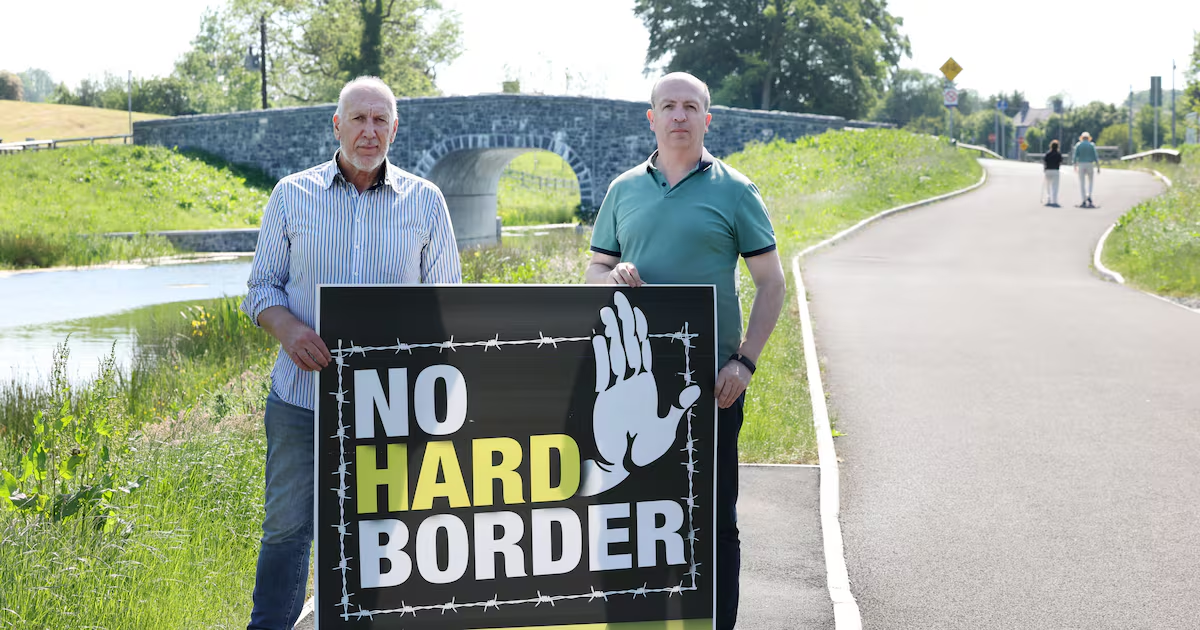
Damian McGenity returned home after midnight from working on his Co Louth farm as counting began in the United Kingdom’s Brexit referendum. Up to then, he remembers a decade on, he had paid little attention to the referendum, believing the campaign to stay in the European Union would win.Exhausted, he made a cup of tea and switched on the television for early results: “Then, the first result came in, Sunderland. I’ll never forget it. I went to bed in disgust.”For McGenity and a man soon to become a colleague, Fermanagh farmer John Sheridan, the hours that followed would shape much of the decade ahead.Both became leading figures in the highly successful Border Communities Against Brexit, which campaigned against the creation of a hard Border on the island of Ireland once the UK left the EU.In the years that followed, the issue consumed them, with McGenity telling tales of the relationships built with politicians such as Nancy Pelosi and Richard Neil in the US, or Guy Verhofstadt in Brussels.Retired diplomat Dan Mulhall was Ireland’s ambassador to London in the years before and after Brexit, giving him a ringside seat into the attitudes that drove it and the post-referendum negotiations.Border Communities Against Brexit members John Sheridan and Damian McGenity. Photograph: Alan Betson/The Irish Times Despite no shortage of warnings, nobody paid attention to the complications Northern Ireland would cause for a clean break with Brussels: “There was just a complete unwillingness to believe that there was any issue,” he remembers.Every prediction that Brexiteers made was quickly proven wrong, especially the belief that Ireland “would be abandoned by the others, once the negotiations got down to the end game”.Following the vote, senior British officials went to every EU capital in search of one-to-one talks, but they were rebuffed as European leaders insisted that London had to negotiate with the EU as a whole.European solidarity was deemed “more important” than securing an advantage “for German cars, or French wine, or Italian cheese”, says Mulhall, who served in London for more than a year after the referendum.Michel Barnier was the EU's chief Brexit negotiator. Photograph: Alain Jocard/AFP via Getty Images Despite the reluctance of many to credit the political system, the roles played by Irish politicians and diplomats of the time is regarded elsewhere, if not always at home, as a masterclass in negotiations.From the off, the Irish side had clear targets – above all, avoiding a trade border on the island that would inevitably require infrastructure, and even more inevitably, protection.Though less often said, such a border was also anathema to Dublin as it would have led to Ireland falling into a second-class category of EU membership, with trade complications forcing opt-outs or exclusion.Dublin strove to ensure there was “not a cigarette paper” between Ireland and EU negotiators led by Michel Barnier, and the Irish government was briefed “moment by moment” on the talks with often poorly-prepared British counterparts.[ Brexit – A Very British Civil War: Ghastly portrait of ruling classes having a larkOpens in new window ]Years on, those closely involved – often people used to dealing with a polished Whitehall machine – still remain puzzled by London’s performance: “There was a lot of surprise at just how lackadaisical the British seemed to be.“The EU is a legal construct. It is a paper-driven organisation. You have to have a clear chain of causality between the treaties, regulations and directives to support what you’re doing,” says one former Irish diplomat.For many, the image that defines London’s handling is one involving Brexit secretary David Davis and officials, minus a document or a file, sitting across from Barnier and his team with bundles of files.Former minister for foreign affairs Simon Coveney was one of those centrally involved in the negotiations – becoming a bete noire, alongside Leo Varadkar, for some unionists unhappy that Dublin was, as they saw it, “thwarting Brexit”.Michel Barnier and his EU delegation with their briefing papers sit across from the UK’s Brexit secretary David Davis and his team. Photograph: Reuters Nearly 10 years on, Coveney retains a respect for David Cameron’s replacement as British prime minister, Theresa May, even if she made a series of errors when she took over in Downing Street.However, she triggered the two-year clock on the UK’s withdrawal, which put London on the back foot in the negotiations, while also insisting on the hardest form of Brexit – outside the single market and the customs union.Another former Irish diplomat says: “She was an honourable person, but not the most adept politician. Maybe a bit like Keir Starmer, in a different way. She couldn’t communicate politically. Not just publicly, but in her private communications, too.”May ended her premiership “on keeping her word to Ireland and to the EU,” Coveney says, “unlike others who followed her who wanted a Brexit outcome linked more to trying to maintain a majority in the Conservative Party”. For which one can read Boris Johnson, if Coveney does not. If there is one constant in scores of Brexit interviews, it is the loathing that exists for the tousled-haired politician – “a man without honour,” says one who dealt closely with him.The departure of the UK has not brought about the chaos feared in the early hours of June 24th, 2016, but there are concerns that seismic change in Westminster’s politics could bring new challenges.John Sheridan lost friends among Protestant neighbours over his stand, but a decade on he is confident that he has been proven right and that those same people know they were not.Nevertheless, a majority of unionists have not realised “that they were lied to, because that would first of all accept that they were conned” by the false promises of Johnson, Sheridan says.[ UK government is still paying the cost of BrexitOpens in new window ]McGenity has no desire to return to campaigning: “I don’t ever want to do that again. I don’t know where I got the time, but I certainly wouldn’t have the time now,” he says.However, if Reform wins the next Westminster election and seeks to deliver a “proper” Brexit, McGenity will campaign again – but not to block or ameliorate the actions of Brexiteers.“There will only be one campaign, and that will be for the united Ireland. We’re not going to go back over this shit again, excuse my language, looking for protocols, or special exemptions,” he says.
Brexit, 10 years on: ‘There was surprise at just how lackadaisical the British seemed’
The UK’s departure from the EU has not caused the chaos once feared, but changes in British politics could bring fresh challenges for Ireland
1,060 words~5 min read